

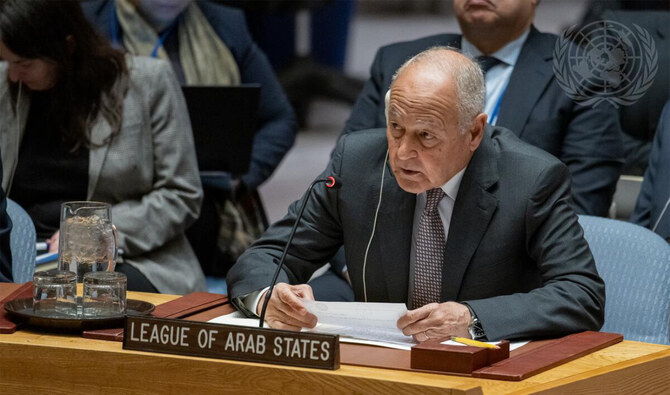

NEW YORK CITY: The secretary-general of the Arab League on Thursday warned that the Arab region is in a critical phase that is underscored by a growing global power rivalry that has complicated the ability of the UN Security Council to effectively address Arab concerns.
Ahmed Aboul Gheit was speaking during a meeting of the council in New York chaired by the Algerian foreign minister, Ahmed Attaf, whose country holds the rotating presidency of the council this month. Algeria convened the meeting to underscore what it described as the urgent need to strengthen the mechanisms for conflict resolution, peace-building and humanitarian assistance in the Arab world.
Several major Arab crises are at the forefront of international diplomacy concerns presently, with particular emphasis on the war between Israel and Hamas, and ongoing instability in Syria, Libya, Sudan, Somalia and Yemen. Some of the crises have been on the Security Council agenda for years.
“Our concerns are one and the same,” said Aboul Gheit as he underscored the importance of building on the historical cooperation between the UN and the Arab League, particularly in light of the “strategic global competition” he said was shaping the current geopolitical landscape.
He expressed concern that these global tensions have had a negative effect on the Security Council’s engagement on Arab issues, most notably the decades-long Israeli-Palestinian conflict.
Aboul Gheit strongly reiterated the League’s position on Palestine, framing the struggle for an independent Palestinian state as not only a regional issue but one that poses a significant threat to international peace and security.
He welcomed recent efforts to establish a ceasefire between Israel and Hamas after more than a year of violence, which he called “genocide,” against the Gaza Strip. However, he stressed that a ceasefire agreement is merely a temporary measure, and a permanent resolution can only be achieved through the establishment of an independent Palestinian state based on pre-1967 borders, with East Jerusalem as its capital.
“The continued denial of Palestinian rights is a direct threat to the stability of the region and, by extension, the world,” Aboul Gheit told council members as he highlighted the urgent need for the international community to support a two-state solution, in line with several Security Council resolutions.
“We have witnessed during the recent months a war that did not stop at the borders of Gaza or Palestine but has spilled over, and its flames have reached the region,” he said.
He called for a greater role for the Security Council in the Global Alliance for the Implementation of the Two-State Solution, the founding of which was spearheaded by Saudi Arabia, the EU and Norway last September with the aim of expediting the establishment of a Palestinian state.
In Sudan, meanwhile, the brutal conflict between rival military factions, the Sudanese Armed Forces and the Rapid Support Forces, has claimed an estimated 150,000 lives and displaced millions since April 2023.
Aboul Gheit called for a return to peace talks there. He warned that the situation in the country has reached catastrophic levels, and urged the Security Council to take stronger action in support of Sudanese sovereignty and unity.
Turning to Syria, he expressed the Arab League’s support for the aspirations of the Syrian people to rebuild after more than a decade of devastating civil war. Acknowledging the complex political dynamics in the country, he called for a transition led by the Syrian people themselves, free from foreign intervention.
He also reiterated the opposition of the League to the continuing Israeli occupation of the Golan Heights, describing it as “illegal and unjustified.” He warned against “the Israeli expansionist greed” in Syria, and the exploitation of this delicate moment. He emphasized the need to remain committed to the 1974 Disengagement Agreement as the basis of the truce between Syria and Israel.
Aboul Gheit also touched on the situations in Lebanon, Libya and Somalia, each of which he said face distinct challenges and will require coordinated international support to achieve stability and progress.
He congratulated Lebanon on the recent election of President Joseph Aoun and praised the formation of a broad consensus government.
“We look forward to a new beginning in Lebanon, one of stability, reconstruction and revival of the economy,” he said.
Aboul Gheit reiterated the League’s support for a political process in Libya free from foreign interference, and acknowledged the continuing instability in Somalia, where he said the League was working to promote national unity.
A particularly pressing issue for the Arab League is the future of the UN Relief and Works Agency, which provides vital humanitarian assistance to Palestinian refugees. An Israeli ban on the organization is due to take effect next week.
Aboul Gheit expressed alarm at what he described as Israeli plans to undermine the agency, stressing that its work is crucial for stability in the region.
“The role of UNRWA is irreplaceable,” he said, warning that any attempt to dismantle it would have grave consequences for regional peace.
“UNRWA is not only carrying out a humanitarian role but it is a pillar of stability in the Arab region.
“Eliminating its role is a direct threat to this stability, and we look forward to a decisive role from the Security Council in defending this specialized agency, which is performing an irreplaceable and critical role.”


