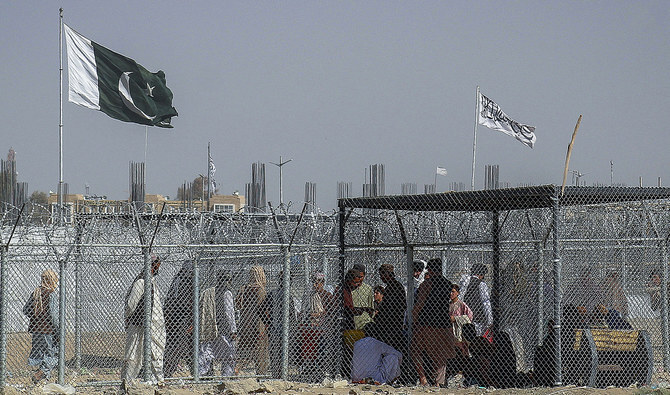
ISLAMABAD: Pakistani security forces have killed six militants attempting to enter the country through its border with Afghanistan in the southwestern Balochistan province, the Pakistan military said on Thursday.
Islamabad frequently accuses neighboring Afghanistan of sheltering and supporting militant groups that launch cross-border attacks. The Taliban government in Kabul says it does not allow Afghan soil to be used by militants, insisting that Pakistan’s security issues are an internal matter of Islamabad.
In the latest incident, the Pakistan army said security forces had picked up on the movement of a group of militants who were attempting to infiltrate the Pakistan-Afghanistan border on the night between Jan 22. and 23 in Balochistan’s Zhob District. Six militants were killed, it said, and a large quantity of weapons, ammunition and explosives was recovered.
“Pakistan has consistently been asking Interim Afghan Government to ensure effective border management on their side of the border,” the army said. “Interim Afghan Government is expected to fulfill its obligations and deny the use of Afghan soil by Khwarij for perpetuating acts of terrorism against Pakistan.”
The Pakistani Taliban, or the Tehreek-e-Taliban Pakistan (TTP), have frequently targeted Pakistani forces in the northwestern Khyber Pakhtunkhwa province. The group also has some presence in Balochistan, the site of a low-level insurgency for decades by separatists fighting for the province’s independence.
On Jan. 19, Pakistani security forces killed five militants as they tried to infiltrate Pakistan’s border in Zhob district.

Pakistan says three militants killed trying to infiltrating its border with Afghanistan
https://arab.news/gp7pr
Pakistan says three militants killed trying to infiltrating its border with Afghanistan
- Islamabad frequently accuses Afghanistan of sheltering, supporting militant groups that launch cross-border attacks
- Afghan officials deny state complicity, insisting Pakistan’s security issues are an internal matter of Islamabad
Pakistan deputy PM speaks with Iranian FM as Saudi Arabia intercepts missiles and drones
- Ishaq Dar expresses concern over evolving regional situation as both officials agree to remain in contact
- Pakistan earlier reminded Tehran of its mutual defense pact with Saudi Arabia during diplomatic outreach
ISLAMABAD: Pakistan’s Deputy Prime Minister and Foreign Minister Ishaq Dar spoke with Iranian Foreign Minister Seyyed Abbas Araghchi on Friday amid escalating tensions in the Gulf, including recent missile and drone attacks targeting Saudi Arabia that were intercepted by the Kingdom’s air defenses.
The call comes as Islamabad remains in contact with both Tehran and Gulf states to prevent the widening Iran conflict from spilling further across the region, particularly after attempted strikes on Saudi territory, a sensitive development for Pakistan, which signed a mutual defense pact with the Kingdom last year.
Pakistan’s foreign ministry said Dar raised concerns about the evolving regional situation during the conversation.
“Deputy Prime Minister/Foreign Minister Senator Mohammad Ishaq Dar spoke this evening with the Foreign Minister of Iran, Seyyed Abbas Araghchi,” the ministry said in a statement.
“The DPM/FM expressed concern over the evolving regional situation. The two agreed to remain in touch on the developments,” it added.
The ministry did not share details of the conversation, though it came amid fast-moving developments in the region, with Saudi Arabia saying its air defenses intercepted multiple missiles and drones early on Friday.
Earlier this week, Prime Minister Shehbaz Sharif’s adviser on political affairs Rana Sanaullah said Pakistan was in contact with Iran to discourage attacks on Gulf countries and prevent misunderstandings.
“Such attacks should not be carried out from Iran’s side,” he told Geo TV.
Prior to that, the deputy prime minister told Pakistan’s Senate that Islamabad had engaged both Iran and Saudi Arabia at the outset of Iran’s retaliation in the region, reminding Tehran of its defense agreement with Saudi Arabia and conveying assurances from Riyadh that Saudi territory would not be used against Iran.
Pakistan says its administration is striving to end the conflict, though the United States-Israeli strikes on Iran, which triggered the war and led to its spillover, have only intensified.
Iranian President Masoud Pezeshkian said on Friday some countries had begun mediation efforts but insisted Tehran would defend its sovereignty.
Meanwhile, US President Donald Trump has called for Iran’s “unconditional surrender” on his Truth Social platform as the confrontation shows little sign of easing.


