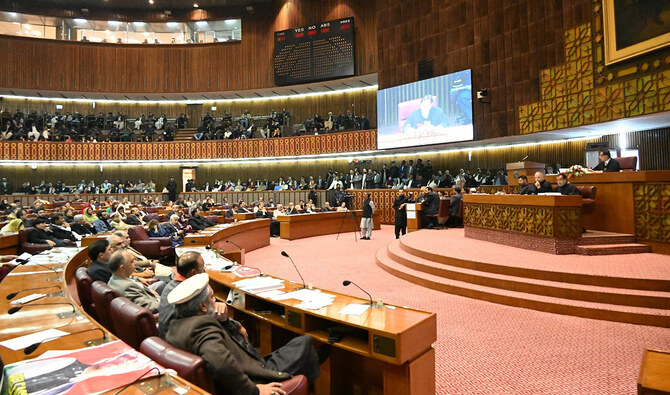
ISLAMABAD: Pakistan's National Assembly on Thursday passed a bill to amend the country’s cybercrime law amid a walkout by opposition parties and journalists who fear the new legislation will be used to censor social media platforms.
Pakistan adopted the much-criticized Pakistan Electronic Crimes Act (PECA) in 2016, granting sweeping powers to regulators to block private information they deemed illegal. The law provided for up to seven years in prison for “recruiting, funding and planning of terrorism” online. It also allowed “authorized officers” to require anyone to unlock any computer, mobile phone or other device during an investigation.
The government said at the time restrictions under the new law were needed to ensure security against growing threats, such as terrorism, and to crackdown on unauthorized access, electronic fraud and online harassment. However, journalists and rights activists complain that the law has been largely used to go after journalists, bloggers and other people critical of the government and state institutions like the military.
The new amendment bill now proposes the establishment of the Social Media Protection and Regulatory Authority to perform a range of functions related to social media, including awareness, training, regulation, enlistment and blocking. SMPRA would be able to order the immediate blocking of unlawful content targeting judges, the armed forces, parliament or provincial assemblies or material which promotes and encourages terrorism and other forms of violence against the state or its institutions. The law also makes spreading disinformation a criminal offense punishable by three years in prison and a fine of two million rupees ($7,150).
“Whoever intentionally disseminates, publicly exhibits, or transmits any information through any information system, that he knows or has reason to believe to be false or fake and likely to cause or create a sense of fear, panic or disorder or unrest in general public or society shall be punished with imprisonment which may extend up to three years or with fine which may extend to Rs2m or with both,” a copy of the bill says.
The bill was presented in the National Assembly on Thursday by Federal Minister Rana Tanveer Hussain from the ruling Pakistan Muslim League-Nawaz party of premier Shehbaz Sharif.
“The bill will not harm but protect working journalists,” Information Minister Ataullah Tarar told reporters after the passage of the bill. “This is the first time the government has defined what social media is. There is already a system in place for print and electronic media and complaints can be registered against them.”
He said “working journalists” should not feel threatened by the bill, which had to be passed because the Federal Investigation Agency, previously responsible for handling cybercrime, “does not have the capacity to handle child pornography or AI deep fake cases.”
Tarar said the government was also aiming to bring social media journalists, including those operating YouTube accounts, under the tax framework.
The operative part of the new bill outlines that the Social Media Protection and Regulatory Authority would have the power to issue directions to a social media platform for the removal or blocking of online content if it was against the ideology of Pakistan, incited the public to violate the law or take the law in own hands with a view to coerce, intimidate or terrorize the public, individuals, groups, communities, government officials and institutions, incited the public to cause damage to governmental or private property or coerced or intimidated the public and thereby prevented them from carrying on their lawful trade and disrupted civic life.
The authority will also crackdown on anyone inciting hatred and contempt on a religious, sectarian or ethnic basis as well as against obscene or pornographic content and deep fakes.
Rights activists say the new bill is part of a widespread digital crackdown that includes a ban on X since February last year, restrictions on VPN use and the implementation of a national firewall. The government says the measures are not aimed at censorship.


Pakistan parliament passes controversial bill to amend cybercrime law
https://arab.news/camrv
Pakistan parliament passes controversial bill to amend cybercrime law

- Bill proposes Social Media Protection and Regulatory Authority to block illegal online content
- Disinformation will be punishable by three years in prison and fine of $7,150 under new law

Pakistan PM condoles death of Saudi Prince Mishaal bin Badr’s mother
- Saudi prince’s mother passed away on Saturday, drawing condolences from Pakistan, Qatar, other states
- Pakistan, Saudi Arabia who enjoy close cooperation in defense, economic, trade, investment and other sectors
ISLAMABAD: Prime Minister Shehbaz Sharif on Monday expressed his condolences to the Saudi royal family over the recent passing of Prince Mishaal bin Badr bin Saud bin Abdulaziz Al Saud.
The Saudi Royal Court announced the death of Prince Mishaal bin Badr’s mother on Saturday. Her funeral prayers were held a day later, at the Imam Turki bin Abdullah Grand Mosque in Riyadh after Asr prayers.
“I extend my heartfelt condolences to the Royal Family on the passing of the mother of Prince Mishaal bin Badr bin Saud bin Abdulaziz Al Saud,” Sharif wrote on social media platform X.
He prayed for the highest rank in paradise for the departed and hoped the royal family would be able to bear the loss with fortitude.
“Our prayers are with the Custodian of the Two Holy Mosques, His Royal Highness the Crown Prince, and the entire Royal Family in this moment of profound grief,” Sharif added.
Pakistan and Saudi Arabia are close allies that cooperate in several sectors such as defense, trade, investment, tourism, agriculture, mines and minerals and others. The two countries signed a landmark defense pact in September, according to which both agreed to treat an attack on one country as an attack against both of them.
Apart from being a vital trade ally, Saudi Arabia also serves as the top source for foreign remittances for Pakistan, where over 2 million expatriates reside.


