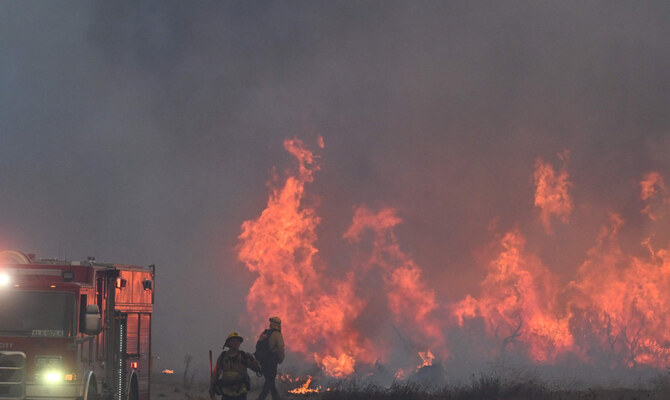
CASTAIC, United States: A new wildfire erupted north of Los Angeles on Wednesday, exploding in size and sparking orders for tens of thousands of people to evacuate in a region already staggering from the effects of huge blazes.
Ferocious flames were devouring hillsides near Castaic Lake, spreading rapidly to cover more than 5,000 acres (2,000 hectares) in just a few hours.
The fire was being fanned by strong, dry Santa Ana winds that were racing through the area, pushing a vast pall of smoke and dangerous embers ahead of the flames.
Evacuations were ordered for 31,000 people around the lake, which sits around 35 miles (56 kilometers) north of Los Angeles, and close to the city of Santa Clarita.
“I’m just praying that our house doesn’t burn down,” one man told broadcaster KTLA as he packed his car.
The fire came with the greater Los Angeles area still suffering after two enormous fires that killed more than two dozen people and destroyed thousands of structures.
Robert Jensen, of the Los Angeles County Sheriff’s Department, urged everyone in the impacted area of the new blaze — dubbed the Hughes Fire — to leave immediately.
“We’ve seen the devastation caused by people failing to follow those orders in the Palisades and Eaton fires,” he said.
“I don’t want to see that here in our community as well. If you’ve been issued an evacuation order, please get out.”
Television footage showed police driving around neighborhoods urging people to leave.
Los Angeles County Sheriff Robert Luna said the Pitchess Detention Center in Castaic was under an evacuation order, and around 500 inmates were being moved to a neighboring facility.
He told broadcaster KCAL9 that around 4,600 inmates being held at other jails in the area were sheltering in place, but buses were on hand in case conditions changed and they needed to be moved.
Melissa Camacho, an attorney with the American Civil Liberties Union, noted the rights group’s opposition to “the expansion of the jail system especially in dangerous fire zones,” adding that “we are gravely concerned for the safety of people incarcerated in those jails.”
California Highway Patrol said the fire was impacting traffic on the I5 freeway, with a section of the road — which runs the length of the US West Coast — shuttered.
Helicopters and planes were on the scene dropping water and retardant on the blaze.
That fleet included two Super Scoopers, enormous amphibious planes that can carry hundreds of gallons (liters) of water.
Crews from Los Angeles County Fire Department and Angeles National Forest were also attacking the blaze from the ground.
California Governor Gavin Newsom, who has been the target of criticism by President Donald Trump over his handling of the Los Angeles fires, said he had ordered officials into action.
“State resources have been deployed to the Hughes Fire in the Angeles National Forest to assist in the federal response,” he said.
“We will continue to monitor the situation closely and provide the federal government with whatever it needs to extinguish this fire.”
It was not immediately clear what sparked the fire, but it occurred during red flag fire conditions — when meteorologists say strong winds and low humidity create conditions ripe for rapid fire spread.
Human activity, including the unchecked burning of fossil fuels, is changing Earth’s climate, increasing average global temperatures and altering weather patterns.
Even though January is the middle of the region’s rainy season, Southern California has not seen any significant precipitation in around eight months, leaving the countryside tinder dry.


![]()

New explosive wildfire erupts near Los Angeles
Short Url
https://arab.news/pje2d
New explosive wildfire erupts near Los Angeles
- Meteorologists say strong winds and low humidity create conditions ripe for rapid fire spread


Latest updates


Recommended


© 2026 SAUDI RESEARCH & PUBLISHING COMPANY, All Rights Reserved And subject to Terms of Use Agreement.