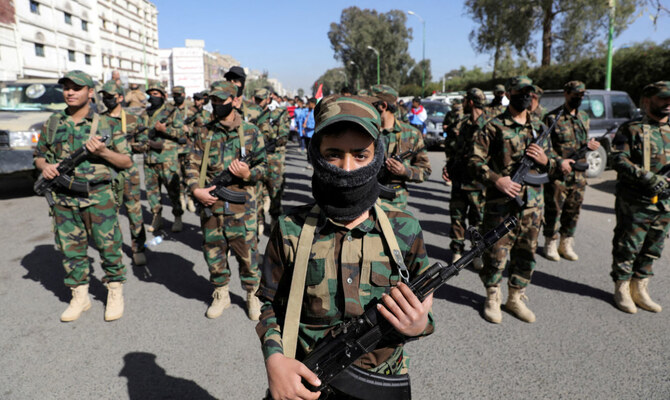
WASHINGTON: US President Donald Trump on Wednesday re-designated Yemen’s Houthi movement, known formally as Ansar Allah, as a “foreign terrorist organization,” the White House said.
The move will impose harsher economic penalties than the Biden administration had applied to the Iran-aligned group in response to its attacks on commercial shipping in the Red Sea and against US warships defending the critical maritime chokepoint.
Proponents of the move say it is overdue, though some experts say it could have implications for anyone seen as aiding the Houthis, including some aid organizations.
“The Houthis’ activities threaten the security of American civilians and personnel in the Middle East, the safety of our closest regional partners, and the stability of global maritime trade,” the White House said in a statement.
The Houthis, who control most of Yemen, have carried out more than 100 attacks on ships plying the Red Sea since November 2023, saying they were acting in solidarity with Palestinians over Israel’s war against Hamas in Gaza. They have sunk two vessels, seized another and killed at least four seafarers.
The attacks have disrupted global shipping, forcing firms to re-route to longer and more expensive journeys around southern Africa for more than a year.
The group has targeted the southern Red Sea and the Gulf of Aden, which are joined by the narrow Bab Al-Mandab strait, a chokepoint between the Horn of Africa and the Middle East.
Under the Biden administration, the US military sought to intercept Houthi attacks to safeguard commercial traffic and waged periodic strikes to degrade Houthi military capabilities. But it did not target the group’s leadership.
At the start of his presidential term in 2021, Joe Biden had dropped Trump’s terrorist designations to address humanitarian concerns inside Yemen. Confronted with the Red Sea attacks, Biden last year designated the group as a “Specially Designated Global Terrorist” organization. But his administration held off on applying the harsher FTO designation.
British charity Oxfam said the move would worsen the suffering of Yemeni civilians, disrupting vital imports of food, medicine, and fuel.
“The Trump administration is aware of these consequences but chose to move forward anyway, and will bear responsibility for the hunger and disease that will follow,” Oxfam America’s director of peace and security, Scott Paul, said in a statement.
David Schenker, who was assistant secretary of state for Near Eastern affairs in the first Trump administration, said Trump’s move on Wednesday was an obvious, early step to respond to what he described as one of Iran’s leading proxy forces in the Middle East.
“While the redesignation likely won’t have a positive impact on the group’s behavior, the measure suggests the new administration is not looking to induce (or cajole) the Iranians to negotiations through blandishment,” Schenker told Reuters.
The Trump administration said the US will work with regional partners to eliminate Houthi capabilities, deprive it of resources “and thereby end its attacks on US personnel and civilians, US partners, and maritime shipping in the Red Sea.”
The designation will also trigger a broad review of UN partners, non-governmental organizations and contractors operating in Yemen, the White House said.
“The President will direct USAID to end its relationship with entities that have made payments to the Houthis, or which have opposed international efforts to counter the Houthis while turning a blind eye toward the Houthis’ terrorism and abuses,” the White House said.
The Houthis in recent days have signaled they were scaling back attacks in the Red Sea following a multi-phase cease fire deal between Israel and Hamas. Earlier on Wednesday, the group released the crew of the Galaxy Leader commercial ship more than a year after they seized their Bahamas-flagged vessel off the Yemeni coast.


Trump designates Yemen’s Houthis as a ‘foreign terrorist organization’
https://arab.news/yrfva
Trump designates Yemen’s Houthis as a ‘foreign terrorist organization’

- The Houthis’ activities threaten the security of American civilians and personnel in the Middle East, the White House says


Military coalition in Yemen condemns attack on commander’s convoy
- Al-Maliki also said the coalition is committed to supporting Yemeni security efforts and pursuing those involved in the attack and bringing them to justice
RIYADH: The Coalition to Support Legitimacy in Yemen condemned on Wednesday an attack that targeted the convoy of a senior commander.
The attack in the Jaoula area of Lahj governorate targeted vehicles under the command of Brigadier General Hamdi Shukri, who heads the second division of the Giants Forces.
Coalition spokesman Major General Turki Al-Maliki said there were numerous deaths injuries and called the ambush “a criminal act that is contrary to all human and moral values.”
He said the coalition, which includes Saudi Arabia, will continue coordinating with the relevant authorities to ensure the security of citizens and maintain stability, Saudi Press Agency reported.
He called for people to work with the Yemeni government and military authorities to confront any sabotage attempts or terrorist operations targeting the security and stability of liberated governorates.
Al-Maliki also said the coalition is committed to supporting Yemeni security efforts and pursuing those involved in the attack and bringing them to justice.


