

Qatar’s duty to help Syria, global debt poses economic crisis: Finance minister

Qatari Finance Minister Ali Ahmed Al-Kuwari speaking at the World Economic Forum in Davos (Screengrab/Courtesy: WEF)
Short Url
Updated 23 January 2025
Follow

Qatar’s duty to help Syria, global debt poses economic crisis: Finance minister

  • Syrian leadership’s promises ‘very positive,’ Ali Ahmed Al-Kuwari tells World Economic Forum
  • Fiscal deficit, rising borrowing affecting many countries are ‘problems that few want to discuss’

DAVOS: Qatar considers it a duty to support Syria and its new administration after 14 years of devastating civil war, Qatari Finance Minister Ali Ahmed Al-Kuwari said on Wednesday.

The cost of reconstructing Syria is estimated at $400 billion, as the country needs to rebuild the housing, industrial and energy infrastructure damaged during the conflict.

Since 2011, Qatar supported Syrian opposition factions that captured the seat of power in Damascus in early December 2024.

Doha also avoided reestablishing diplomatic relations during the twilight months of the Assad regime, which rejoined the Arab League in 2023.

Al-Kuwari, who visited Syria last week, said: “The whole world is supposed to help Syria (right now). The words and promises from the leadership there are promising and very positive.”

He added that the new leadership, led by rebel-turned-statesman Ahmed Al-Sharaa, recognizes that the task ahead is transitioning from insurgency to building Syrian institutions.

“This task will need the help of the world. We can’t afford Syria going back to the (years) of bloodshed again,” Al-Kuwari said.

“We’ll invest in education (to help the Syrians) because educated people will work hard, they’ll make money, they’ll prosper and grow.”

The Qatari minister made these comments during the “Navigating the Fiscal Squeeze” panel at the World Economic Forum in Davos, which discussed challenges for financial growth, global debt and rising inflation.

The panel included speakers from the International Monetary Fund, the UCLA School of Law, the London Stock Exchange Group, and Zimbabwe’s Finance Minister Mthuli Ncube.
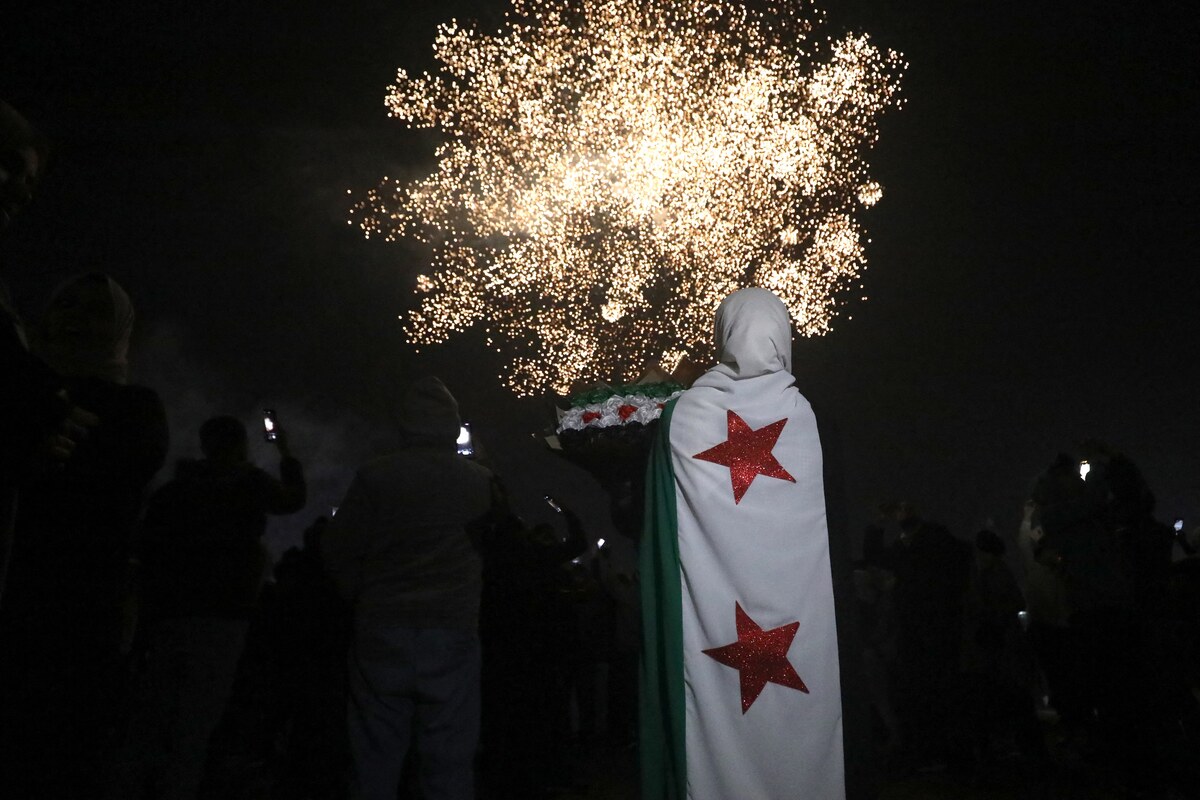


Syrians watch fireworks as they gather for New Year's Eve celebrations in Damascus after the fall of Assad (AFP)

Qatar has one of the highest per capita incomes in the world, making it one of the wealthiest nations due to its abundant natural gas and oil reserves.

However, the country dealt with several challenges following the COVID-19 pandemic, leading to an inflation rate of 5 percent in 2022.

Doha was not alone in facing these difficulties; the pandemic contributed to a nearly 4.4 percent contraction of the global economy in 2020. 

Al-Kuwari said Qatar is pursuing a policy of fiscal discipline, which has allowed the country to maintain a budget surplus and low debt levels, as well as effectively manage any economic challenges it encounters.

“We’ve developed a medium-term fiscal policy framework for the upcoming 20 years, with different scenarios of revenues based on oil prices, taxation and spending scenarios ... (Based on that) we decide to invest or save,” he said, adding that the fiscal deficit and rising borrowing affecting many countries are “problems that few want to discuss,” which poses the threat of a financial crisis.

An IMF report projected that global debt — including government, business and personal borrowing — will exceed $100 trillion, about 93 percent of global gross domestic product, by the end of 2024. It is expected to reach 100 percent of GDP by 2030.

“There will be a huge impact if we don’t do anything about it today,” Al-Kuwari warned. “So many people focus on economic growth and creating quick wins for their economy while the fiscal issues get forgotten.

“The fiscal balance should complement the economic growth, and we shouldn’t have growth at the expense of the fiscal.”


Kuwait to boost Islamic finance with sukuk regulation

Updated 05 February 2026
Follow

Kuwait to boost Islamic finance with sukuk regulation

  • The move supports sustainable financing and is part of Kuwait’s efforts to diversify its oil-dependent economy

RIYADH: Kuwait is planning to introduce legislation to regulate the issuance of sukuk, or Islamic bonds, both domestically and internationally, as part of efforts to support more sustainable financing for the oil-rich Gulf nation, Prime Minister Sheikh Ahmad Abdullah Al-Ahmad Al-Sabah said on Wednesday.

Speaking at the World Governments Summit in Dubai, Al-Sabah highlighted that Kuwait is exploring a variety of debt instruments to diversify its economy. The country has been implementing fiscal reforms aimed at stimulating growth and controlling its budget deficit amid persistently low oil prices. Hydrocarbons continue to dominate Kuwait’s revenue stream, accounting for nearly 90 percent of government income in 2024.

The Gulf Cooperation Council’s debt capital market is projected to exceed $1.25 trillion by 2026, driven by project funding and government initiatives, representing a 13.6 percent expansion, according to Fitch Ratings.

The region is expected to remain one of the largest sources of US dollar-denominated debt and sukuk issuance among emerging markets. Fitch also noted that cross-sector economic diversification, refinancing needs, and deficit funding are key factors behind this growth.

“We are about to approve the first legislation regulating issuance of government sukuk locally and internationally, in accordance with Islamic laws,” Al-Sabah said.

“This enables us to deal with financial challenges flexibly and responsibly, and to plan for medium and long-term finances.”

Kuwait returned to global debt markets last year with strong results, raising $11.25 billion through a three-part bond sale — the country’s first US dollar issuance since 2017 — drawing substantial investor demand. In March, a new public debt law raised the borrowing ceiling to 30 billion dinars ($98 billion) from 10 billion dinars, enabling longer-term borrowing.

The Gulf’s debt capital markets, which totaled $1.1 trillion at the end of the third quarter of 2025, have evolved from primarily sovereign funding tools into increasingly sophisticated instruments serving governments, banks, and corporates alike. As diversification efforts accelerate and refinancing cycles intensify, regional issuers have become regular participants in global debt markets, reinforcing the GCC’s role in emerging-market capital flows.

In 2025, GCC countries accounted for 35 percent of all emerging-market US dollar debt issuance, excluding China, with growth in US dollar sukuk issuance notably outpacing conventional bonds. The region’s total outstanding debt capital markets grew more than 14 percent year on year, reaching $1.1 trillion.