

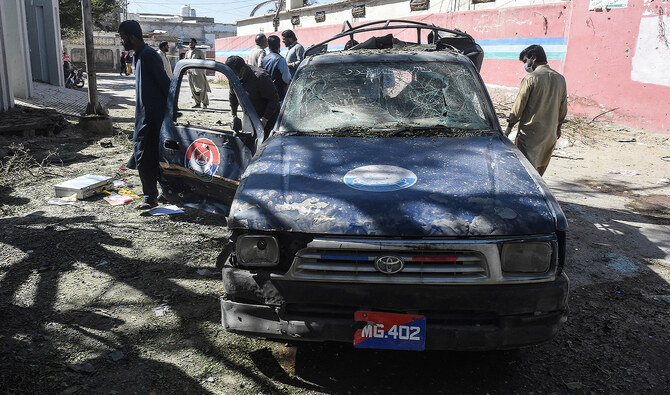

QUETTA: Militants set on fire a paramilitary forces check-post and a convoy of trucks carrying minerals in two separate attacks in Pakistan’s Balochistan province, officials said on Wednesday, the latest assaults in a region plagued by a decades-long separatist insurgency.
Groups like the Baloch Liberation Army (BLA) seek independence for Balochistan, a mineral-rich, southwestern province bordering Afghanistan to the north and Iran to the west. The region, Pakistan’s largest in terms of land mass but its most impoverished, is home to key mining projects, including Reko Diq, run by mining giant Barrick Gold, and believed to be one of the world’s largest gold and copper mines. China also operates a gold and copper mine in the province, is building a deep-sea port in the coastal town of Gwadar and has funded an international airport, among several other projects that are part of the China Pakistan Economic Corridor (CPEC) scheme.
Separatist groups often target key infrastructure projects and security posts in Balochistan as well as Chinese interests, in particular the port of Gwadar on the Arabian Sea, accusing Beijing of helping Islamabad to exploit the province.
Nearly 300 people, including soldiers, were killed and dozens injured in more than 500 attacks reported in Balochistan in 2024.
In the last attack, Zahid Langove, Deputy Commissioner Panjgur, told Arab News unidentified gunmen attacked a paramilitary Levies check-post with a rocket in the district’s Pullabad area during the early hours of Wednesday.
“The midnight attack on Levies check-post was not of a large-scale,” Langove said. “No casualty was reported in the attack but the attackers set the check-post ablaze and escaped in the nearby mountains.”
In a separate attack, unidentified gunmen attacked a convoy of trucks carrying minerals in the province’s Nushki district.
Zafar Sumalani, Station House Officer at the Nushki Police Station, said unidentified attackers stopped a convoy of trucks on the Pak-Iran highway, some four kilometers outside of Nushki city on Tuesday night.
“Two trucks carrying minerals were torched and the attackers burst the tires of a truck with gunfire,” Sumalani said.
No group immediately claimed responsibility for the two attacks but most attacks in the region are claimed by the BLA and other separatists who accuse Islamabad of exploiting the province’s natural resources such as gold and copper while neglecting the local population. Successive Pakistani governments have denied the allegations, saying they have prioritized Balochistan’s development through investments in health, education and infrastructure projects.
On Jan. 13, the military said Pakistani security forces had killed 27 militants in Balochistan in an intelligence-based operation in Kacchi district.
The operation came after dozens of fighters of the BLA stormed the small town of Zehri in Khuzdar district and took control of the town for hours. The group set government buildings, including a Levies police station, ablaze and robbed 768,000 rupees ($2745) from a private bank.
In August last year, separatists killed over 50 people, including security forces, in a string of coordinated attacks in Balochistan, the deadliest the region had seen in decades.


