

Pakistan court issues arrest warrants for top Imran Khan aides over riots led by supporters in 2023

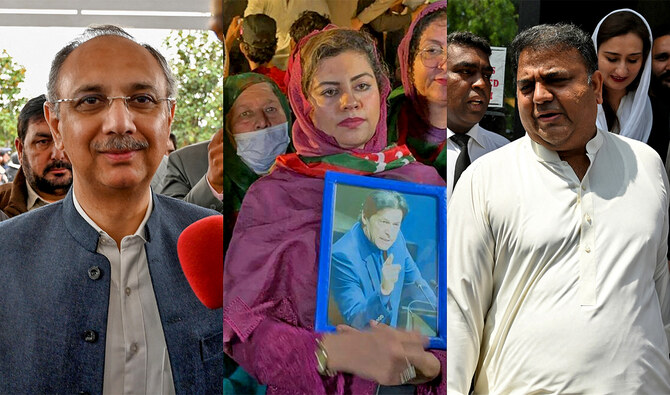
The collage of images created on January 22, 2025 shows Pakistan Tehreek-e-Insaf leaders Omar Ayub Khan (left), Kanwal Shauzab (center) and Fawad Chaudhry. (AFP/Facebook/File)
Short Url
Updated 22 January 2025
Follow

Pakistan court issues arrest warrants for top Imran Khan aides over riots led by supporters in 2023

  • Khan was himself indicted last month on charges of inciting supporters to attack military’s GHQ headquarters on May 9, 2023
  • Hundreds of PTI supporters and leaders were arrested while police registered cases against top leaders, including Khan

ISLAMABAD: An Anti-Terrorism Court (ATC) on Wednesday issued non-bailable arrest warrants for key aides of former premier Imran Khan, local media widely reported, in a case involving riots by supporters of the jailed PM’s Pakistan Tehreek-e-Insaf (PTI) party, including attacks on military installations.

Khan was himself indicted last month on chparges of inciting his supporters to attack the military’s GHQ headquarters during protests on May 9, 2023. That day, after Pakistan’s powerful army publicly rebuked the PTI founder for repeatedly accusing a senior military officer of trying to engineer his assassination, Khan was arrested by the national anti-corruption agency in a land graft case. The arrest sparked a wave of protests by Khan supporters across the country, with rioters attacking important state buildings and ransacking military facilities, including the GHQ in the garrison city of Rawalpindi and the residence of the army’s top commander in the eastern city of Lahore. 

Hundreds of PTI supporters and dozens of leaders were subsequently arrested while police registered cases against the party’s top leaders, including Khan.

Pakistan’s top TV news channel, Geo News, reported on Wednesday that non-bailable arrest warrants had been issued for Omar Ayub Khan, the opposition leader in the National Assembly, and Shibli Faraz, the opposition leader in Senate, after both failed to appear before an anti-terrorism court in a case registered at the Civil Lines Police Station. 

“Warrants have also been issued ... against PTI’s Kanwal Shauzab as well as former party leader Fawad Chaudhry,” Geo reported. Several other Pakistani news channels also reported on the development.

Nearly 2,000 people were arrested following the May 9 protests and at least eight were killed. The government had called out the army to help restore order.

Though Khan was released on bail within days of the May 9 arrest, he was later arrested in August 2023 after he was handed a three-year prison sentence in a corruption case. He has been in jail since then.

His party was barred from Pakistan’s election on Feb. 8, 2024, but the would-be candidates stood as independents.

Despite the ban and Khan’s imprisonment for convictions on charges ranging from leaking state secrets to corruption, millions of the former cricketer’s supporters voted for him. Independent candidates from his party won the highest number of seats but not enough to form a government on their own. Khan cannot be part of any government while he remains in prison.

Khan and his party say all legal cases against him are based on made-up charges to keep him out of politics at the behest of the army after he had fallen out with the military’s generals. The army denies the accusation.

Last month, the government launched talks with the PTI to cool political temperatures in the South Asian nation. The two sides have met thrice and the PTI has said it will only attend a fourth round of talks if the government announced judicial commissions into accusations Khan’s party and supporters led violent protests on May 9, 2023, and Nov. 26, 2024, when protests in Islamabad demanding Khan’s release turned violent, with the PTI saying 12 supporters were killed while the state said four troops had died. 


Pakistan says defense pact with Saudi Arabia elevated brotherly ties to ‘new heights’

Updated 25 February 2026
Follow

Pakistan says defense pact with Saudi Arabia elevated brotherly ties to ‘new heights’

  • Pakistan, Saudi Arabia signed strategic defense pact last year pledging aggression against one will be treated as attack on both
  • Deputy PM Ishaq Dar says enduring bonds with Islamic and Arab nations form vital pillar of Pakistan’s foreign policy 

ISLAMABAD: Deputy Prime Minister Ishaq Dar said on Wednesday that Pakistan’s defense pact with Saudi Arabia elevated its brotherly ties with the Kingdom to “new heights,” stressing that close ties with Arab and Islamic nations form a key pillar of Islamabad’s foreign policy. 

Pakistan and Saudi Arabia signed a Strategic Mutual Defense Agreement on Sept. 17 last year, pledging that aggression against one country would be treated as an attack on both, enhancing joint deterrence and formalizing decades of military and security cooperation.

Both nations agreed in October 2025 to launch an economic cooperation framework to strengthen trade and investment ties. 

“In the Middle East, our landmark Strategic Mutual Defense Agreement with Saudi Arabia has elevated our brotherly ties to new heights,” Dar said while speaking at the Pakistan Governance Forum 2026 event in Islamabad. 

The Pakistani deputy prime minister was speaking on the topic “Navigating International Relations Amidst Changing Geo-Politics.”

Dar noted that Pakistan has reinforced partnerships with other Middle Eastern nations such as the UAE, Qatar, Jordan, Oman, Egypt and Bahrain. He said these partnerships have yielded “concrete agreements” in investment, agriculture, infrastructure, and energy sectors. 

“Our enduring bonds with Islamic and Arab nations form a vital pillar of our foreign policy, and we will continue to expand our partnerships across Asia, Latin America, and Africa,” he said. 

Dar pointed out that the presidents of Kazakhstan, Uzbekistan and Kyrgyzstan have undertaken visits to Pakistan in recent months, reflecting Central Asian nations’ desire to boost cooperation with Islamabad.

On South Asia, the Pakistani deputy PM said Pakistan has successfully transformed its fraternal ties with Bangladesh into “a substantive partnership.”

“Similarly, the trilateral mechanism involving China, Pakistan, and Bangladesh has been launched with a view to expanding and deepening regional cooperation and synergy,” the Pakistani minister said. 

He said Islamabad has strengthened its “all-weather” partnership with China via the second phase of the multi-billion-dollar China-Pakistan Economic Corridor agreement and “unwavering support” from both sides for each other’s core interests. 

Dar said Pakistan had also reinvigorated its partnership with the US, advancing cooperation in trade, technology, investment, and regional stability. 

“This calibrated approach has enhanced our ability to navigate complexity with skill and confidence, ensuring that our national interests are served without compromising our core foreign policy principles,” he said.