

Holistic approach crucial to sustaining growth in emerging-market economies, say WEF panelists

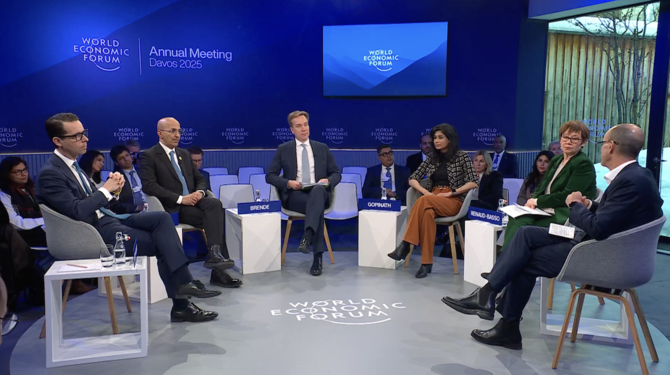
A panel of global leaders at Davos emphasized the importance of a holistic approach to building resilience in emerging markets. (Screen shot)
Short Url
Updated 22 January 2025
Follow

Holistic approach crucial to sustaining growth in emerging-market economies, say WEF panelists

  • Structural reforms, digital infrastructure, private investment vital, says IMF’s Gita Gopinath
  • Saudi Arabia’s Finance Minister Mohammed Al-Jadaan says Vision 2030 is model for resilience

DUBAI: A holistic approach is needed to build resilience and sustainable growth in emerging-market economies, through structural reforms, technological investment, and private sector engagement.

This was the consensus of panelists during a discussion on Wednesday at the World Economic Forum in Davos.

The panelists noted that emerging-market economies have managed recent global shocks such as rising interest rates, the COVID-19 pandemic, and increased energy prices, due to long-term investments in macroeconomic stability.

However, Gita Gopinath, first deputy MD of the International Monetary Fund, warned that per capita gross domestic product growth has slowed since the pandemic.

She emphasized that further structural reforms are needed to boost productivity and private sector investment. “Emerging markets need to reinvest in reforms that deepen capital markets, encourage innovation, and enhance human capital.”

She noted that countries including Saudi Arabia and Mexico are exceptions, having maintained growth despite global slowdowns.

Gopinath also pointed to artificial intelligence as a potential driver of productivity but highlighted a significant digital divide.

While advanced economies face 60 percent job exposure to AI, low-income countries remain far behind, with only 26 percent. She said that emerging markets need to invest in digital infrastructure and education to harness the full potential of AI.

Global debt levels are also of major concern. Public sector debt globally now stands at $100 trillion and is projected to reach 100 percent of global GDP by 2030.

Gopinath warned that debt levels are often underestimated, potentially creating a “serious issue” for countries to address in the coming years.

The solution, she said, lies in attracting private sector investment. For example, climate finance will require 80 to 90 percent of funding from private investors.

Governments must create policies that de-risk investments and encourage private capital to flow into critical areas including climate adaptation and digital transformation, said Gopinath.

Saudi Arabia’s Finance Minister Mohammed Al-Jadaan said the country’s Vision 2030 has laid the foundation for structural reforms.

Through initiatives including the Expenditure and Project Efficiency Authority, the country has significantly improved government spending efficiency and attracted increasing private sector investments, he said.

Al-Jadaan emphasized that resilience-building initiatives may not yield immediate returns but prove their value in times of crisis.

Saudi Arabia’s strong recovery during the COVID-19 pandemic can be attributed to the country’s long-term planning and alignment between government and the private sector, he said.

Odile Francoise Renaud-Basso, president of the European Bank for Reconstruction and Development, said Multilateral Development Banks play a key role in supporting resilience in emerging markets.

She said MDBs help countries develop effective macroeconomic frameworks and create environments that attract private investment.

However, Renaud-Basso said that MDBs cannot substitute for private capital but can help foster investment-friendly policies by improving regulatory frameworks, strengthening the rule of law, and simplifying processes.


‘Future cities will be built for visitors, not just residents,’ Saudi tourism minister tells Arab News

Updated 10 November 2025
Follow

‘Future cities will be built for visitors, not just residents,’ Saudi tourism minister tells Arab News

RIYADH: Saudi Arabia is positioning itself at the forefront of the global travel evolution by designing destinations that will target the tourists of the future, the Kingdom’s tourism minister has said.

Ahmed Al-Khateeb added that sustainability would serve as the guiding principle behind Saudi Arabia’s role in tomorrow’s global travel landscape.

Travelers’ habits and the tourism industry’s revenue sources have shifted dramatically in recent years, he told Arab News in an interview.

“People used to travel in groups. Today, they are traveling in smaller groups. Hotels used to make most of their revenues from rooms — now, they are making more from lounges and restaurants.”

And younger generations, empowered by technology, are also redefining how travel is planned and experienced, Al-Khateeb added. “They are driving their own itineraries on the go, which puts pressure on traditional travel companies that once organized large group trips. We are witnessing big shifts in the global travel market.”

Among the world’s fastest-growing tourism markets, China and India are reshaping international travel flows. “China has become the most important source market for outbound travelers, while India is expected to double its number of travelers in the coming years,” the minister said. “This opens a major opportunity for the Middle East — and Saudi Arabia in particular — to emerge as a top destination for international tourists.”

Since 2019, Saudi Arabia has recorded the fastest tourism growth among all G20 nations, said Al-Khateeb. “We have a very strong domestic market and a very strong religious market. Now, we have opened our doors for leisure, business and holiday travelers — whether they seek the Red Sea coast, the southern mountains, our major cities or our beautiful islands.”

Yet the Kingdom’s long-term vision for tourism extends far beyond the present, with destinations being built to serve both visitors and residents sustainably, he added.

“In the 1950s and 1960s, cities were built for residents,” Al-Khateeb said. “Today, in places like Greece, visitors outnumber residents three to one. The cities of the future must be designed for visitors as well — and that’s what we are doing in Saudi Arabia.”

Sustainability has become a non-negotiable element of all tourism development in the Kingdom, he added. “In the last two decades, sustainability has become extremely important. As we build new destinations like the Red Sea, we are fully aligned with sustainability regulations. Whatever we build today is environmentally friendly, ensuring not only environmental, but also social and economic sustainability.”

This principle lies at the heart of Vision 2030’s tourism transformation: “Sustainability is at our forefront whenever we build or operate any new destination,” he added.