China’s ADM Group announces $250 million investment to set up EV manufacturing plant in Pakistan

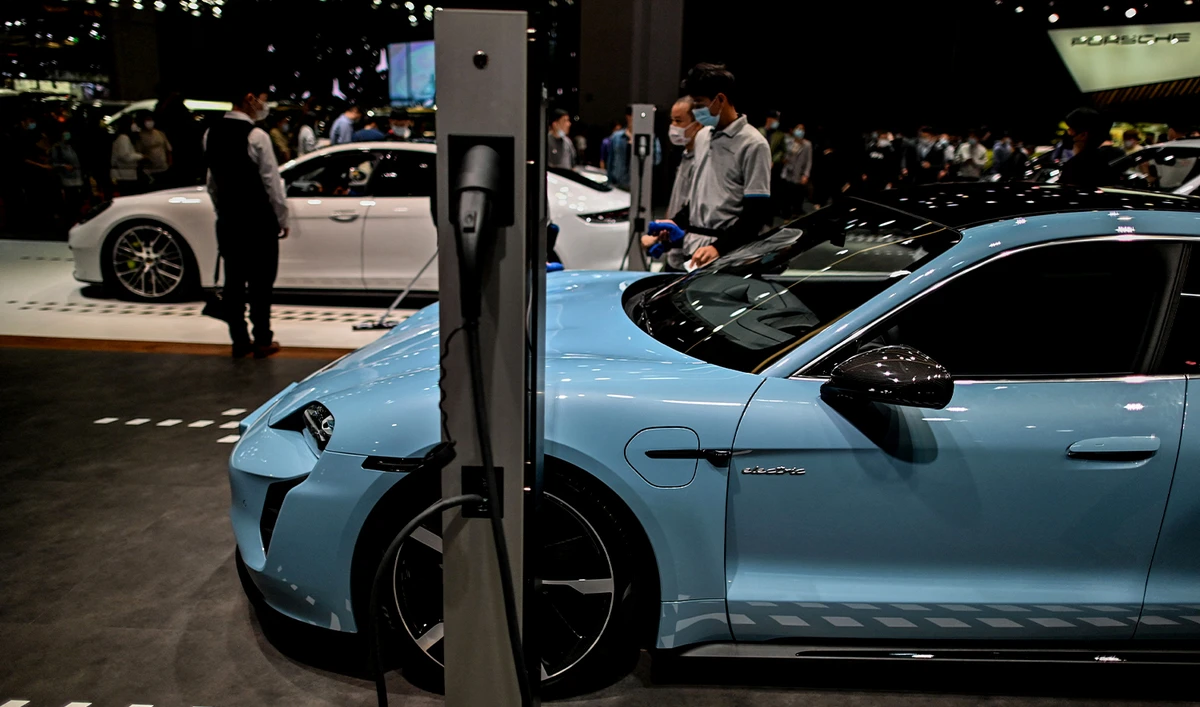
A Porsche Taycan 4S electric car is seen during the 19th Shanghai International Automobile Industry Exhibition in Shanghai on April 21, 2021. (AFP/File)
Short Url
Updated 22 January 2025
Follow

China’s ADM Group announces $250 million investment to set up EV manufacturing plant in Pakistan

  • ADM Group last year announced an investment of $350 million in Pakistan’s electric vehicle sector
  • Group will set up manufacturing plant, over 3,000 electric vehicle charging stations across Pakistan

ISLAMABAD: China’s ADM Group will invest $250 million to set up an electric vehicle manufacturing plant in Pakistan, state media reported on Wednesday, as Islamabad seeks for Beijing to collaborate in setting up industrial zones to manufacture electronic cars.

The government of Pakistan approved an ambitious National Electric Vehicles Policy (NEVP) in 2019 with the goal of electric vehicles comprising 30 percent of all passenger vehicle and heavy-duty truck sales by 2030, and an even more ambitious target of 90 percent by 2040. For two- and three-wheelers, as well as buses, the policy set a goal of achieving 50 percent of new sales by 2030 and 90 percent by 2040.

“Chinese Company ADM Group has announced an investment of two hundred and fifty million dollars to set up an EV manufacturing plant in Pakistan,” Radio Pakistan reported, saying the initiative was part of efforts by the Special Investment Facilitation Council set up last year to attract foreign investment. 

“Transition to EVs is expected to cut fuel import costs, saving billions of dollars.”

Last year, ADM Group announced an investment of $350 million in Pakistan’s EV sector, saying it would establish more than 3,000 electric vehicle charging stations across the South Asian country.

Earlier this month, Pakistan said it would cut the power tariff for operators of electric vehicle charging stations by 45 percent as part of the ongoing reform of the energy sector designed to boost demand. The government is also planning to introduce financing schemes for e-bikes and the conversion of two- and three-wheeled petrol vehicles.

The cabinet on Jan. 15 approved a reduced tariff of 39.70 rupees ($0.14) per unit, down from 71.10 rupees previously, which will be in place within a month. The government expects an internal rate of return of more than 20 percent for investors in the sector.

According to a report submitted to the government by power ministry adviser Ammar Habib Khan and reported by Reuters, there are currently more than 30 million two- and three-wheeled vehicles in Pakistan, which consume more than $5 billion worth of petroleum annually.

The ministry plans to convert 1 million two-wheelers to electric bikes in a first phase, at an estimated net cost of 40,000 rupees per bike, according to the report, saving around $165 million in fuel import costs annually.

BYD Pakistan, a partnership between China’s BYD and Pakistani car group Mega Motors, told Reuters in September that up to 50 percent of all vehicles bought in Pakistan by 2030 will be electrified in some form in line with global targets.

Imran Khan not a ‘national security threat,’ ex-PM’s party responds to Pakistan military

Updated 4 sec ago
Follow

Imran Khan not a ‘national security threat,’ ex-PM’s party responds to Pakistan military

  • Pakistan’s military spokesperson on Friday described Khan’s anti-army narrative as a “national security threat”
  • PTI Chairman Gohar Ali Khan says words used by military spokesperson for Khan were “not appropriate”

ISLAMABAD: Former prime minister Imran Khan’s Pakistan Tehreek-e-Insaf (PTI) party on Saturday responded to allegations by Pakistan military spokesperson Lt. Gen. Ahmed Sharif Chaudhry from a day earlier, saying that he was not a “national security threat.”

Chaudhry, who heads the military’s media wing as director general of the Inter-Services Public Relations (ISPR), spoke to journalists on Friday, in which he referred to Khan as a “mentally ill” person several times during the press interaction. Chaudhry described Khan’s anti-army narrative as a “national security threat.”

The military spokesperson was responding to Khan’s social media post this week in which he accused Chief of Defense Forces Field Marshal Asim Munir of being responsible for “the complete collapse of the constitution and rule of law in Pakistan.” 

“The people of Pakistan stand with Imran Khan, they stand with PTI,” the party’s secretary-general, Salman Akram Raja, told reporters during a news conference. 

“Imran Khan is not a national security threat. Imran Khan has kept the people of this country united.”

Raja said there were several narratives in the country, including those that created tensions along ethnic and sectarian lines, but Khan had rejected all of them and stood with one that the people of Pakistan supported. 

PTI Chairman Gohar Ali Khan, flanked by Raja, criticized the military spokesperson as well, saying his press talk on Thursday had “severely disappointed” him. 

“The words that were used [by the military spokesperson] were not appropriate,” Gohar said. “Those words were wrong.”

NATURAL OUTCOME’

Speaking to reporters earlier on Saturday, Pakistan’s Defense Minister Khawaja Asif defended the military spokesperson’s remarks against Khan.

“When this kind of language is used for individuals as well as for institutions, then a reaction is a natural outcome,” he said. 

“The same thing is happening on the Twitter accounts being run in his [Khan’s] name. If the DG ISPR has given any reaction to it, then I believe it was a very measured reaction.”

Khan, who was ousted after a parliamentary vote of confidence in April 2022, blames the country’s powerful military for removing him from power by colluding with his political opponents. Both deny the allegations. 

The former prime minister, who has been in prison since August 2023 on a slew of charges he says are politically motivated, also alleges his party was denied victory by the army and his political rivals in the 2024 general election through rigging. 

The army and the government both deny his allegations.