

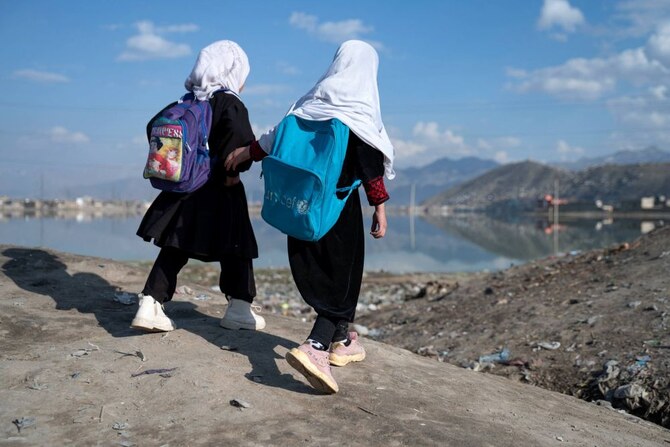

KABUL: A senior Taliban official has called on his leadership to scrap education bans on Afghan women and girls, a move that experts said on Tuesday voiced the public’s concerns and marked a new phenomenon for Afghanistan’s current regime.
Sher Mohammad Abbas Stanikzai, Afghanistan’s acting deputy foreign minister, said in a speech over the weekend that the Taliban’s restrictions on girls’ and women’s education were not in line with Islamic Shariah law.
“Our expectation from the leaders of the Islamic Emirate is to open the doors of education. There is no excuse for this, and there never will be one,” Stanikzai said at an event in the Khost province.
Around 1.1 million girls have been denied access to formal education since September 2021, when the Taliban suspended secondary schools for girls.
It is part of a series of curbs that, in the three years since the Taliban took power, have increasingly restricted women’s access to education, the workplace and public spaces.
“In our population of 40 million, we are committing injustice against 20 million … The entire world is opposing us because of this problem. They criticize us for this same matter. The path we are currently following stems from personal attitudes, not Shariah.”
Stanikzai was the leader of a team of negotiators at the Taliban’s political office in Doha for talks that led to the complete withdrawal of US-led forces from Afghanistan in 2021.
His latest remarks were one of the strongest public rebukes of a government policy that has furthered the international isolation of the Taliban.
“In Afghanistan, women’s rights are being taken away in the name of Islam. As Stanikzai … said, the decision to stop girls’ education is a matter of the nature of the Taliban, not a matter of Shariah. This is only a rural and tribal view that they present,” Ziaulhaq Amarkhil, senior advisor to the former president of Afghanistan, told Arab News.
“The issue that Mr. Stanikzai discussed is the voice of every Afghan and every Muslim. Women should be granted their rights. They should be allowed to study and get higher education.”
Amarkhil said if the current education ban were to continue, there would be grave consequences in Afghanistan.
“After 12 years, we will not have a single female doctor in the country because those who are there will not be able to continue working due to their age and the new generation will not be educated, or they will leave the country,” he said.
Stanikzai’s criticism was “significant,” said Kabul-based political expert Tameem Bahiss, as it marked one of the first times that a senior member of the Taliban publicly criticized the supreme leader, Hibatullah Akhundzada.
Similar criticisms have also come from Taliban’s acting Interior Minister Sirajuddin Haqqani, who in 2023 made veiled remarks against Akhundzada on “monopolizing” power and “damaging the government” in Afghanistan.
“Publicly criticizing the leader’s decisions is a new phenomenon within the Taliban. Until now, we haven’t seen criticism of this magnitude,” Bahiss told Arab News.
“If criticism from a Taliban leader of such stature continues to grow, it will undoubtedly put significant pressure on Sheikh Hibatullah.”
Bahiss highlighted how Stanikzai had challenged Akhundzada’s decision by saying that the education policy reflected the leader’s personal sentiment, rather than being based on Islamic law.
“Such voices within the Islamic Emirate of Afghanistan are crucial as it transitions from an insurgency to a governing entity. Important decisions regarding the people’s affairs should involve all leaders’ input,” Bahiss said.
“We are seeing that such voices garner significant support, not only from the people of Afghanistan but also from within the Taliban ranks.”
With this new development within the Taliban and given Stanikzai’s status in the group, Bahiss said Akhundzada may tolerate the criticism.
“If this happens, it could encourage other leaders to publicly challenge Hibatullah’s decision to ban schools, potentially putting significant pressure on him and leading to the removal of the ban,” he said.


