

Trial opens into UK stabbing spree that sparked riots over misinformation attacker was Muslim

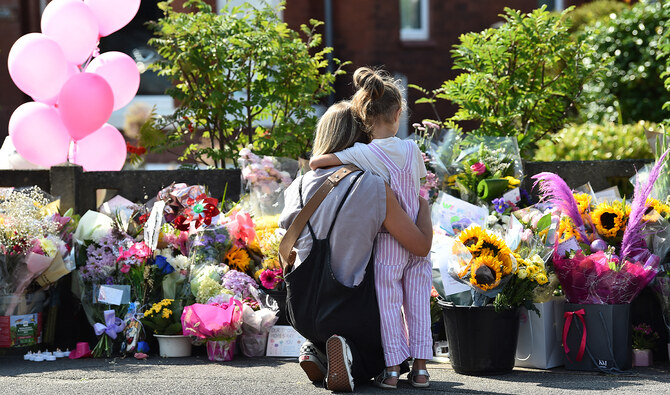
A mother hugs her child as they look at floral tributes for the victims of a deadly knife attack in Southport, northwest England, on July 31, 2024. (AFP/File)
Short Url
Updated 20 January 2025
Follow

Trial opens into UK stabbing spree that sparked riots over misinformation attacker was Muslim

  • Authorities blame far-right agitators for violence, including by sharing misinformation alleged attacker was Muslim asylum seeker
  • Unrest, which lasted several days, saw far-right rioters attack police, shops, hotels housing asylum seekers and mosques

LONDON: The trial of a teenager accused of killing three young girls in a stabbing spree last year that sparked the UK’s most violent riots in a decade is set to begin Monday.

Axel Rudakubana, 18, is due to stand trial at Liverpool Crown Court, accused of murdering three girls at a Taylor Swift-themed dance class last year in Southport, northwest England.

Bebe King, six, Elsie Dot Stancombe, seven, and Alice da Silva Aguiar, nine, were killed in the attack in the seaside resort near Liverpool on July 29, 2024.

Ten others were injured, including eight children, in one of the country’s worst mass stabbings in years.

Rudakubana faces a total of 16 charges, including three counts of murder, 10 counts of attempted murder and one count of possessing a blade days after the attack.

The trial is expected to last four weeks after pleas of not guilty were entered on his behalf.

The stabbings sent shock waves across the UK, triggering unrest and riots in more than a dozen English and Northern Irish towns and cities, including in Southport and Liverpool.

Authorities blamed far-right agitators for fueling violence, including by sharing misinformation claiming the alleged attacker was a Muslim asylum seeker.

The unrest, which lasted several days, saw far-right rioters attack police, shops, hotels housing asylum seekers and mosques, with hundreds of participants subsequently arrested and charged.

Rudakubana was born in Wales to parents of Rwandan origin and lived in Banks, a village northeast of Southport.

Despite being 17 years old at the time, restrictions on reporting Rudakubana’s name were lifted in August due to concerns over the spread of misinformation.

“Continuing to prevent the full reporting has the disadvantage of allowing others to spread misinformation, in a vacuum,” judge Andrew Menary said as he lifted the restrictions.

Taylor Swift, then in the middle of her Eras tour, wrote on Instagram that she “was completely in shock” the day after the attack on the dance class at the start of the school holidays.

The pop star reportedly met two of the survivors of the attack during her August shows in London.

The UK’s head of state King Charles III also traveled to Southport in August to meet with survivors, inspecting a sea of floral tributes laid outside the city’s town hall.

And Catherine, Princess of Wales, and Prince William visited Southport in October “to show support to the local community,” Kensington Palace said. It was their first joint public engagement since Kate ended a course of chemotherapy for cancer.

In October, the suspect was charged with two additional offenses in relation to evidence obtained “during searches of Axel Rudakubana’s home address” following the attack, the Crown Prosecution Services (CPS), which brings public prosecutions, said.

The charges were for the “production of a biological toxin, namely ricin,” and “possessing information ... likely to be useful to a person committing or preparing an act of terrorism.”

The terrorism offense related to suspicion of possessing an Al-Qaeda training manual, although the attack was not treated as a terrorist incident.

Following speculation on social media related to policing decisions in the case, Chief Constable Serena Kennedy said she realized the added charges could trigger fresh rumors.

“We would strongly advise caution against anyone speculating as to motivation in this case,” Kennedy was quoted as saying.

She urged people to be patient and “don’t believe everything you read on social media.”

Rudakubana has appeared in several hearings since the attack, often wearing a grey sweatshirt, and refusing to speak in all of them.

In the last hearing in December, he appeared via videolink at Liverpool Crown Court from high-security Belmarsh prison, in southeast London.

The Attorney General and Merseyside police have warned the press and public against publishing any material that risks prejudicing the trial.


94 million need cataract surgery, but access lacking: WHO

A Somali patient undergoes free cataract surgery at Al Nuur eye Hospital in Mogadishu, on February 16, 2015. (AFP)
Updated 11 February 2026
Follow

94 million need cataract surgery, but access lacking: WHO

  • Of the 94 million affected, fewer than 20 percent are blind, while the rest suffer from impaired vision

GENEVA: More than 94 million people suffer from cataracts, but half of them do not have access to the surgery needed to fix it, the World Health Organization said Wednesday.
Cataracts — the clouding of the eye’s lens that causes blurred vision and can lead to blindness — are on the rise as populations get older, with age being the main risk factor.
“Cataract surgery — a simple, 15-minute procedure — is one of the most cost-effective medical procedures, providing immediate and lasting restoration of sight,” the WHO said.
It is one of the most frequently performed surgeries undertaken in high-income countries.
However, “half of the world’s population in need of cataract surgery don’t have access to it,” said Stuart Keel, the UN health agency’s technical lead for eye care.
The situation is worst in the WHO’s Africa region, where three in four people needing cataract surgery remain untreated.
In Kenya, at the current rate, 77 percent of people needing cataract surgery are likely to die with their cataract blindness or vision impairment, said Keel.
Across all regions, women consistently experience lower access to care than men.
Of the 94 million affected, fewer than 20 percent are blind, while the rest suffer from impaired vision.

- 2030 vision -

The WHO said that over the past two decades, global cataract surgery coverage had increased by 15 percent.

In 2021, WHO member states set a target of a 30-percent increase by 2030.
However, current modelling predicts that cataract surgery coverage will rise by only about 8.4 percent this decade.
To close the gap, the WHO urged countries to integrate eye examinations into primary health care and invest in the required surgical equipment.
States should also expand the eye-care workforce, training surgeons in a standardised manner and then distributing them throughout the country, notably outside major cities.
The WHO was on Wednesday launching new guidance for countries on how to provide quality cataract surgery services.
It will also issue guidance to help support workforce development.
Keel said the main issue was capacity and financing.
“We do need money invested to get rid of this backlog, which is nearly 100 million people,” he told a press conference.
While age is the primary risk factor for cataracts, others include prolonged UV-B light exposure, tobacco use, prolonged corticosteroid use and diabetes.
Keel urged people to keep up regular eye checks as they get older, with most problems able to be either prevented or diagnosed and treated.
The cost of the new lens that goes inside the eye can be under $100.
However, out-of-pocket costs can be higher when not covered by health insurance.
“Cataract surgery is one of the most powerful tools we have to restore vision and transform lives,” said Devora Kestel, head of the WHO’s noncommunicable diseases and mental health department.
“When people regain their sight, they regain independence, dignity, and opportunity.”