


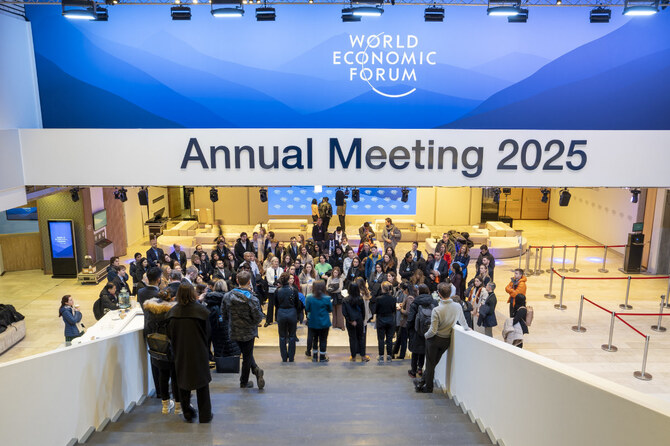


DUBAI: As the world’s elite arrive in the snow-capped Swiss mountains for the World Economic Forum (WEF) Annual Meeting 2025, the event promises to be a pivotal moment as global leaders address the world’s most pressing challenges.
With more than 350 government leaders, including 60 heads of state, attending, alongside business executives, civil society leaders, global experts, and other influential individuals from more than 130 countries, the forum’s organizers say the event — which runs from Jan. 20 to Jan. 24 — is intended to “drive dialogue and create solutions to the world’s shared problems.”

A picture taken on January 19, 2025 shows the Alpine resort of Davos ahead of the World Economic Forum annual meetig. (AFP)
The theme of the 2025 meeting, “Collaboration for the Intelligent Age,” will focus on five pillars crucial for a sustainable and inclusive future: Reimagining Growth, Industries in the Intelligent Age, Investing in People, Safeguarding the Planet, and Rebuilding Trust.
Klaus Schwab, the WEF’s founder and chairman, emphasized the role of Davos as a unique venue in bringing together thousands of decision makers to address global challenges.
“Despite divergent positions and great uncertainties, the Annual Meeting 2025 will foster a spirit of cooperation and constructive optimism with the objective of shaping the forthcoming Intelligent Age in a more sustainable and inclusive way” Schwab said in a press release

WEF founder and chairman Klaus Schwab speaks with the forum's managing directors Mirek Dusek and Neo Gim Huay, president and CEO Borge Brende and head of media Yann Zopf ahead of the annual meeting in Davos. (AFP)
In that same release, Børge Brende, president and CEO of the WEF, echoed this sentiment, noting that unprecedented collaboration is required to deal with the world’s most pressing issues.
“The only way to address urgent challenges and unlock new opportunities is through innovative, cooperative approaches,” Brende stated.
Among the heads of state set to participate are U.S. President-elect Donald Trump (via video link), European Commission President Ursula von der Leyen, German Chancellor Olaf Scholz, South African President Cyril Ramaphosa, Argentine President Javier Milei, and Ukrainian President Volodymyr Zelenskyy.
Opinion
This section contains relevant reference points, placed in (Opinion field)
Leaders from international organizations including the United Nations, the World Health Organization, and the International Monetary Fund will also be present, alongside 1,600 business leaders, including more than 900 CEOs and more than 120 “tech pioneers.”
Civil society will also be well represented, with more than 170 leaders from labor unions, non-governmental organizations, and academia, and more than 160 members of the WEF’s Global Shapers, Young Global Leaders and Social Innovators.

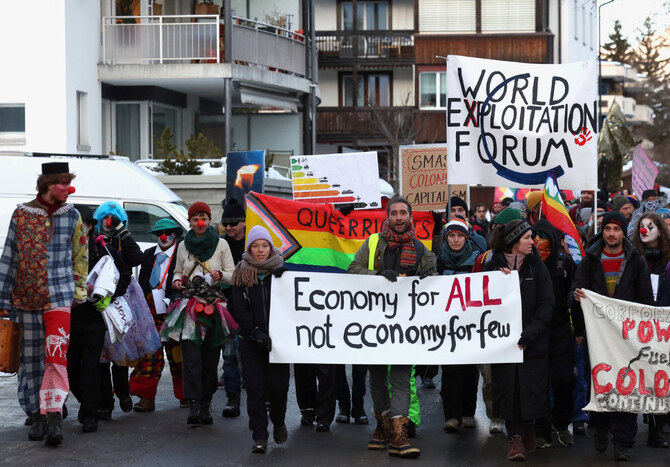
Protestors are seen on a two-day hike from Kueblis to Davos as part of a demonstration of the collective 'Strike WEF' in Switzerland on Jan. 18, 2025 ahead of the annual meeting of the World Economic Forum in Davos. (Keystone via AP)
The event will also be attended by 120 “cultural leaders,” and will feature an Arts and Culture program showcasing music, film, photography, interactive AI-driven art and handcrafted creations.
Mirek Dusek, WEF managing director, said in a statement: “By convening leaders from around the world and different walks of life, the Annual Meeting provides a platform to share views and knowledge at a time of profound change for people and communities.
“A core goal of our proceedings is to enable broad-based agency and solutions in the context of the new economy that seems to be emerging.”
Discussions at Davos will include debates on the future of work, technology, and climate action, and will also examine critical initiatives in areas including cybersecurity, artificial intelligence, and renewable energy. (AFP)
Discussions at Davos will include debates on the future of work, technology, and climate action. Reports such as the Global Cooperation Barometer 2025 and the Future of Jobs Report will be discussed during sessions, as will the ways in which new technologies will reshape industries and potentially create millions of jobs, while also terminating many others.
The meeting will also examine critical initiatives in areas including cybersecurity, artificial intelligence, and renewable energy, with the aim of creating “responsible, inclusive strategies for the future.”
Gim Huay Neo, WEF managing director said in a press release, “We will explore how data and technologies, as well as innovative partnerships, can be harnessed to create value and empower leadership for people, planet and prosperity.”


