

Saudi ambassador to Japan expresses high hopes about Expo 2025 Osaka

1 / 2
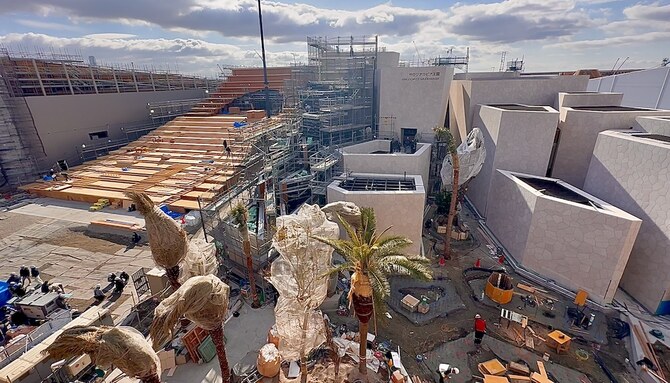
Binzagr shared that the construction work on the Kingdom’s pavilion is progressing rapidly, with around 85 percent already complete. (ANJ)
2 / 2
Binzagr shared that the construction work on the Kingdom’s pavilion is progressing rapidly, with around 85 percent already complete. (ANJ)
Short Url
Updated 19 January 2025
Follow

Saudi ambassador to Japan expresses high hopes about Expo 2025 Osaka

TOKYO: Saudi Ambassador to Japan Ghazi Bin Faisal Binzagr told Arab News Japan that he has high hopes of achieving the goals for which he was appointed general commissioner of the Kingdom’s pavilion at Expo 2025 Osaka.

“We are striving to create an amazing experience for our visitors,” he said. “We are capturing the essence of our Saudi Arabia Vision 2030 and bringing it live to Japan.”

Binzagr shared that the construction work on the Kingdom’s pavilion is progressing rapidly, with around 85 percent already complete. This progress is a testament to the Kingdom's commitment to the Expo, and we can all look forward to the grand opening in April.

Binzagr extended a warm invitation to visitors to “come and immerse themselves in our past, our present, and our future. Experience our rich heritage, our diverse food, our vibrant music, our colorful culture, and our ambitious future aspirations.”

This invitation is an opportunity to discover the beauty and potential of Saudi Arabia.

The Saudi ambassador expressed his sincere hope that visitors would be inspired to visit the Kingdom. This desire reflects the warm welcome and value the Kingdom places on its visitors.

“We want you to experience our pavilion,” he said. “We are confident that when you do, you will want to visit Saudi, perhaps even do business, partner with us, dream with us, or work with us to make a wonderful world.”

The Kingdom’s pavilion at Expo 2025 Osaka aims to highlight Saudi Arabia’s culture, traditions and transformation and look towards a sustainable form of human development.

Binzagr’s responsibilities as the general commissioner of the Kingdom’s pavilion at Expo 2025 Osaka include supervising efforts and initiatives to strengthen relations between the Kingdom and Japan and ensuring the successful representation of Saudi Arabia at the Expo.

• This article also appears on Arab News Japan


Red Sea Global unveils scientific model for regenerative tourism worldwide

Updated 26 February 2026
Follow

Red Sea Global unveils scientific model for regenerative tourism worldwide

  • The report details the model’s rollout at “The Red Sea” and “AMAALA” destinations, backed by studies covering 8 marine habitats

TABUK: Red Sea Global (RSG) has unveiled a science-based model aimed at achieving a 30 percent net positive conservation benefit across its tourism destinations by 2040. 

The framework is now available for global adoption, according to a statement released by RSG.

Owned by Saudi Arabia’s Public Investment Fund (PIF), Red Sea Global is the multi-project developer behind ambitious regenerative tourism destinations like “The Red Sea” and “AMAALA.” 

As a cornerstone of the Kingdom’s Vision 2030, the company aims to diversify the national economy while setting new global benchmarks for sustainable, nature-positive development.

CEO John Pagano stated that openly sharing this detailed approach will help elevate the global tourism sector and secure a healthier environment for future generations.
 

Map showing the boundaries of the Red Sea Zone. (Graphic from the RSG report)

The cornerstone of this initiative is the proprietary SIIG Model, a four-step framework:
• Survey: Establish biodiversity baselines and monitor long-term changes.
• Identify: Assess risks to priority habitats and species.
• Intervene: Execute evidence-based actions, such as regulating fishing and enhancing natural habitats.
• Gain: Measure and verify biodiversity improvements.

The report details the model’s rollout at “The Red Sea” and “AMAALA” destinations, backed by extensive 2022–2023 environmental baseline studies covering eight marine habitats and priority species groups during 2022 and 2023. 

A major intervention is the 5,015-square-kilometer Fishery Management Area in Al-Wajh Lagoon. The plan reserves 38 percent of the area for priority conservation—protecting 62 percent of local coral reefs—while allocating 61 percent for sustainable fishing.

According to scientific modeling, eliminating fishing in high-protection zones could increase reef fish populations by 113 percent, sharks and rays by 72 percent, and marine mammals by 24 percent. These measures are expected to boost coral resilience, support ecosystem recovery, and protect vulnerable species like sea turtles and seabirds.
Ihab Kindi, RSG’s Red Sea Destination Executive Director, called the data-driven model a practical roadmap for large-scale marine recovery. The complete methodology is available in the new report, “The SIIG Model: A Roadmap Toward Achieving Measurable Conservation Gains.”
