

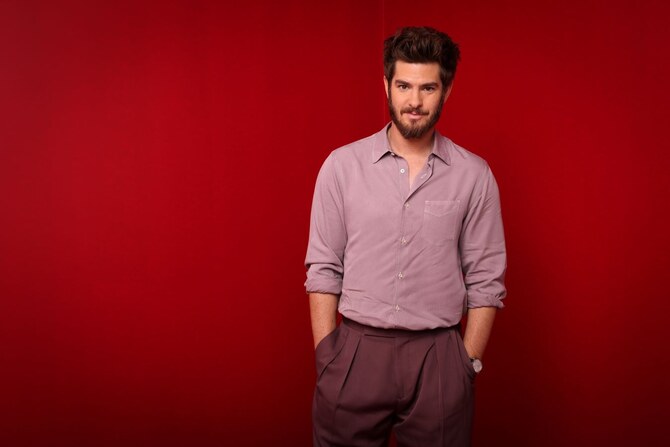
Andrew Garfield says tear-jerker film ‘We Live in Time’ is everyone’s story

Andrew Garfield stars in ‘We Live in Time.’ (Getty Images)
Short Url
Updated 19 January 2025
Follow

Andrew Garfield says tear-jerker film ‘We Live in Time’ is everyone’s story

DUBAI: It is no secret that Andrew Garfield’s latest movie, John Crowley’s “We Live in Time,” now in cinemas across the Middle East, is a tear-jerker that will pull at your heartstrings from Scene 1.

Beginning with the cancer diagnosis of co-main character Almut (Florence Pugh), the story then follows her back and forth through time to tell the story of her relationship with Tobias (Garfield), from their first encounter after a road accident to the birth of their daughter at a filling station and more.


Grace Delaney, Andrew Garfield and Florence Pugh in ‘We Live in Time.’ (Supplied)

“I think the point of this film is that it is everyone’s story,” Garfield told Arab News. “I think after any human being lives a certain amount of time, if they’re lucky, they get to experience terrible loss. And I know that that’s a strange way of phrasing it, but I do see it as a privilege to love deeply and therefore to lose terribly, to lose each other, whether it’s a partner or a mother or a father or a friend.”

While over the past few years Garfield has been on an on-and-off break from filming in an attempt to know himself better, the script from Justine Wright lured him back to set.

“I was in a very peaceful, contemplative place in my life, and reflecting on everything and wanting to be creative, but not necessarily wanting to be on a film set. But then, you know, reading the script, I thought, ‘Oh, this will be a very natural creative process,’” he said.

“There was a certain amount of letting go, but it was a letting go of a different kind. It was a letting go of too much overthinking. It felt like a very natural letting go, getting out of the way of not working too hard, letting the moment define the moment, letting myself be filled up, and trusting that the moment was enough,” said Garfield, who lost his mother to cancer in 2019.

His subsequent journey of self-discovery has further helped his craft as an actor.

“This is one of the privileges of being an actor, I think, being an artist, but particularly about being an actor is that, depending on the roles you get to play, you’re accessing and finding and inhabiting parts of yourself that you didn’t know were there and capabilities that you didn’t know you had. Dark and light, expressive, expansive and destructive and shady. So, yes, I’m definitely drawn to knowing myself as thoroughly as possible,” Garfield said.

“And yeah, I’m definitely seeking out as much of being in authentic relationship to myself, and therefore others, and therefore the world, and therefore my work as possible. And sometimes it’s really, really painful, because there are aspects of myself that I wish I didn’t have, like all of us. But the danger is, I think, if we try to exile those parts of ourselves, we end up being in denial of what we’re capable of, and then we end up really doing damage and electing the wrong people to lead countries, etc.

“So, yeah, it feels important to me to find all of those different parts and own them and welcome them; and therefore be able to govern them and not be governed by them, because they’re just unconscious drives.”


‘The Wild Within’ sees artists breathe new life into Mideast buildings

Updated 16 December 2025
Follow

‘The Wild Within’ sees artists breathe new life into Mideast buildings

DUBAI: Lens-based artist Ryan Koopmans and digital artist Alice Wexell are staging a showcase at Dubai’s Leila Heller Gallery that breathes new life into regional buildings.

The series of digital artworks is part of the exhibition “The Wild Within,” featuring images of old structures in Beirut, Istanbul, and Abu Dhabi filled with wild flowers.

Two of the largest works, “Heartbeats” and “The Wish,” are displayed using Ventana, a microLED architectural display surface created by visual technology company Megapixel.

'Around Us' by Ryan Koopmans and Alice Wexell. (Supplied) 

The former artwork depicts the entrance hall of Qasr Al-Watan, the UAE’s presidential palace in Abu Dhabi, while the latter reimagines the upper floors of the Emirates Palace Mandarin Oriental in Abu Dhabi.

“Each building we work with comes to us through a combination of research, travel, and intuition,” the artists told Arab News in a joint statement.

'Constellations' by Ryan Koopmans and Alice Wexell. (Supplied) 

“We are drawn to structures that carry both emotional and historical resonance, often buildings that once embodied human ambition and now exist in a state of quiet transformation.”

Koopans and Wexell made sure to research the context of each building they choose to recreate, saying “an old villa in Jeddah or a former school in Sharjah each hold their own cultural memory, influencing everything from the lighting and atmosphere to the plants and flowers that we digitally sculpt and implement into the photographs.”

'Heart of Sharjah' by Ryan Koopmans and Alice Wexell. (Supplied) 

The hypnotic works depict the interior of buildings in the region, with digitally rendered flowers carpeting the floor in a bid to “(reimage) these spaces (and) explore the relationship between nature, place, and time, while celebrating each site as a unique work of architecture with its own spirit and story,” the artists said.

Koopmans is of dual Canadian and Dutch heritage, while Wexell is Swedish and based in Stockholm, so it is noteworthy that both artists chose to explore the Middle East for their latest project.

'Blossom of the Ancestors' by Ryan Koopmans and Alice Wexell. (Supplied) 

“In the Middle East especially, the architecture reflects a layered past that merges different styles and eras, while also expressing a sense of renewal and forward-looking energy, particularly in the region’s fantastic contemporary buildings. We are drawn to the symmetry, geometry and patterns that are found not only in nature itself, but in the architectural language of the region both past and present,” they said.

The series — featuring works such as “Adore You,” “Between Worlds,” and “Blossom of the Ancestors” — explores contrasts between the natural world and human-made forms, as well as the traditional and contemporary worlds.

“We are interested in how these elements coexist and merge into one another, creating a sense of hyperrealism that feels both familiar and imaginary. By merging photography with digital sculpture, the artworks question where the boundary lies between documentation and invention, and how technology can extend rather than replace our sense of the natural world.”

'Under the Rain of Light' by Ryan Koopmans and Alice Wexell. (Supplied) 

Although the scale of the artworks ensures they leave the viewer entranced, it did pose challenges, according to the artists.

“Presented at a large scale, every texture in these artworks becomes visible, which can be demanding but is also incredibly rewarding. The magnified detail allows the visceral and atmospheric layers of the pieces to come through with greater impact,” they said, adding that each piece took “many months” to create.

“Ultimately, we want our collectors to experience a sense of wonder and contemplation, as if they are standing inside a dream that feels both entirely real yet unreal.”

The exhibition runs until Jan. 15, 2026.