

Pakistan to send trade delegations to Bangladesh on Jan. 19, 20 amid thaw in ties

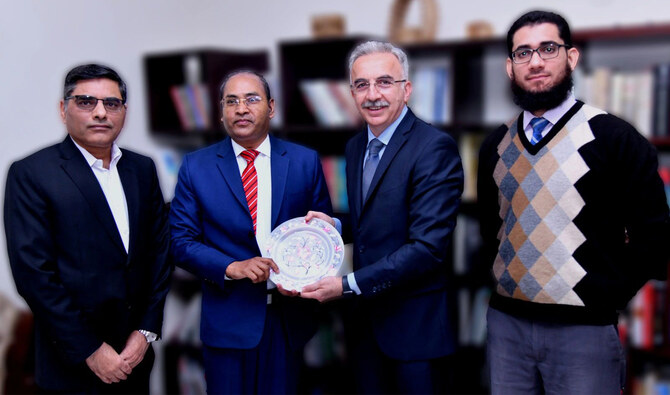
Sheryar Taj (second right), Secretary of Trade Development Authority of Pakistan, calls on the Deputy High Commissioner of Bangladesh in Karachi on January 6, 2025. (TDAP/Facebook)
Short Url
Updated 19 January 2025
Follow

Pakistan to send trade delegations to Bangladesh on Jan. 19, 20 amid thaw in ties

  • Pakistan to send business delegations of citrus, date fruits to Bangladesh next week
  • Trade exhibition to showcase Pakistan’s potential in Bangladeshi market, says organizer

ISLAMABAD: The Trade Development Authority of Pakistan (TDAP) said on Sunday it will send two trade delegations to Bangladesh from Jan. 19-20 in a bid to increase bilateral relations and economic collaboration, as both countries move to repair strained ties. 

Pakistan and Bangladesh were once one nation, but they split in 1971 as a result of a bloody civil war, which saw the part previously referred to as East Pakistan seceding to form the independent nation of Bangladesh.

In the years since, Bangladeshi leaders, particularly former prime minister Sheikh Hasina, chose to maintain close ties with India. Relations between Pakistan and Bangladesh have warmed up since Hasina’s ouster as a result of a student-led uprising in August 2024, witnessing a marked improvement.

The TDAP said that it would send two Pakistani trade delegations focusing on the trade of date fruits and citrus between the two countries.

“The first delegation of dates comprising 13 exporters will leave for a week-long visit on Jan. 19 while the second delegation of citrus will leave for a business-to-business (B2B) meeting on Jan. 20,” the TDAP said. 

It said the business delegations aimed to explore more trade opportunities, promote business partnerships and Pakistan’s export potential in the Bangladeshi market. 

Muhammad Zubair Motiwala, TDAP chief executive, said the authority planned to organize a trade exhibition in Bangladesh where Pakistani entrepreneurs will have a chance to showcase their products. 

“Pakistan is one of the top ten importers of Bangladesh, covering sectors such as textiles, agriculture, food, chemicals and basic metals, but there is still room for further expansion of these imports,” he said. 

He said both countries have been in talks for a Free Trade Agreement (FTA) since 2002, adding that it could pave the way for greater opportunities for the people of both countries. 

The development comes after Tuesday’s signing of a landmark agreement between Pakistan and Bangladeshi businesspersons to establish a joint business council between the two countries.

Pakistan’s Deputy Prime Minister Ishaq Dar is also scheduled to visit Dhaka at the start of February to further consolidate the relations between the two countries.


Pakistan to hold first anti-polio nationwide campaign of 2026 from Feb. 2

Updated 8 sec ago
Follow

Pakistan to hold first anti-polio nationwide campaign of 2026 from Feb. 2

  • Pakistan to target over 45 million children in first national anti-polio campaign of this year
  • Natural disasters, security issues have disrupted anti-polio vaccination campaigns in the past

ISLAMABAD: Pakistan will conduct its first nationwide anti-polio drive of the new year from Feb. 2, the National Emergency Operation Center (NEOC) said on Wednesday, vowing to vaccinate over 45 million children against the disease. 

Pakistan and neighboring Afghanistan are the only two countries where transmission of the wild poliovirus has never been interrupted, posing a risk to global eradication efforts. The virus, which can cause irreversible paralysis, has no cure and can only be prevented through repeated oral vaccination.

The NEOC said it conducted six nationwide campaigns against poliovirus last year, adding that they resulted in a “significant” reduction in cases from 74 in 2024 to 30 in 2025. 

“The first national polio campaign of 2026 will be conducted across the country from Feb. 2,” the NEOC said in a statement.

“During the campaign, over 45 million children will be administered polio drops.”

The NEOC said involvement of communities, religious leaders and the media has increased the public’s confidence in the government’s polio program. 

“Strong government leadership and effective institutional collaboration continue to play a key role in polio eradication,” it said. 

The authority urged parents to cooperate with polio teams and ensure their children receive polio drops. 

Health officials say insecurity remains a major obstacle. Polio workers and their security escorts have repeatedly been targeted in militant attacks, particularly in parts of the northwestern Khyber Pakhtunkhwa (KP) and Balochistan provinces, complicating efforts to reach every child.

A gun attack targeting a polio vaccination team in Pakistan’s northwestern Bajaur district last month left one police constable and a civilian dead.

Natural disasters, including flooding, have also disrupted vaccination campaigns in recent years.