

Pakistani neuroscientist accused of ‘terrorism’ calls for pardon before Biden leaves office

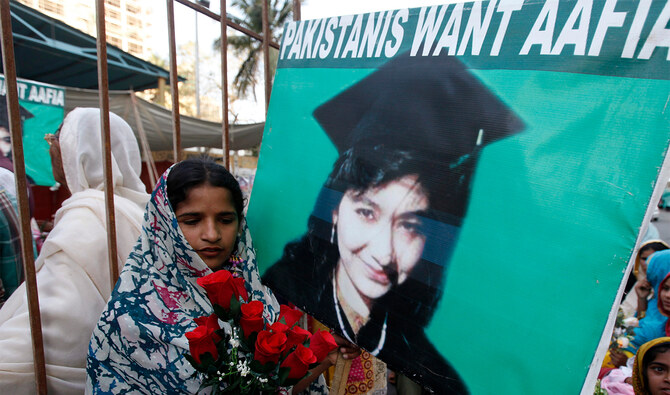
An Aafia Siddiqui supporter carries silk roses next to a poster during a celebration to mark Siddiqui's 41st birthday in Karachi March 2, 2014. (REUTERS/File)
Short Url
Updated 19 January 2025
Follow

Pakistani neuroscientist accused of ‘terrorism’ calls for pardon before Biden leaves office

  • Dr. Aafia Siddiqui was sentenced to 86 years in prison on multiple charges, including attempting to kill US nationals
  • Her lawyer has submitted a dossier to Biden, who has until Monday to grant clemency before Trump's swearing-in

KARACHI: A Pakistani neuroscientist accused of “terrorism” by Washington has appealed to outgoing US President Joe Biden to grant her clemency before he hands over the reins of the country to President-elect Donald Trump, her lawyer said this week.

Dr. Aafia Siddiqui, a US-trained neuroscientist, was convicted in 2010 on multiple charges, including attempting to kill US nationals. She became a suspect after leaving the US and marrying a nephew of Khalid Sheikh Mohammed, a self-proclaimed mastermind of the Sept. 11, 2001, attacks.

Siddiqui was wounded during a confrontation with US officials in Afghanistan in 2008, with some reports suggesting she shot at the Americans. She was sentenced to 86 years in prison in 2010, prompting a huge outcry from Pakistan and human rights voices worldwide.

Her family claims she was visiting Pakistan in 2003 when she was abducted with her three children by Pakistan’s premier intelligence agency and handed to the Central Intelligence Agency (CIA), which took her to Afghanistan. Pakistan’s intelligence agencies have denied the claims. 

Dr. Siddiqui’s lawyer, Clive Stafford Smith, has submitted a 76,500-word dossier to Biden and is calling on the American president to pardon him before Trump’s swearing-in on Monday.

“We just pray and keep our fingers crossed and I hope to goodness our clemency is granted Monday morning,” Smith told Arab News late Saturday night.

“And if not, revert to plan B and plan C and plan D until we get her out of this awful place,” he added.

Smith said Siddiqui was “in good spirits” when he met her on Friday at the detention facility in Fort Worth, Texas, for four hours despite her trauma. He said Dr. Fowzia Siddiqui, her sister, had traveled 10,000 miles to see her sister but was only allowed an hour and 40 minutes to see her sister.

Prime Minister Shehbaz Sharif also wrote a letter to Biden in October 2024, calling for Siddiqui’s release.

In the letter, Sharif stressed that several Pakistani officials had made consular visits to her in prison, raising “serious concerns” about her treatment while incarcerated.

The prime minister said her time in prison had “severely impacted her already fragile mental and frail physical health,” adding: “In fact, they [the officials] even fear that she could take her own life.”

Biden has until Monday to grant Siddiqui clemency. So far, he has issued 39 pardons and commuted 3,989 sentences.

According to Sky News, Smith claims a catalog of intelligence errors led to her initially becoming a suspect, citing witness testimonies that were unavailable at the time of her trial.

Smith said US intelligence “got the wrong end of the stick in the beginning” as agencies thought Siddiqui was a nuclear physicist working on a radioactive bomb “when she really did her PhD in education.”

He said this happened as the US was “terrified of terrorists getting their hands on WMD (weapons of mass destruction),” adding: “She’s no more of a terrorist than I am.”

The US Department of Justice did not respond to Sky News.


IMF staff to visit Pakistan Feb. 25 for key loan reviews as reforms stabilize economy

Updated 6 sec ago
Follow

IMF staff to visit Pakistan Feb. 25 for key loan reviews as reforms stabilize economy

  • Talks to cover third review under $7 billion bailout and climate resilience program
  • Analysts warn tax shortfall, power tariff cuts could face scrutiny by lender 

KARACHI: An International Monetary Fund (IMF) staff team will visit Pakistan from Feb. 25 to begin discussions on key program reviews, the lender said on Thursday, as authorities seek to lock in recent economic stabilization after a prolonged financial crisis.

The talks will cover the third review under Pakistan’s $7 billion Extended Fund Facility (EFF) bailout and the second review under the Resilience and Sustainability Facility (RSF), which supports countries dealing with climate vulnerabilities.

Pakistan has spent the past year implementing tough fiscal and structural reforms — including tax increases, subsidy cuts and a tighter monetary policy — to stabilize a fragile economy that faced record inflation, dwindling foreign reserves and default fears in 2023.

“We do have a staff team that is expected to visit Pakistan starting February 25th for discussions on the third review under the EFF and the second review under the RSF,” IMF communications director Julie Kozack said at a regular press briefing.

The IMF says the program aims to restore macroeconomic stability, rebuild external buffers and make Pakistan more resilient to climate shocks following devastating floods in recent years.

Kozack said Pakistan’s policy implementation had already produced measurable improvements.

“Pakistan’s policy efforts under the EFF have helped stabilize the economy and rebuild confidence,” she said.

She noted fiscal indicators were improving in line with program targets.

“Pakistan currently has a primary fiscal surplus of 1.3 percent of GDP in FY25, which was in line with program targets. Headline inflation has been relatively contained. And Pakistan posted its first current account surplus in 14 years in FY2025.”

Pakistani authorities have also cited improving macroeconomic trends. 

Governor State Bank of Pakistan Jameel Ahmad has said growth could reach about 4.75 percent in the fiscal year ending June, while inflation, which peaked above 38 percent in May 2023, has fallen sharply over the past year following interest rate hikes and fiscal tightening.

The IMF official added that governance reforms remain a major component of the program.

“The governance and corruption diagnostic assessment report was recently published,” Kozack said.

“It includes proposals for reforms, including simplifying tax policy design, levelling the playing field for public procurement, and improving the asset declaration transparency.”

The upcoming review will determine whether Pakistan remains eligible for continued disbursements under the bailout program and help reinforce investor confidence.

Analysts say the review is likely to pass but may involve difficult negotiations on fiscal discipline and energy policy.

“This is expected to be a smooth sailing, however questions might arise,” Shankar Talreja, head of research at Karachi-based Topline Securities Limited, told Arab News.

Experts say the IMF could question whether Islamabad consulted the lender before reducing electricity tariffs by about Rs4 per unit for export-oriented industries, a move designed to support manufacturing but with fiscal implications.

He also flagged a revenue gap.

“Pakistan has missed” the IMF’s revenue target by Rs336 billion ($1.2 billion), he said.

“Tax revenue shortfall which is one of the indicative targets which Pakistan has missed.”

Muhammad Waqas Ghani, head of research at JS Global Capital Limited., said the next review may be “tough”:

“Although (Pakistan’s) macroeconomic indicators have improved since the start of the program, the IMF is still expected to press firmly on energy reforms and circular debt before clearing the next tranche, which the government is likely to secure after tough negotiations.”