El-Sisi highlights Egypt’s commitment to Libyan unity

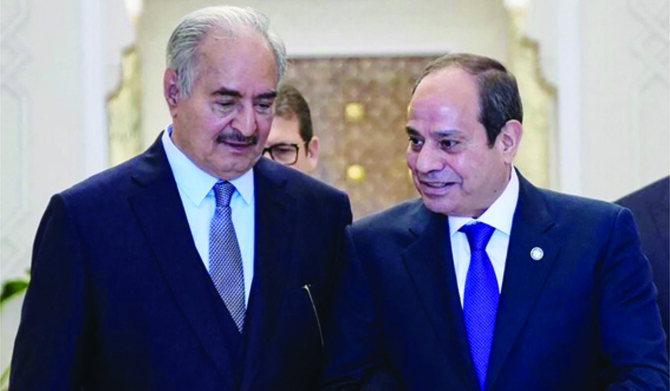
A handout picture released by the Egyptian Presidency on January 18, 2025, shows Egypt's President Abdel Fattah El-Sisi (R) receiving Libyan military strongman Khalifa Haftar in Cairo. (AFP)
Short Url
Updated 18 January 2025
Follow

El-Sisi highlights Egypt’s commitment to Libyan unity

  • Haftar’s last visit to Cairo was a few months before nationwide parliamentary and presidential elections that were later delayed due to disagreements over their legal framework

CAIRO: Egyptian President Abdel Fattah El-Sisi on Saturday hosted Libyan military leader Khalifa Haftar for their first meeting since September 2021.
El-Sisi’s office said that during their talks, he stressed Egypt’s commitment to “ensuring the unity and cohesion of Libya’s national institutions.”
He also urged “coordination between all Libyan parties to crystallize a comprehensive political roadmap” toward long-overdue parliamentary and presidential elections.
Haftar’s last visit to Cairo was a few months before nationwide parliamentary and presidential elections that were later delayed due to disagreements over their legal framework.
Libya, which borders Egypt to the east, is struggling to recover from years of conflict after the 2011 NATO-backed uprising that ended dictator Muammar Qaddafi’s four-decade rule.
The country remains split between the UN-recognized government of Prime Minister Abdul Hamid Dbeibah in Tripoli and Haftar’s authority in the east.
El-Sisi on Saturday said “all foreign forces and mercenaries must be expelled from Libyan territory.”


Syrian government vows to protect Kurds in Aleppo, accuses SDF of planting explosives

Updated 4 sec ago
Follow

Syrian government vows to protect Kurds in Aleppo, accuses SDF of planting explosives

  • Kurdish-led group targeting neighborhoods with mortars, machine guns, Ministry of Defense says
  • Army declares Ashrafieh, Sheikh Maqsoud ‘closed military zone’ after hundreds of civilians evacuated

LONDON: The Syrian government on Wednesday affirmed its commitment to protect all citizens, including Kurds, as armed tensions in Aleppo between the Syrian army and the Kurdish-led Syrian Democratic Forces continued for a fourth day.

The Ministry of Defense accused the SDF of planting explosives on roads and setting booby traps in the Sheikh Maqsoud and Ashrafieh neighborhoods, and bombarding them with mortar shells and heavy machine gun fire.

The army designated the two neighborhoods a “closed military zone” after the Syrian Arab Red Crescent evacuated 850 civilians from the area.

The government said in a statement that the SDF played no role in the city’s security and military affairs.

“This confirms that the exclusive responsibility for maintaining security and protecting residents falls upon the Syrian state and its legitimate institutions, in accordance with the constitution and applicable laws,” it said.

Protecting all citizens, including Kurds, was a non-negotiable responsibility upheld without discrimination based on ethnicity or affiliation, it said.

It also rejected any portrayal of its security measures as targeting a specific community, according to the Syrian Arab News Agency.

“The authorities concerned stress that those displaced from areas of tension are exclusively civilians, all of them Kurdish citizens who left their neighborhoods out of fear of escalation,” the statement said.

“They sought refuge in areas under the control of the state and its official institutions, which clearly demonstrates the trust of Kurdish citizens in the Syrian state and its ability to provide them with protection and security and refutes claims alleging that they face threats or targeted actions.”

The government called for the withdrawal of armed groups from Aleppo.

At least three civilians and a Syrian soldier have been killed and dozens more injured in Aleppo since Tuesday. Authorities have accused the SDF of targeting medical and educational facilities.

The escalation in violence has dealt a blow to an agreement between the two sides that was meant to be implemented by the end of last year.

The Syrian government reached an agreement with the SDF in March that included plans to integrate the group’s military, territory and natural resources, including oil fields, into the new government in Damascus.