

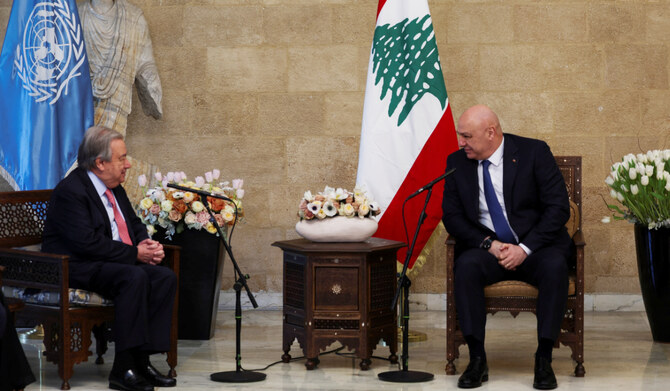

BEIRUT: Lebanon’s President Joseph Aoun stressed to UN Secretary-General Antonio Guterres on Saturday the urgency of an Israeli military withdrawal as stipulated by a ceasefire deal that ended the Israel-Hezbollah war in November.
President Aoun told the visiting UN chief that it was necessary for “Israeli forces to withdraw from occupied territories in the south within the deadline set by the agreement reached on Nov. 27.”
Aoun also highlighted “the readiness of the Lebanese army to replace the Israelis once they withdraw” from the Lebanese border area, which was invaded on Oct. 1.
“Israel’s continued violations on land and in the air ... blowing up homes and destroying border villages, completely contradicts what was stated in the ceasefire agreement,” a statement from Aoun’s office added.
Aoun said that the Israeli breaches were “a continued violation of the Lebanese sovereignty and the international community’s will to restore stability in southern Lebanon.”
Guterres inspected the Blue Line and met UN peacekeepers carrying out their operations south of the Litani River.
On his second day in Lebanon on Saturday, he conveyed to Lebanese officials the UN’s “continued commitment to support the Lebanese army and the Lebanese institutions, as well as President Aoun in his tenure.”
Guterres said that he would “do everything possible to secure the withdrawal of the Israeli forces from the south within the specified period.”
According to the presidential palace’s media office, Guterres said: “I am confident that under your leadership, things will go back to normal in Lebanon, and the country will regain its strength and stability in the region.”
He added: “It is true that your mission is not easy, but a solid will can achieve what we’re aiming for.”
Guterres reiterated “the support of the UN and all its institutions for Lebanon.”
He said: “We have the will to mobilize to secure the international community’s support so Lebanon can rise again and recover from the repercussions of the last years.”
According to the president’s media office, Aoun “tackled Israel’s burning of cultivated lands in southern Lebanon.”
He called on “the UN, namely the Food and Agriculture Organization, to help farmers restore their lands and make them investment-ready.”
Aoun also urged the UN to “help secure the return of the Syrian refugees to their country since the political and security reasons for their asylum are no longer valid.”
Following the meeting, Guterres said: “It was an opportunity to express our solidarity with the people of Lebanon who have suffered so much and our total support to the president and the future government.”
He added: “Now, it will be possible to consolidate the Lebanese institutions, and it will be possible to create the conditions for the Lebanese state to protect its citizens fully.
“With the withdrawal of the Israeli forces and with the presence of the Lebanese army in the whole of the Lebanese territory, it will also be possible to open a new chapter of peace.”
Guterres said: “I know that the Lebanese are dynamic, resilient and courageous.
“And I know that reconstruction begins as soon as a conflict ends.
“I want to express our total support and our will to fully mobilize the international community to provide Lebanon with all the support for what we believe will be a speedy recovery of this country, making it again the center of the Middle East.”
Guterres visited Prime Minister-designate Nawaf Salam at his residence.
After the meeting, Guterres reiterated the UN’s “full support for the ongoing process in Lebanon, where the country has witnessed the election of a new president and a new prime minister tasked with forming a government.
“New opportunities are emerging for Lebanon with the completion of the ceasefire agreement, the withdrawal of Israeli forces, and the Lebanese armed forces assuming full responsibilities entrusted to them,” he said.
“We are convinced this development will represent an extraordinary qualitative leap for Lebanon.
“The UN fully supports the president and the Lebanese government in mobilizing the international community to provide comprehensive support for Lebanon, which must regain its status as a pivotal center in the Middle East.”
Salam said that he relied on the secretary-general “to mobilize diplomatic support to ensure the Israelis’ withdrawal on the scheduled day and to rally efforts for the reconstruction conference mentioned by French President Emmanuel Macron during his visit to Lebanon on Friday, which will be held soon.”
Salam added: “With the changing situation in Syria, we need to begin preparations with the UN for the safe and dignified return of Syrian refugees in Lebanon.”
The UN chief also met Lebanese Parliament Speaker Nabih Berri.
He confirmed the UN’s support for Lebanon. He said that the government would “soon be formed, representing all Lebanese parties, and the Israeli army must withdraw after the set deadline.”
Berri’s media office reported that he highlighted “the necessity for Israel to adhere to its withdrawal from Lebanese territories that it still occupies, under the terms of the agreement, and to halt its violations and systematic destruction of villages, fields, agricultural lands, and forests.”
Meanwhile, Israeli forces continued their violations in the south through incursions and bulldozing operations in the Marjeyoun plain and the towns of Yaroun and Mays Al-Jabal, as well as extensive operations in Wadi Saluki and the storming of homes west of the town of Houla.
The Red Cross and the Lebanese army have not yet been able to search for three people targeted by an Israeli drone three days ago in the Jabal Sadana area, pending the results of UNIFIL’s communications with the Israeli side.
The UN chief emphasized to the UNIFIL forces during a meeting in Naqoura on Friday the importance of “enabling them to resume patrols and monitoring tasks,” stressing that “adapting operational methods is crucial for restoring freedom of movement and access throughout the UNIFIL operational area.”


