


Noman and Sajid give Pakistan lead in spin-dominated first Test

Short Url
Updated 18 January 2025
Follow

Noman and Sajid give Pakistan lead in spin-dominated first Test

  • Noman grabbed 5-39 for his seventh five-wicket haul in Tests, Sajid finished with 4-65
  • Pakistan earlier lost their last six wickets for 43 runs after resuming the day at 143-4

MULTAN: Spin pair Noman Ali and Sajid Khan shared nine wickets between them to give Pakistan a 93-run lead on the second day of the opening Test against West Indies in Multan on Saturday.
Noman grabbed 5-39 for his seventh five-wicket haul in Tests, while Sajid finished with 4-65 to dismiss the West Indies for 137 after lunch in a first innings that lasted just 25.2 overs.
Pakistan earlier lost their last six wickets for 43 runs after resuming at 143-4 and were bowled out for 230 in their first innings.
The dry and grassless Multan pitch has already produced 20 wickets in five sessions even though two-and-a-half hours were lost on day one, and another 30 minutes on Saturday, because of poor visibility.
Noman and Sajid, who shared 39 of the 40 wickets in the last two Tests against England in Pakistan’s 2-1 series win last year, were once again unplayable.

Sajid opened the bowling and removed Mikyle Louis (one), Keacy Carty (0), Kraigg Brathwaite (11) and Kavem Hodge (four) in his first three overs.


Pakistan’s Said Khan (center) celebrates with teammates after taking the wicket of West Indies Mikyle Louis during the day two of the first Test cricket match between Pakistan and West Indies, in Multan on January 18, 2025. (AP)

Noman then further jolted the tourists with another four wickets to leave them on 66-8.
The tail-enders showed more resistance, with number 10 batsman Jomel Warrican unbeaten on 31, with Gudakesh Motie adding 19 and Jayden Seales the last wicket to fall for 22.
Seales hit three sixes before holing out off spinner Abrar Ahmed.
Warrican also took 3-69 in Pakistan’s innings.
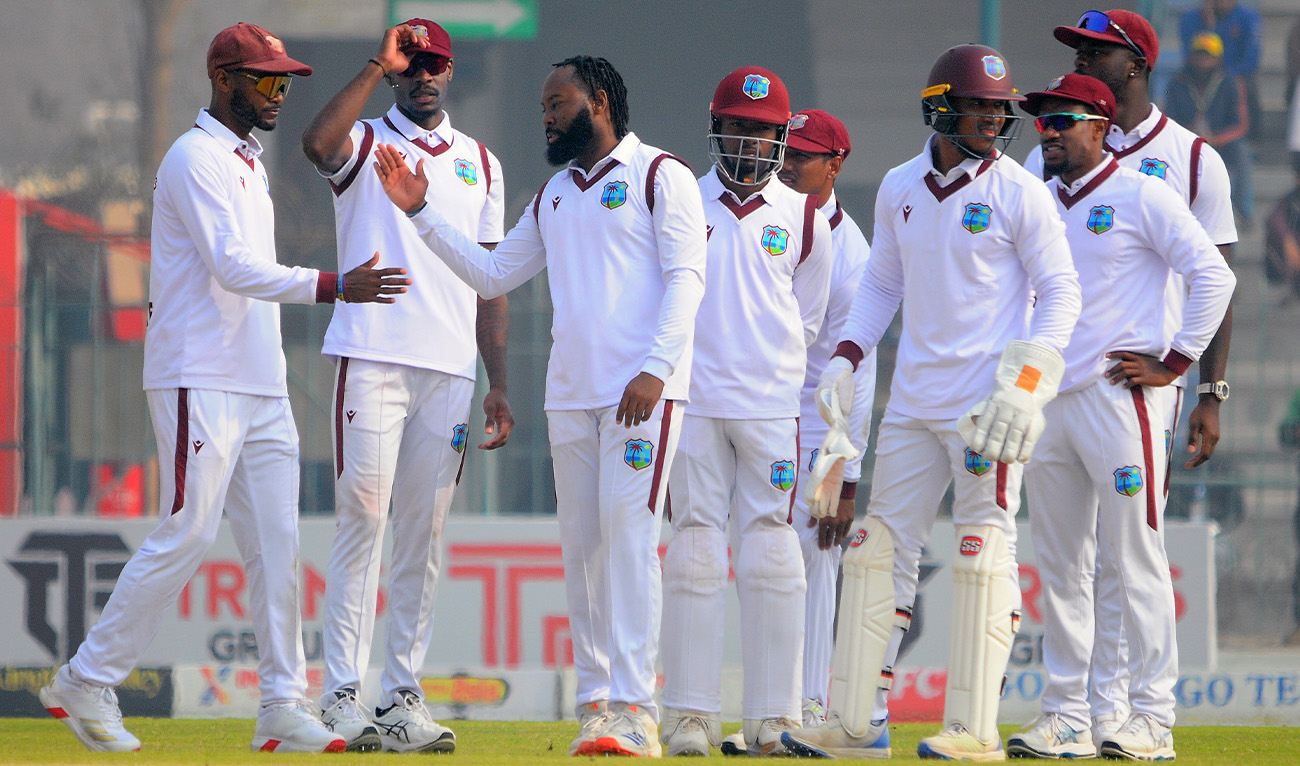


West Indies Jomel Warrican (third left) celebrates with teammates after taking the wicket of Salman Ali Agha during the second day of the first Test match against Pakistan in Multan, Pakistan, on January 18, 2025. (PCB)

Saud Shakeel top-scored for Pakistan with 84 off 157 deliveries, including six boundaries, while keeper Mohammad Rizwan added 71.
Shakeel added an invaluable 141 for the fifth wicket with Rizwan, lifting Pakistan from a precarious 46-4 on day one.
Kevin Sinclair sparked the Pakistan batting collapse by taking Shakeel’s wicket with the first ball after drinks.
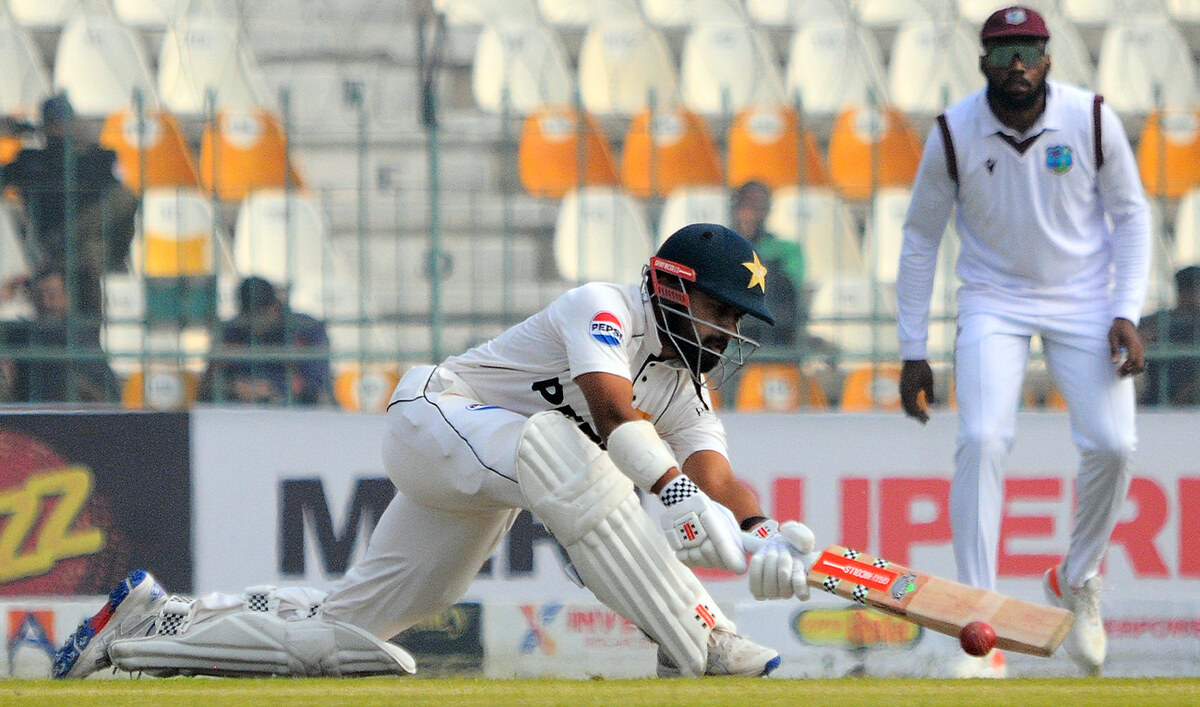


Pakistan’s Saud Shakeel, center, plays a shot during the day two of the first test cricket match between Pakistan and West Indies, in Multan on January 18, 2025. (AP)

He then trapped Rizwan leg-before off a missed reverse sweep, the original decision of not out overturned on review.
Rizwan’s 133-ball stay included nine boundaries.
Sajid hit a boundary and a six in a rapid-fire 18 before he was bowled by Warrican on the stroke of lunch to end Pakistan’s innings.


Punjab expands Pakistan-India Wagah border arena with museum, partition-themed park

Updated 4 sec ago
Follow

Punjab expands Pakistan-India Wagah border arena with museum, partition-themed park

  • The border crossing, near eastern city of Lahore, is the primary land route between Pakistan and India and one of the most recognizable symbols of their often-tense relations
  • The site is best known for its daily flag-lowering ceremony, a choreographed military ritual performed by border forces from both countries that draws thousands of spectators

ISLAMABAD: Maryam Nawaz, chief minister of Pakistan’s Punjab province, on Thursday inaugurated the newly constructed arena at Wagah border cross between Pakistan and India, which includes a museum and a partition themed park.

The Wagah border crossing, located near the eastern city of Lahore, is the primary land route between Pakistan and India and one of the most recognizable symbols of the often-tense relationship between the two neighbors. It serves as a key point for prisoner exchanges and limited movement of travelers, while remaining tightly regulated due to security considerations.

The site is best known for its daily flag-lowering ceremony, a choreographed military ritual performed by border forces from both countries that draws thousands of spectators. Over the years, the ceremony has evolved into a popular tourist attraction, blending displays of nationalism with public spectacle and making it one of Pakistan’s most visited landmarks, which connects with India’s Attari.

Flanked by military officials, CM Nawaz visited the crossing and inaugurated the new arena, with its seating capacity increased from 7,500 to 25,000 spectators, the state-run Radio Pakistan broadcaster reported. The chief minister also visited the martyrs’ monument and offered her respects.

“In addition to the arena’s expansion, several new constructions have been added at the Joint Check Post Wagah. These new developments include a theme park depicting the partition of the Subcontinent, featuring models of a railway station, military equipment and a Martyrs’ Memorial,” the broadcaster reported.

“A Pakistan Museum has also been established within the arena, showcasing the country’s history and culture from the Freedom Movement to the present day.”

In August 1947, Britain divided the Indian Sub-continent, its former colony, into two countries — Hindu-majority India and Muslim-majority Pakistan.

Excitement over independence was quickly overshadowed by some of the worst bloodletting that left up to 1 million people dead as gangs of Hindus and Muslims slaughtered each other.

Creating two independent nations also tore apart millions of Hindu and Muslim families in one of the world’s largest peacetime migrations, which displaced at least 15 million people.

The fate of Kashmir, then a princely state, was left undecided. The Himalayan territory continues to remain a flashpoint in relations between the neighbors, who have fought multiple wars over it.
