

‘Proud moment’ as Pakistan launches first indigenous satellite to predict natural disasters

People watch a screen displaying the launch of Pakistan's indigenous Electro-Optical (EO-1) satellite from the Jiuquan Satellite Launch Centre (JSLC) in northern China, at the Pakistan Space and Upper Atmosphere Research Commission (SUPARCO) Complex in Karachi, Pakistan on January 17, 2025. (REUTERS)
Short Url
Updated 17 January 2025
Follow

‘Proud moment’ as Pakistan launches first indigenous satellite to predict natural disasters

  • PM Sharif praises all Pakistani scientists and engineers working on the project for their team effort
  • The country’s military calls the development ‘a momentous milestone in Pakistan’s space journey’

ISLAMABAD: Prime Minister Shehbaz Sharif called it a “proud moment” for the nation as China launched Pakistan’s first indigenously developed Electro-Optical (EO-1) satellite into space on Friday, aiming to monitor mineral resources and predict natural disasters.
The EO-1 satellite was launched from China’s Jiuquan Satellite Launch Center, following work by Pakistan’s Space and Upper Atmosphere Research Commission (SUPARCO) to advance the country’s technological capabilities in space science.
The satellite is expected to enhance Pakistan’s ability to manage natural resources, predict and respond to floods and other disasters, support food security and drive economic growth through informed decision-making and sustainable development.
“Soaring higher and higher! Proud moment for the nation as [Pakistan] proudly launches its first indigenous Electro-Optical (EO-1) satellite from the Jiuquan Satellite Launch Center, China,” Sharif said in a social post on X, formerly Twitter.



Pakistan's indigenous Electro-Optical (EO-1) satellite launched from the Jiuquan Satellite Launch Centre (JSLC) in northern China on January 17, 2025. (PMO)

“From predicting crop yields to tracking urban growth, #EO1 is a leap forward in our journey towards progress,” he continued, praising SUPARCO and all the scientists and engineers involved in the project for their team effort.
According to China’s state-run Xinhua news agency, the satellite was launched at 12:07 p.m. Beijing time aboard a Long March-2D carrier rocket and successfully entered its planned orbit.
The Pakistani military also applauded the development, highlighting its wide-ranging applications across various sectors.
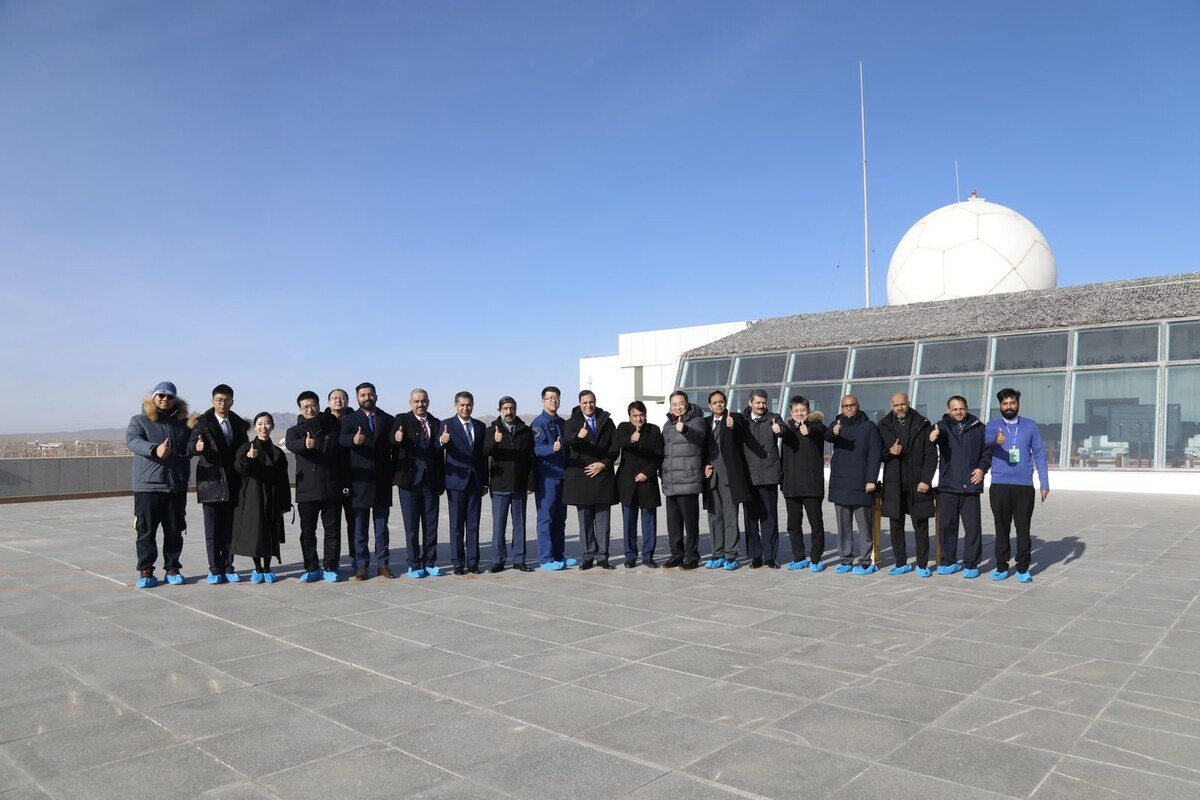


Officials gesture for a group photograph following the launch of Pakistan's indigenous Electro-Optical (EO-1) satellite from the Jiuquan Satellite Launch Centre (JSLC) in northern China on January 17, 2025. (PMO)

“In agriculture, it will enable precision farming by monitoring crops, assessing irrigation needs, predicting yields, and supporting food security initiatives,” the military media wing, the Inter-Services Public Relations (ISPR), said in a statement, calling the development a “momentous milestone in Pakistan’s space journey.”
“For urban development planning, the satellite will assist in tracking infrastructure growth and managing urban sprawl,” it added.
Among its other roles, the EO-1 will aid in the extraction and conservation of natural resources such as minerals, oil and gas. Additionally, it will help monitor glacier recession and water resources.
Pakistan has made significant progress in its space research program. Last year, SUPARCO announced its rover would join China’s Chang’E 8 mission to explore the moon’s surface in 2028.
“This achievement positions advanced space technology capabilities at the forefront of national progress,” ISPR added in the statement after the satellite launch, emphasizing its role in furthering Pakistan’s ambitions in space exploration.


Pakistan launches final nationwide polio drive of 2025 to vaccinate 45 million children

Updated 4 sec ago
Follow

Pakistan launches final nationwide polio drive of 2025 to vaccinate 45 million children

  • Campaign comes as Pakistan records 30 polio cases this year, one of only two countries where virus is endemic
  • Health minister urges parents to welcome vaccinators as insecurity, misinformation hinder eradication efforts

ISLAMABAD: Pakistan on Thursday launched its final polio vaccination campaign of the year, with Health Minister Mustafa Kamal administering drops to children under five as part of a nationwide effort to reach 45 million children, the country’s polio program said.

The Dec. 15–21 drive is part of Pakistan’s decades-long struggle to eliminate wild poliovirus. Pakistan and neighboring Afghanistan are the only two countries where the virus remains endemic, keeping global eradication efforts at risk.

Pakistan has reported 30 polio cases so far this year. The incurable and highly infectious virus can cause lifelong paralysis and can only be prevented through repeated oral vaccinations and routine immunization, health officials say.

“I want to take this opportunity to speak directly to parents and caregivers. When our polio vaccinator knocks at your door, I urge you to welcome them in and ensure that every child under five in your house receives two drops of this essential vaccine,” the polio program quoted Health Minister Kamal as saying.

“I also urge you to advocate for vaccination in your families and communities and create a welcoming environment for our vaccinators.”

The new campaign comes days after Pakistan conducted a nationwide measles, rubella and polio vaccination drive from Nov. 17–29, which targeted 22.9 million children across 89 high-risk districts.

Pakistan recorded 74 polio cases in 2024, a steep rise from six in 2023 and just one in 2021, underscoring the volatility of eradication efforts in a country where misinformation, vaccine hesitancy and political instability have repeatedly disrupted progress.

Violence has also hampered the program. Polio teams and their security escorts have been attacked frequently by militants and religious hard-liners in parts of northwestern Khyber Pakhtunkhwa and southwestern Balochistan. Officials say continued security threats, coupled with natural disasters such as recent flooding, pose major obstacles to reaching every child.

Pakistan has drastically reduced polio prevalence since the 1990s, when annual cases exceeded 20,000. By 2018, the number had fallen to eight. But health authorities warn that without consistent access to children, particularly in high-risk, underserved region, eradication will remain out of reach.