

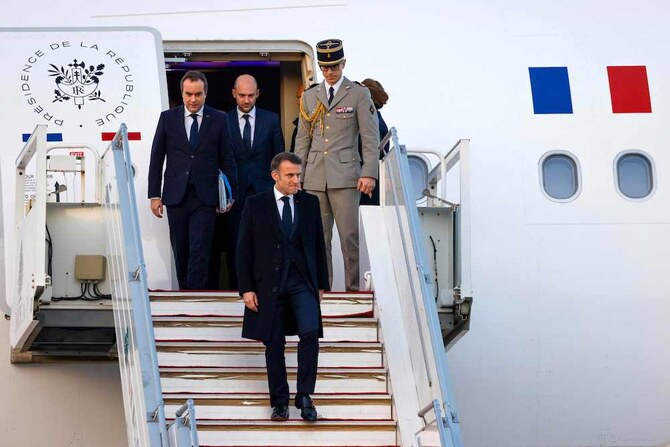

BEIRUT: France’s President Emmanuel Macron arrived in Beirut on Friday for a visit that will see him meet his counterpart and offer support as Lebanon’s leaders seek to open a new chapter in their country’s turbulent history.
After more than two years of a political vacuum at the top, Joseph Aoun was elected president on January 9 and chose Nawaf Salam as prime minister-designate.
They now face the daunting task of leading Lebanon after a devastating Israel-Hezbollah war and years of economic crisis.
Macron is also expected to meet UN Secretary-General Antonio Guterres in the Lebanese capital as a January 26 deadline to fully implement an Israel-Hezbollah ceasefire deal approaches.
Macron’s visit aims to “help” Aoun and Salam “to consolidate Lebanon’s sovereignty, ensure its prosperity and maintain its unity,” the French presidency said prior to his arrival.
Analysts say Hezbollah’s weakening in the war with Israel last year allowed Lebanon’s deeply divided political class to elect Aoun and to back his naming of Salam as premier.
France has special ties with Lebanon, which it administered for two decades after World War I, and the two countries have maintained close relations even since Lebanon’s independence in 1943.
Macron and Saudi Crown Prince Mohammed bin Salman have given “their full support” to the formation of a “strong government” in Lebanon, the French presidency said on Thursday after a call between the two leaders.
The new government must “bring together Lebanon’s diverse people, ensure the ceasefire between Israel and Lebanon is respected and carry out the reforms necessary for the prosperity, stability and sovereignty of the country,” the presidency said.
Macron is also set to meet Lebanon’s powerful speaker of parliament Nabih Berri, a Hezbollah ally.
He will also meet UNIFIL chief Aroldo Lazaro and the heads of a committee comprising Israeli, Lebanese, French and US delegates, alongside a UNIFIL representative, tasked with monitoring ceasefire violations.
Under the November 27 ceasefire accord, the Lebanese army has 60 days to deploy alongside UN peacekeepers in the south of Lebanon as the Israeli army withdraws.
At the same time, Hezbollah is required to pull its forces north of the Litani river, around 30 kilometers (20 miles) from the border, and dismantle any remaining military infrastructure it has in south Lebanon.
After an aid conference in Paris in October, France’s presidency promised “symbolic gestures” to mobilize the international community to come to Lebanon’s assistance.


