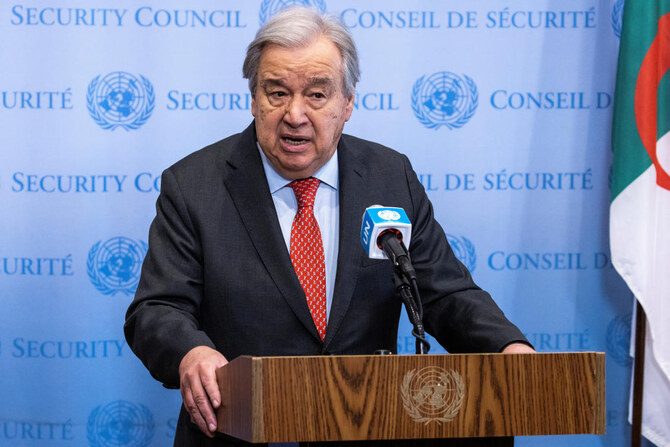
BEIRUT: UN Secretary-General Antonio Guterres arrived in Lebanon Thursday on a “visit of solidarity,” he said, after a long-stalled presidential election and a devastating war between armed group Hezbollah and Israel.
“I have arrived in Beirut on a visit of solidarity with the Lebanese people,” Guterres posted on X.
“A window has opened for a new era of institutional stability with a state fully able to protect its citizens and a system that would allow the tremendous potential of the Lebanese people to flourish,” he added.
“We will do everything to help keep that window open wide.”
His deputy spokesman Farhan Haq said Guterres would meet political officials and visit UN peacekeepers in southern Lebanon during his trip which would last until Saturday.
Lebanon’s deeply divided political class last week finally elected a new president, Joseph Aoun, after two years of deadlock.
Aoun on Monday named Nawaf Salam, until recently the presiding judge at the International Court of Justice in The Hague, to form a government.
Since Wednesday Salam has been consulting political parties ahead of drawing up a list of cabinet members.
Guterres is visiting the country as the deadline approaches for full implementation of a November 27 ceasefire between Hezbollah and Israel in southern Lebanon.
Under the truce, which ended two months of all-out war between both sides, the Lebanese army is to deploy alongside UN peacekeepers in the south as the Israeli army withdraws before January 26.
Hezbollah is due to pull its forces north of the Litani River, some 30 kilometers (20 miles) from the border with Israel, and dismantle any remaining military infrastructure in south Lebanon.


![]()

UN’s Guterres in Lebanon on ‘visit of solidarity’
Short Url
https://arab.news/bbyau
UN’s Guterres in Lebanon on ‘visit of solidarity’
- Guterres will meet political officials and visit UN peacekeepers in southern Lebanon during his trip which will last until Saturday


Latest updates


Recommended


© 2026 SAUDI RESEARCH & PUBLISHING COMPANY, All Rights Reserved And subject to Terms of Use Agreement.