DOHA/CAIRO/JERUSALEM: Israel airstrikes killed at least 77 people in Gaza overnight on Thursday, residents and authorities in the enclave said, hours after a ceasefire and hostage release deal was announced to bring an end to 15 months of war between Israel and Hamas.
The complex ceasefire accord emerged on Wednesday after mediation by Qatar, Egypt and the US to stop the war that has devastated the coastal territory and inflamed the Middle East.
The deal, scheduled to be implemented from Sunday, outlines a six-week initial ceasefire with the gradual withdrawal of Israeli forces from the Gaza Strip, where tens of thousands have been killed. Hostages taken by militant group Hamas, which controls the enclave, would be freed in exchange for Palestinian prisoners detained in Israel.
The deal also paves the way for a surge in humanitarian aid for Gaza, where the majority of the population has been displaced and is facing acute food shortages, food security experts warned late last year.
Rows of aid trucks were lined up in the Egyptian border town of El-Arish waiting to cross into Gaza, once the border is reopened.
Israel’s acceptance of the deal will not be official until it is approved by the country’s security cabinet and government, and a vote was slated for Thursday, an Israeli official said.
However, Israeli Prime Minister Benjamin Netanyahu has delayed the meeting, accusing Hamas of making last-minute demands and going back on agreements.
“The Israeli cabinet will not convene until the mediators notify Israel that Hamas has accepted all elements of the agreement,” a statement from Netanyahu’s office said.
Hamas senior official Izzat el-Reshiq said on Thursday the group is committed to the ceasefire agreement announced by mediators on Wednesday.
Hard-liners in Netanyahu’s government were still hoping to stop the deal, though a majority of ministers were expected to back it.
Finance Minister Bezalel Smotrich’s Religious Zionism Party said in a statement that its condition for remaining in the government would be a return to fighting at the end of the first phase of the deal, in order to destroy Hamas and bring all the hostages back. Far-right police minister Itamar Ben-Gvir has also threatened to quit the government if the ceasefire is approved.
In Jerusalem, some Israelis marched through the streets carrying mock coffins in protest at the ceasefire, blocking roads and scuffling with police.
Despite the hold-up to the cabinet meeting, political commentators on Israel’s public broadcaster Kan said the latest delay would likely be resolved and that the ceasefire was a done deal.
The White House also downplayed reports of a snag in the ceasefire deal on Thursday. Jonathan Finer, the deputy national security adviser, said in an interview with CNN: “We fully expect the deal to be implemented as described by the president and by the mediators — Egypt and Qatar — yesterday and on the timeline that was described. What we’re doing now is working through details of implementation.”
Calls for faster implementation
For some Palestinians, the deal could not come soon enough.
“We lose homes every hour. We demand for this joy not to go away, the joy that was drawn on our faces — don’t waste it by delaying the implementation of the truce until Sunday,” Gazan man Mahmoud Abu Wardeh said.
The accord requires 600 truckloads of humanitarian aid to be allowed into Gaza every day of the ceasefire, with 50 carrying fuel. The first phase of the agreement will also see Israel releasing more than 1,000 Palestinian prisoners, including many long-serving inmates.
Israelis may find it hard to see Palestinian militants who were serving life sentences for their involvement in deadly attacks in their country, set free.
But successive surveys have shown broad support among the public for a deal that would see the hostages released, even at what is seen as a heavy price.
“This has to be the only choice that we take in order to continue surviving as a state and as a nation, knowing that we will do anything to save each other,” said Jerusalem resident Chava Treitel.
While people celebrated the pact in Gaza and Israel, Israel’s military conducted more attacks, the civil emergency service and residents said.
Gaza’s health ministry said at least 81 people had been killed over the past 24 hours and about 188 injured. The Palestinian Civil Emergency Service said at least 77 of those were killed since the ceasefire announcement.
The Israeli military is looking into the reports, a military spokesperson said.
Israel secured major gains over Iran and its proxies, mainly Hezbollah, as the Gaza conflict spread. In Gaza, however, Hamas may have been crippled, but without an alternative administration in place, it has been left standing.
If successful, the ceasefire will halt fighting that has razed much of heavily urbanized Gaza, killed over 46,000 people, and displaced most of the tiny enclave’s pre-war population of 2.3 million, according to Gaza authorities.
That in turn could defuse tensions across the wider Middle East.
With 98 foreign and Israeli hostages remaining in Gaza, phase one of the deal entails the release of 33 of them, including all women, children and men over 50.
Global reaction to the ceasefire was enthusiastic.
Israel launched its campaign in Gaza after Hamas-led gunmen burst into Israeli border-area communities on Oct. 7, 2023, killing 1,200 soldiers and civilians and abducting over 250 hostages, according to Israeli tallies.
Negotiations on implementing the second phase of the deal will begin by the 16th day of phase one, and this stage was expected to include the release of all remaining hostages, a permanent ceasefire and the complete withdrawal of Israeli forces from Gaza.
The third stage is to address the return of all remaining dead bodies and the start of Gaza’s reconstruction supervised by Egypt, Qatar and the United Nations.


![]()
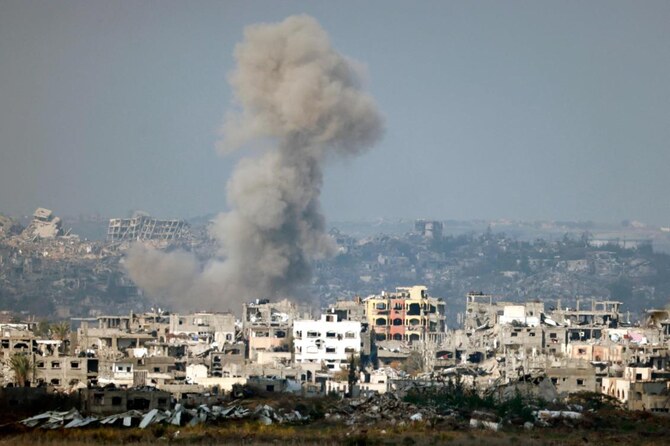
Death toll in Israeli strikes on Gaza since ceasefire deal rises to 77, residents say
Short Url
https://arab.news/48m7c
Death toll in Israeli strikes on Gaza since ceasefire deal rises to 77, residents say
- Israel’s acceptance of the deal will not be official until it is approved by the country’s security cabinet and government
- Netanyahu has delayed the meeting, accusing Hamas of making last-minute demands and going back on agreements

Latest updates


© 2026 SAUDI RESEARCH & PUBLISHING COMPANY, All Rights Reserved And subject to Terms of Use Agreement.