

US imposes fresh round of sanctions against Russia ahead of Trump return to White House

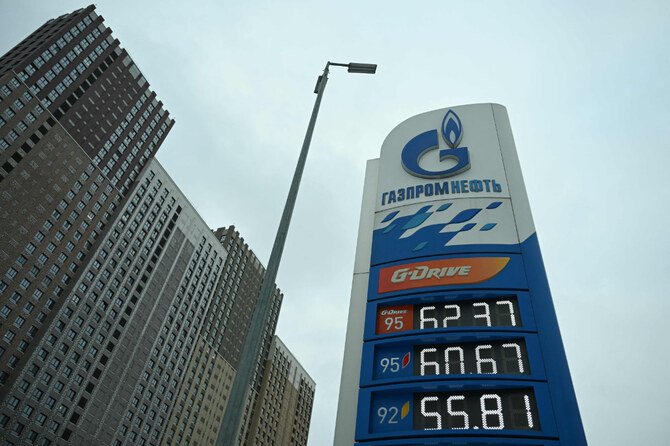
A view shows a petrol station of the Russian oil producer Gazprom Neft in Moscow on January 13, 2025. (AFP)
Short Url
Updated 16 January 2025
Follow

US imposes fresh round of sanctions against Russia ahead of Trump return to White House

  • Sanctions target Russia’s military industrial base and evasion schemes
  • Congressional approval required to lift some sanctions on critical Russian entities
  • China-based entities, Kyrgyzstan financial institution among targets

WASHINGTON: The United States on Wednesday imposed hundreds of sanctions targeting Russia, seeking to increase pressure on Moscow in the Biden administration’s final days and protect some sanctions previously imposed.
The US State and Treasury departments imposed sanctions on over 250 targets, including some based in China, taking aim at Russia’s evasion of US sanctions and its military industrial base.
As part of the action, the Treasury imposed new curbs on almost 100 entities that were already under sanctions, potentially complicating any future efforts to remove the measures.
Russia’s embassy in Washington did not immediately respond to requests for comment.
The Treasury in a statement said Washington was imposing fresh sanctions on almost 100 critical Russian entities — including Russian banks and companies operating in Russia’s energy sector — that were previously sanctioned by the United States. It said the move increases secondary sanctions risk for them.
The new sanctions are issued under an executive order that a senior Treasury official said requires Congress to be notified before any of the actions can be reversed.
Jeremy Paner, a partner at the law firm Hughes Hubbard & Reed, said the actions are “Trump-proofed,” preventing reversal of the additional sanctions without congressional approval.
“You can’t just with the stroke of a pen remove what’s being done,” he said.
Edward Fishman, a former US official who is now a research scholar at Columbia University, called it a “very significant action.”
“It protects these sanctions against sort of any frivolous decision to lift them,” he said. “It gives the new Trump administration more leverage with Russia.”
Trump’s transition team did not immediately respond to a request for comment.
It was unclear how Donald Trump, who succeeds President Joe Biden on Monday, will approach the issue of sanctions on Russia. Trump has been friendly toward Russian President Vladimir Putin in the past and said on Monday that he would aim to meet quickly with him to discuss Ukraine.
When asked about his strategy to end the war, Trump told Newsmax: “Well, there’s only one strategy and it’s up to Putin and I can’t imagine he’s too thrilled about the way it’s gone because it hasn’t gone exactly well for him either.”

Sanctions evasion scheme
Washington also took action against a sanctions evasion scheme established between actors in Russia and China, targeting regional clearing platforms in the two countries that it said have been working to allow cross-border payments for sensitive goods. The Treasury said several Russian banks under US sanctions were participants.
“China firmly opposes any illegal unilateral sanctions and ‘long-arm jurisdiction’,” Liu Pengyu, spokesperson for the Chinese embassy in Washington, said in a statement.
“The normal economic and trade exchanges between China and Russia should not be interfered with or disrupted, and should not be used as a tool to smear and contain China.”
Also hit with sanctions on Wednesday was Keremet Bank, a Kyrgyzstan-based financial institution the Treasury accused of coordinating with Russian officials and a bank identified by the United States as circumventing sanctions.
Keremet Bank did not immediately respond to a request for comment.
The US State Department also imposed sanctions on Russian-held Zaporizhzhia nuclear power plant, the largest in Europe.
The plant, located in Ukraine’s south east, was captured by Russia shortly after it launched the invasion in 2022. It is shut down but needs external power to keep its nuclear material cool and prevent a meltdown.
The sanctions will not affect its operations, Russian news agencies reported on Wednesday, citing the plant’s spokeswoman.
The Biden administration has imposed rafts of punitive measures targeting Russia over its February 2022 invasion of Ukraine that has killed or wounded thousands and reduced cities to rubble. Washington has repeatedly sought to counter the evasion of its measures.
Less than a week ago, the administration imposed its broadest package of sanctions so far targeting Russia’s oil and gas revenues in an effort to give Kyiv and Trump’s incoming team leverage to reach a deal for peace in Ukraine.


In Bangladesh’s mangrove forest, villagers brave tigers to collect rare honey

Updated 28 December 2025
Follow

In Bangladesh’s mangrove forest, villagers brave tigers to collect rare honey

  • Honey is gathered from wild bee colonies deep in the Sundarbans
  • Producers made a debut at the biggest food fair in Jeddah this month

DHAKA: When the harvest begins, Mizanur Rahman gathers a few hundred men and sets out into the mangrove forest along the Bay of Bengal, where for months they climb trees to collect by hand a wild natural honey whose unique properties are only starting to attract global attention.

The honey is collected from wild bee colonies deep within the Sundarbans, the world’s largest mangrove reserve spanning parts of India and southwestern Bangladesh.

“Honey collection from this forest is mostly done in the Bangladesh part,” Rahman said. “All plants, trees, and the overall environment of this forest are natural. There is no human touch.”

Sundarban honey comes from an ecosystem where trees grow and bloom naturally, without the use of fertilizers or pesticides. Its collectors, known as mawalis, begin work in March for about three and a half months.

Rahman estimates there are about 4,000 mawalis in the local community. To enter the forest, they require special passes from the forest department.

“It’s a very risky job for the people who enter the forest,” he told Arab News. “It’s the only honey in the world where collectors risk their lives in the den of the mighty Bengal tiger to gather it. Sometimes, they also face the danger of poisonous snake bites.”

During the season, his team reaches up to 1,200 members who together manage to collect about 400 tons of honey.

“One hundred small boats start sailing together, each carrying eight to 10 people,” Rahman said. “Despite the dangers, it is a matter of pride to be part of these challenging tasks.”

Collected from a humid environment, Sundarban honey is thinner than other types. Its greenish-amber shade comes from the nectar of mangrove flowers, and the taste is less sweet than most commercial honeys, with a subtle citrus-like tanginess. The scent is mild.

Being raw and unprocessed, the honey retains more enzymes, antioxidants, and pollen.

“Some people can feel acidity similar to orange juice,” Rahman said. “It has a unique taste. If someone tastes this honey once, she or he will definitely love to taste it again and again.”

Well known locally in Bangladesh and parts of eastern India, where it has been harvested and consumed for generations, Sundarban honey is only starting to gain attention in organic and specialty food markets.

Earlier this month, it debuted at AgroFood Jeddah, Saudi Arabia’s leading international exhibition for the agriculture, food, and agritech industries.

The organic honey from the Sundarbans received an encouraging reception, according to Mohammed Saleh Uddin Bhuyan, chief category officer at Ghorer Bazar, one of the companies participating in the expo.

“We have been receiving good responses from the local buyers,” he said. “Saudi Arabia is a very promising market for us.”

Bangladeshi authorities recognize the honey’s export potential but also the fact that production still needs to be standardized to enter global markets.

Mahmudul Hasan, director of Bangladesh’s Export Promotion Bureau, told Arab News that there are plans to promote the organic practices behind the honey during future food fairs in the Gulf region.

“There is huge export potential for our mangrove honey in the Gulf countries, as Arab consumers are fond of honey. They just need to be assured of the quality in the production process,” he said.

“Our mangrove honey is undoubtedly an organic product. It has unique value, but the world is not very aware of it yet.”