

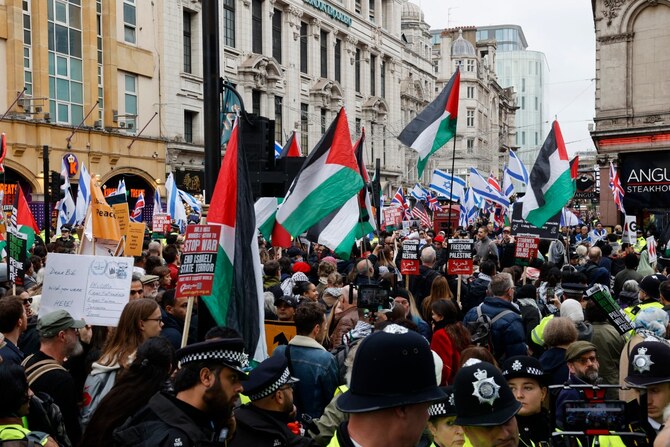

LONDON: The organizers of a planned pro-Palestine demonstration outside the BBC’s London headquarters have labeled a police decision to block the march as “discriminatory” and announced their intention to proceed with the event on Jan. 18.
The Palestinian Solidarity Campaign, which is organizing the march, made the announcement on Tuesday following a meeting with London’s Metropolitan Police.
In a statement, the group accused the authorities of deliberately seeking to prevent their protest outside the BBC. “The police have made abundantly clear that the real aim is to block us from protesting at the BBC under any circumstances,” the PSC said.
The Met had previously announced its decision to ban the march, citing security concerns after consultations with local business owners and religious leaders who raised objections to the demonstration’s proximity to a synagogue.
The PSC has repeatedly denied that its marches — which are regularly attended by Jewish groups — pose any threat to the Jewish community.
The Metropolitan Police are attempting to block our protest at the BBC.
This attack on our right to protest is discriminatory and anti-democratic.
Despite this, #WeWillMarch.
Join us at 12PM on Saturday 18 January at Whitehall. pic.twitter.com/orGHbKpC7a
— Palestine Solidarity Campaign (@PSCupdates) January 14, 2025
To address the police’s concerns, the PSC proposed reversing the original route, and suggested that the march begin at Whitehall and avoid the synagogue’s Shabbat service, which ends at 1 p.m., before finishing at Portland Place.
However, the group said that police rejected the proposal and instead introduced “new and dubious justifications” for the ban. The PSC also accused authorities of falsely claiming that “influential supporters and organizers” of the march had encouraged attendees to defy police-imposed conditions.
Over the weekend, hundreds of political, cultural and social figures voiced their support for the right to demonstrate in solidarity with Palestine.
A letter organized by a Jewish bloc that regularly takes part in pro-Palestine marches gathered more than 700 signatures from members of the Jewish community.
The PSC said its protest is rooted in frustration over “the complicity of the BBC, which has failed to report the facts of this genocide,” adding that the police have “no legitimate grounds” to block the march.
It remains unclear how the situation will unfold on Saturday or whether an agreement will be reached to avoid potential disruption or police intervention.
In a statement to Arab News on Wednesday, a Metropolitan Police spokesperson said that there were no updates, highlighting that the police’s position “still stands” based on earlier statements.
PSC media officer Bhavesh Hindocha described the situation as “fluid,” adding that changes could occur up to the day of the march.
“We intend to march from Whitehall towards the BBC, as close as we can depending on police conditions,” he said.


