

Pakistani PM orders cooperation with Interpol against suspects running human trafficking schemes abroad

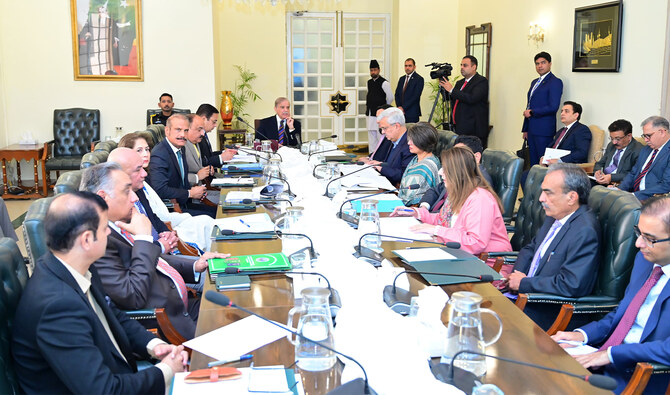
Pakistan Prime Minister Shehbaz Sharif (center) chairs a meeting regarding measures taken against human trafficking in Islamabad on January 15, 2025. (PID)
Short Url
Updated 15 January 2025
Follow

Pakistani PM orders cooperation with Interpol against suspects running human trafficking schemes abroad

  • Illegal immigration in spotlight in Pakistan since last month after five Pakistani nationals killed in boat capsize off Greek coast 
  • In 2023, hundreds, including 262 Pakistani nationals, drowned when an overcrowded vessel sank off Greek coast

ISLAMABAD: Pakistani Prime Minister Shehbaz Sharif on Wednesday called on the Federal Investigation Agency (FIA) to work with international police organization Interpol for the extradition of suspects running the “heinous business of human trafficking abroad.”

The issue of illegal immigration has been in the spotlight in the South Asian nation since last month following the death of five Pakistanis when a migrant boat capsized off the southern Greek island of Gavdos. 

The tragedy, which occurred on Dec. 14, underscored the perilous journeys many migrants undertake due to military or political conflicts in their home countries or in search of better financial prospects. 

On Wednesday, Sharif presided over a review meeting to discuss progress on actions taken against human trafficking.

“Prime Minister instructed the FIA ​​to seek cooperation from Interpol for the extradition of the most wanted smugglers running the heinous business of human trafficking abroad,” the PM’s office said in a statement. 

“Ministry of Information and Broadcasting should run an effective awareness campaign about illegal foreign travel and human trafficking.”

Authorities told Sharif dozens of traffickers had been arrested in 2024 and several government officials who were found to be facilitating them had been dismissed and several more were facing disciplinary action.

“Punitive measures are being taken against government officials involved in human trafficking,” the statement added. “Assets worth over Rs 500 million of human traffickers have been seized and the process of confiscating more is underway rapidly … Special prosecutors have been appointed to prosecute human traffickers.”

In 2023, hundreds of migrants, including 262 Pakistanis, drowned when an overcrowded vessel traveling from Libya capsized and sank in international waters off the southwestern Greek coastal town of Pylos.


Nearly 25% of Pakistan’s primary schools enrolling girls operate as single-teacher ones— report

Updated 13 sec ago
Follow

Nearly 25% of Pakistan’s primary schools enrolling girls operate as single-teacher ones— report

  • Pakistan needs over 115,000 more teachers in primary schools enrolling girls to meet global benchmark of one teacher per 30 students, says report
  • Sixty percent of Pakistani primary schools enrolling girls are overcrowded, while 32% lack clean drinking water or toilets, says Tabadlab report

ISLAMABAD: Nearly 25% of Pakistan’s primary schools that enrolls girls operate as single-teacher ones, a report by a leading think tank said this week, calling on the government to devolve teacher recruitment powers, upskill underutilized teachers and introduce reforms to hire and promote faculty members. 

Pakistan faces an acute education crisis which is reflected in the fact that it has the world’s second-highest number of out-of-school children, an estimated 22.8 million aged 5-16 who are not in educational institutions, according to UNICEF. 

While poverty remains the biggest factor keeping children out of classrooms, Pakistan’s education crisis is exacerbated by inadequate infrastructure and underqualified teachers, cultural barriers and the impacts of frequently occurring natural disasters. 

According to “The Missing Ustaani,” a report published by Islamabad-based think tank Tabadlab and supported by Malala Fund and the Pakistan Institute of Education (PIE), Pakistan needs over 115,000 more teachers in primary schools with girls’ enrolment to meet the basic international benchmark of ensuring one teacher per 30 children. Currently, the average Student-to-Teacher Ratio (STR) across Pakistan’s primary schools with girls’ enrolment is 39:1, it said. 

“Approximately 60% of these schools are overcrowded, necessitating the recruitment of over 115,000 additional teachers nationwide,” the report said on Monday. “Compounding this, nearly 25% of primary schools with girls’ enrolment operate as single-teacher schools, placing immense pressure on the quality of education.”

It said the situation is more dire in Pakistan’s poverty-stricken southwestern Balochistan province, where nearly 52% of the schools are single-teacher only ones while the percentage decreases slightly in the southern Sindh province to 51 percent. 

The report said while the STR improves to 25:1 at the middle school level, acute shortages of subject specialists emerge as the top-priority concern for quality education in these schools.

“Furthermore, around 32% of primary schools with girls’ enrolment and 18% of middle schools face ‘critical infrastructural shortages’— lacking clean drinking water or toilets in addition to high STRs— which significantly affects girls’ attendance and learning, particularly during adolescence,” the report said. 

The report cited a set of priority recommendations to address Pakistan’s systemic teacher deployment challenges and improve educational equity for girls. 

It urged the government to devolve recruitment authority to school or cluster levels to enable timely, context-specific hiring. It also called upon authorities to reform teacher transfer and promotion policies to introduce school-specific postings with minimum service terms. 

This, it said, would reduce arbitrary transfers and improving continuity in classrooms. The report advised authorities to upskill surplus or underutilized primary teachers to support instruction at the middle school level, helping address subject-specialist shortages.

“Together, these reforms offer a pathway toward a more equitable, efficient, and responsive teaching workforce— one capable of improving learning outcomes and ensuring that every girl in Pakistan has access to a qualified teacher,” the report said. 

To tackle Pakistan’s education crisis, Prime Minister Shehbaz Sharif declared an ‘education emeregency’ in September 2024, stressing the importance of education for all.
