

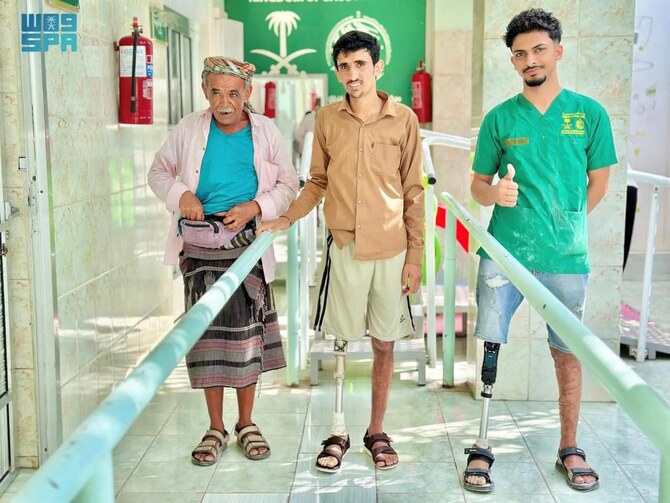
Saudi aid agency KSrelief treats hundreds at Aden prosthetics center

A total of 1,407 procedures were completed for men, who made up 65 percent of patients, and women at 35 percent. (SPA)
Short Url
Updated 16 January 2025
Follow

Saudi aid agency KSrelief treats hundreds at Aden prosthetics center

  • The services included the manufacturing and fitting of prosthetic limbs, as well as physical therapy

RIYADH: The Kingdom’s aid agency KSrelief has helped to treat 452 Yemenis, who lost limbs because of the ongoing conflict, at the Prosthetics and Rehabilitation Center in Aden governorate, the Saudi Press Agency reported recently.

A total of 1,407 procedures were completed for men, who made up 65 percent of patients, and women at 35 percent.

In addition, 54 percent were displaced individuals and 46 percent residents.

The services included the manufacturing and fitting of prosthetic limbs, as well as physical therapy.

KSrelief continues to provide general and critical care for vulnerable Yemeni people, the SPA reported.


Pakistan, Qatar leaders discuss Middle East tensions amid Iran crisis

Updated 5 sec ago
Follow

Pakistan, Qatar leaders discuss Middle East tensions amid Iran crisis

  • Iran has warned of retaliation against US military bases in region if Washington intervenes in support of anti-government protests
  • United States on Wednesday withdrew some personnel from Mid East key bases, including Al Udeid Air Base, according to Reuters

ISLAMABAD: Pakistani Prime Minister Shehbaz Sharif spoke by telephone on Wednesday with Qatar’s Emir Sheikh Tamim bin Hamad Al Thani, discussing regional developments as tensions escalated in the Middle East following warnings from Iran over potential US military action.

The phone call comes as Iran warned it would retaliate against US military bases in the region if Washington intervenes in support of anti-government protesters, prompting the United States to withdraw some personnel from key bases, including Al Udeid Air Base, according to Reuters.

For Pakistan, a wider escalation could have economic and security implications, including pressure on energy supplies, shipping routes and regional trade, as well as potential risks to Pakistani workers and businesses across the Gulf. Islamabad has traditionally sought to balance relations with Iran, Gulf Arab states and the United States, and analysts say heightened tensions could complicate that diplomacy at a time when Pakistan remains dependent on external financing, remittances and stable energy imports.

According to a statement from the Prime Minister’s Office, Sharif and Al Thani expressed satisfaction with the trajectory of Pakistan-Qatar relations and reaffirmed their commitment to strengthening bilateral ties. 

“Recent developments in the Middle East were also discussed,” a statement from Sharif’s office said. “The Prime Minister appreciated Qatar’s constructive and proactive role in promoting peace, dialogue, and mediation across the region, and acknowledged its meaningful efforts to defuse tensions through diplomatic solutions.”

Sharif also assured the Qatari leadership that Pakistan would also continue “to play a positive role in maintaining regional peace and stability.”

Tensions are high in the Middle East, with Iranian officials having said Tehran has conveyed messages to regional states, including Saudi Arabia, the United Arab Emirates and Turkiye, warning that US bases in those countries could be attacked if Iran is struck. Direct contacts between Iranian and US officials have reportedly been suspended.

The unrest in Iran, sparked by demonstrations over worsening economic conditions, has escalated into the most violent internal challenge faced by the Islamic Republic since the 1979 revolution, according to Western officials and rights groups. Iranian authorities have accused the United States and Israel of fomenting the protests, which they describe as acts of terrorism.

Human rights organizations have reported thousands of deaths and arrests amid a sweeping crackdown by Iranian security forces, while Western governments say Iran’s leadership remains in control but under unprecedented pressure.

Qatar, which maintains close ties with both Washington and Tehran and has played a mediating role in multiple regional crises, has emerged as a key diplomatic hub as fears grow of a wider regional escalation involving US forces, Iran and its allies.