

Pakistan expects $40 billion as World Bank announces decade-long development framework

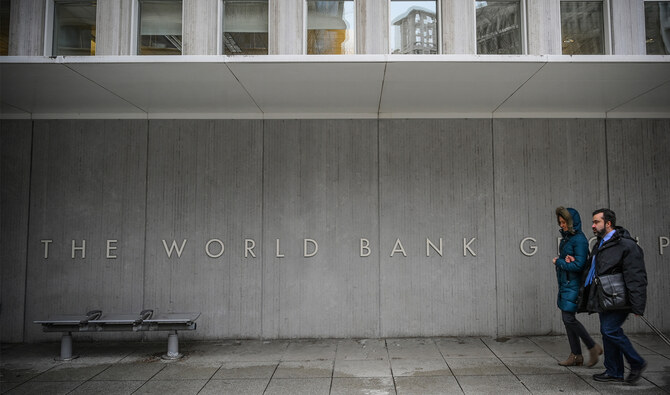
Two perosns walk by the building of the Washington-based global development lender, The World Bank Group, in Washington on January 17, 2019. (AFP/File)
Short Url
Updated 15 January 2025
Follow

Pakistan expects $40 billion as World Bank announces decade-long development framework

  • World Bank Group’s Country Partnership Framework is designed to support inclusive and sustainable growth
  • The framework aims to focus on education, health care, environmental resilience and financial management

ISLAMABAD: The World Bank Group’s (WBG) Boards of Executive Directors on Tuesday announced a decade-long Country Partnership Framework (CPF) for Pakistan, a plan the administration in Islamabad hopes will channel $40 billion in economic support to drive inclusive and sustainable development.

The country plan is a strategic framework that shapes the WBG’s long-term engagement with a country. It is built on a thorough assessment of the nation’s critical challenges and opportunities, ensuring that the group’s financial, technical and advisory resources are precisely aligned with the country’s development priorities for optimal impact.

According to the World Bank, the new framework for Pakistan targets six major areas, including education, health care, environmental resilience and financial management.

“Our new decade-long partnership framework for Pakistan represents a long-term anchor for our joint commitment with the Government to address some of the most acute development challenges facing the country,” said Najy Benhassine, World Bank Country Director for Pakistan. “Support to policy and institutional reforms that boost private sector-led growth and create fiscal space to finance the investments needed to address these challenges will remain key in our engagements.”

According to a statement from Pakistan’s Economic Affairs Division, the World Bank and its partner institutions have committed a total of $40 billion under the framework. This includes $20 billion from the International Development Association (IDA) and the International Bank for Reconstruction and Development (IBRD), while an additional $20 billion will come from the International Finance Corporation (IFC), which focuses on private sector development.

The WBG noted that the country plan aims to reduce child stunting by improving access to clean water, sanitation and nutrition services, while also addressing learning poverty through better foundational education.

Other priorities include bolstering resilience to floods and climate-related disasters, improving food and nutrition security, promoting cleaner energy and better air quality, and enhancing fiscal management to create space for development spending.

Zeeshan Sheikh, IFC Country Manager for Pakistan and Afghanistan, highlighted the importance of private sector participation in these areas, saying, “We are focused on prioritizing investment and advisory interventions that will help crowd-in much needed private investment in sectors critical for Pakistan’s sustainable growth and job creation, including energy and water, agriculture, access to finance, manufacturing and digital infrastructure.”

The framework also includes cross-cutting measures such as expanding social safety nets, advancing financial inclusion and enhancing digital and transport connectivity to protect vulnerable populations, particularly women.

Since commencing operations in Pakistan in 1950, the WBG has provided over $48.3 billion in assistance through IBRD, invested $13 billion via IFC to advance private sector-led growth, and delivered $836 million in guarantees through Multilateral Investment Guarantee Agency (MIGA).

Currently, the WBG’s portfolio in Pakistan includes 106 projects with a total commitment of $17 billion.


Pakistan concludes 60-hour joint military exercise featuring 19 states, including Saudi Arabia, US

Updated 8 sec ago
Follow

Pakistan concludes 60-hour joint military exercise featuring 19 states, including Saudi Arabia, US

  • Exercise also featured participation from Turkiye, Uzbekistan, Bangladesh, Egypt, Jordan and Qatar, says military’s media wing
  • Says exercise is designed to enhance professional military skills through exchange of innovative ideas, tactical experiences

ISLAMABAD: A 60-hour-long joint military exercise organized by Pakistan’s army concluded this week at the eastern city of Kharian, featuring participation from 19 countries including Saudi Arabia and the US, the military’s media wing said. 

The 9th International Pakistan Army Team Spirit (PATS) Competition is a 60-hour-long patrolling exercise, which the Pakistani military says is designed to enhance professional military skills through the exchange of innovative ideas, tactical experiences and best practices among participating teams. 

The exercise was held from Feb. 5-9 in the semi-mountainous terrains of Pakistan’s eastern Punjab province, providing participants a “realistic and challenging operational environment.” Pakistan’s Chief of Defense Forces (CDF) Field Marshal Syed Asim Munir attended the closing ceremony of the exercise on Monday and presented awards to participants.

“Over the years, PATS has evolved into a prestigious and highly competitive military exercise, recognized for promoting professional excellence and mutual learning among participating nations,” the Inter-Services Public Relations (ISPR), the military’s media wing, said in a statement. 

“The forum continues to strengthen military-to-military cooperation and understanding, while fostering camaraderie and team spirit in a demanding operational setting.”

This year’s exercise featured participants from 19 countries including Saudi Arabia, Bahrain, Bangladesh, Belarus, Egypt, Iraq, Jordan, Malaysia, Maldives, Morocco, Nepal, Qatar, Sri Lanka, Turkiye, USA and Uzbekistan, the ISPR said.

Indonesia, Myanmar and Thailand attended the exercise as observers while 16 domestic teams from the Pakistan Army and Pakistan Navy, along with observers from the Pakistan Air Force also participated in the event.

Munir appreciated participating teams for their “exceptional professionalism, physical and mental endurance, operational competence and high morale” displayed during the exercise, the military’s media wing said.

“He emphasized the importance of such multinational engagements in enhancing collective preparedness and adapting to the evolving character of modern warfare,” the ISPR added. 

Pakistan routinely holds joint air, ground and sea exercises with regional countries and traditional allies to foster interoperability to counter threats to global peace.