

Venezuela restricts diplomats from ‘hostile’ European countries

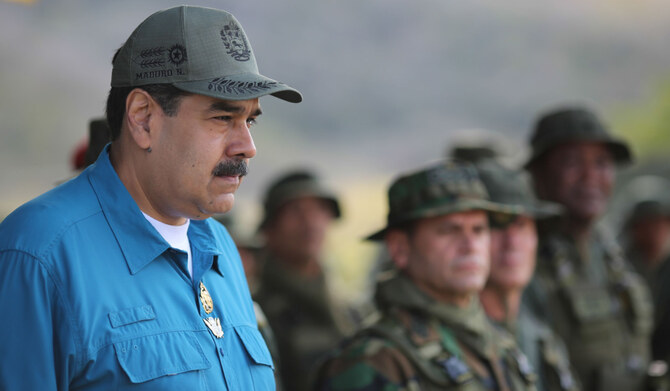
Handout picture released by the Venezuelan presidency showing Venezuela's President Nicolas Maduro delivering a speech to troops at the Naval Base of Turiamo, Aragua State, in Venezuela on February 3, 2019. (AFP)
Short Url
Updated 15 January 2025
Follow

Venezuela restricts diplomats from ‘hostile’ European countries

  • On Tuesday, Venezuela’s Foreign Minister Yvan Gil took to Telegram to accuse the three governments of “support for extremist groups” and “interference in the country’s internal affairs”

CARACAS: Venezuela on Tuesday announced restrictions on French, Italian and Dutch diplomats on its soil, citing their governments’ “hostile” response to Nicolas Maduro’s presidential inauguration, widely rejected as a power grab.
In a move branded an “escalation” by the Dutch government, the foreign ministry announced it would limit the number of accredited diplomats to three for each of the countries.
Those remaining would also need “written authorization... to travel more than 40 kilometers (25 miles) from Plaza Bolivar” in the capital Caracas.
Maduro, 62, is embroiled in a standoff with the West and several Latin American countries over his disputed claim to have won another six year-term in July 28 elections he is widely accused of stealing.
The United States, European Union, G7 and several democratic neighbors have refused to recognize his reelection, and France, Italy and the Netherlands last week loudly condemned Maduro’s administration.
On Tuesday, Venezuela’s Foreign Minister Yvan Gil took to Telegram to accuse the three governments of “support for extremist groups” and “interference in the country’s internal affairs.”
Within 48 hours, he said, the embassies must each reduce to three their number of accredited diplomats.
Due to the new travel restrictions, any trip outside the capital will now require a government permit. The international airport, Simon Bolivar, which serves Caracas, is 23 kilometers from the Plaza Bolivar.
“Venezuela demands respect for sovereignty and self-determination... especially from those subordinated to the directives of Washington,” wrote Gil.
Dutch Foreign Minister Caspar Veldkamp replied that this “escalation” by Maduro “will make dialogue all the more complicated.”
In a statement to AFP, he added there would “certainly be a response.”

The opposition says its tally of results from the July vote showed a clear victory for its candidate, 75-year-old Edmundo Gonzalez Urrutia, who went into exile in Spain in September after first taking refuge at the Dutch embassy.
Venezuela’s CNE electoral council, loyal to the regime, had announced victory for Maduro within hours of polls closing. It never provided a detailed vote breakdown.
In a sign of Maduro’s isolation, only two prominent regional leaders — Cuban President Miguel Diaz-Canel and Nicaraguan ex-guerrilla Daniel Ortega — attended his inauguration. Russian President Vladimir Putin sent his congratulations and China’s Xi Jinping sent a special envoy.
Washington and London promptly issued a bevy of sanctions on Maduro’s regime for staging what the opposition called a coup.
Critics denounced a fresh crackdown on opponents and critics in the lead-up to Friday’s swearing-in ceremony, with several activists and opposition figures detained.
More than 2,400 people were arrested, 28 killed and about 200 injured in protests that erupted after Maduro disputed claim to election victory.
He has since maintained a fragile peace with the help of the security forces and paramilitary “colectivos” — armed civilian volunteers accused of quelling protest through a reign of neighborhood terror.

French President Emmanuel Macron last week insisted “the will of the Venezuelan people must be respected” in a call with Gonzalez Urrutia, recognized by several countries as the legitimate president-elect.
Italian Prime Minister Giorgia Meloni denounced “another unacceptable act of repression by the Maduro regime” after opposition leader Maria Corina Machado was briefly detained at an anti-Maduro rally on the eve of his inauguration.
And Veldkamp, writing on X, had expressed deep “respect” for Machado and voiced concern about the “increased violent rhetoric of the Maduro regime and reports of recent arrests.”
In office since 2013, the former bus driver and trade unionist has clung to power through a mix of populism and repression, even as the United States imposed punishing sanctions on the key oil sector and the economy imploded.


Afghan barbers under pressure as morality police take on short beards

Updated 19 February 2026
Follow

Afghan barbers under pressure as morality police take on short beards

KABUL: Barbers in Afghanistan risk detention for trimming men’s beards too short, they told AFP, as the Taliban authorities enforce their strict interpretation of Islamic law with increasing zeal.
Last month, the Ministry for the Propagation of Virtue and Prevention of Vice said it was now “obligatory” to grow beards longer than a fist, doubling down on an earlier order.
Minister Khalid Hanafi said it was the government’s “responsibility to guide the nation to have an appearance according to sharia,” or Islamic law.
Officials tasked with promoting virtue “are obliged to implement the Islamic system,” he said.
With ministry officials patrolling city streets to ensure the rule is followed, the men interviewed by AFP all spoke on condition of anonymity due to security concerns.
In the southeastern province of Ghazni, a 30-year-old barber said he was detained for three nights after officials found out that one of his employees had given a client a Western-style haircut.
“First, I was held in a cold hall. Later, after I insisted on being released, they transferred me to a cold (shipping) container,” he said.
He was eventually released without charge and continues to work, but usually hides with his clients when the patrols pass by.
“The thing is that no one can argue or question” the ministry officials, the barber said.
“Everyone fears them.”

 This photograph taken on February 11, 2026 shows an Afghan barber trimming a customer's hair along a sidewalk in Kabul. (AFP)

He added that in some cases where both a barber and clients were detained, “the clients have been let out, but they kept the barber” in custody.
Last year, three barbers in Kunar province were jailed for three to five months for breaching the ministry’s rules, according to a UN report.

‘Personal space’

Alongside the uptick in enforcement, the religious affairs ministry has also issued stricter orders.
In an eight-page guide to imams issued in November, prayer leaders were told to describe shaving beards as a “major sin” in their sermons.
The religious affairs ministry’s arguments against trimming state that by shaving their beards, men were “trying to look like women.”
The orders have also reached universities — where only men study because women have been banned.
A 22-year-old Kabul University student said lecturers “have warned us... that if we don’t have a proper Islamic appearance, which includes beards and head covering, they will deduct our marks.”

 This photograph taken on February 11, 2026 shows an Afghan barber trimming a customer's hair along a sidewalk in Kabul. (AFP)

In the capital Kabul, a 25-year-old barber lamented that “there are a lot of restrictions” which go against his young clients’ preference for closer shaves.
“Barbers are private businesses, beards and heads are something personal, they should be able to cut the way they want,” he said.
Hanafi, the virtue propagation minister, has dismissed such arguments, saying last month that telling men “to grow a beard according to sharia” cannot be considered “invading the personal space.”

Business slump

In Afghanistan, the majority are practicing Muslims, but before the Taliban authorities returned to power in 2021, residents of major cities could choose their own appearance.
In areas where Taliban fighters were battling US-backed forces, men would grow beards either out of fear or by choice.
As fewer and fewer men opt for a close shave, the 25-year-old Kabul barber said he was already losing business.
Many civil servants, for example, “used to sort their hair a couple of times a week, but now, most of them have grown beards, they don’t show up even in a month,” he said.
A 50-year-old barber in Kabul said morality patrols “visit and check every day.”
In one incident this month, the barber said that an officer came into the shop and asked: “Why did you cut the hair like this?“
“After trying to explain that he is a child, he told us: ‘No, do Islamic hair, not English hair’.”