

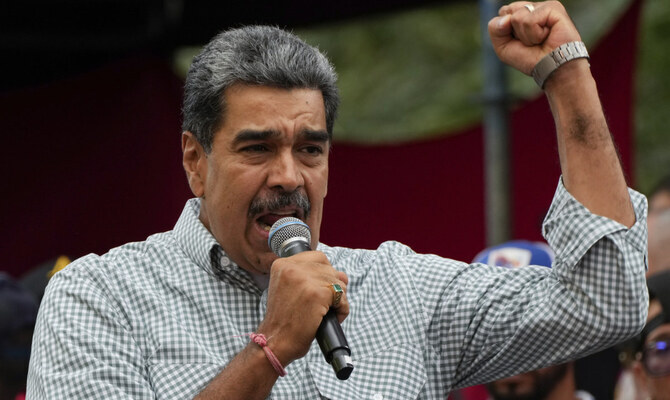

CARACAS: Venezuelan President Nicolas Maduro, whose nearly 12 years in office have been marked by deep economic and social crisis, was sworn in for a third term on Friday, despite a six-month-long election dispute, international calls for him to stand aside and an increase in the US reward offered for his capture.
Maduro, president since 2013, was declared the winner of July’s election by both Venezuela’s electoral authority and top court, though detailed tallies confirming his victory have never been published.
Venezuela’s opposition says ballot box-level tallies show a landslide win for its former candidate Edmundo Gonzalez, who is recognized as president-elect by several countries including the United States. International election observers said the vote was not democratic.
The months since the election have seen Gonzalez’s flight to Spain in September, his ally Maria Corina Machado going into hiding in Venezuela, and the detentions of high-profile opposition figures and protesters.
In the latest in a series of punitive steps, the outgoing Biden administration increased its reward for information leading to the arrest or conviction of Maduro on drug trafficking charges to $25 million, from a previous $15 million.
It also issued a $25 million reward for Interior Minister Diosdado Cabello and a $15 million reward for Defense Minister Vladimir Padrino, as well as new sanctions against eight other officials including the head of state oil company PDVSA Hector Obregon.
The US indicted Maduro and others on narcotics and corruption charges, among others, in 2020. Maduro has rejected the accusations.
The US move coincided with sanctions by Britain and the European Union each targeting 15 officials, including members of the National Electoral Council and the security forces, and Canadian sanctions targeting 14 current and former officials.
The Maduro government has always rejected all sanctions, saying they are illegitimate measures that amount to an “economic war” designed to cripple Venezuela.
“The outgoing government of the United States doesn’t know how to take revenge on us,” Maduro said during his inauguration speech, without directly mentioning sanctions.
The Venezuelan communications ministry did not immediately respond to a request for comment on the sanctions.
Maduro and his allies have cheered what they say is the country’s resilience despite the measures, though they have historically blamed some economic hardships and shortages on sanctions.
OPPOSITION TO SPEAK
Gonzalez, who has been on a whistle-stop tour of the Americas this week, has said he will return to Venezuela to take up the mantle of president, but has given no details.
The government, which has accused the opposition of fomenting fascist plots against it, has said Gonzalez will be arrested if he returns and offered a $100,000 reward for information leading to his capture.
Opposition leaders Gonzalez and Machado are each expected to speak later on Friday.
Both are being investigated by the attorney general’s office for alleged conspiracy, but only Gonzalez has a public warrant out for his arrest.
Machado’s first public appearance since August at an anti-government march in Caracas on Thursday was marred by a brief detention.
Her Vente Venezuela political movement said guns were fired and Machado was knocked off the motorcycle on which she was leaving the event. She was then held and forced to film several videos, it said.
One video shared on social media and by government officials showed her sitting on a curb and recounting losing her wallet.
The government scoffed at the incident and denied any involvement.
Some 42 people have been detained for political reasons since Tuesday, judicial NGO Foro Penal said.
Maduro was sworn in at the national assembly in Caracas and said he was taking his oath in the name of sixteenth-century Indigenous leader Guaicaipuro and late President Hugo Chavez, his mentor, among others.
“May this new presidential term be a period of peace, of prosperity, of equality and the new democracy,” Maduro said, adding he would convene a commission dedicated to constitutional reform.
“This act is possible because Venezuela is peaceful, in full exercise of its national sovereignty, of its popular sovereignty, of its national independence,” Maduro said.
Some 2,000 invitees from 125 countries attended the inauguration, according to the government.
Cuba’s President Miguel Diaz-Canel and Nicaragua’s President Daniel Ortega, staunch allies of Maduro, attended as did Vyacheslav Volodin, the speaker of Russia’s lower house of parliament.
ECONOMIC TROUBLES
Venezuela closed its borders and airspace to Colombia for 72 hours starting at 0500 local time (1000 GMT), the foreign ministry in Bogota said in a statement, adding the border on the Colombian side would remain open.
The opposition, non-governmental organizations and international bodies such as the United Nations have for years decried increasing repression of opposition political parties, activists and independent media in Venezuela.
US President-elect Donald Trump has said the country is being run by a dictator.
Meanwhile the government has repeatedly accused the opposition of plotting with foreign governments and agencies including the Central Intelligence Agency to commit acts of sabotage and terrorism.
The government said this week it had detained seven “mercenaries,” including a high-ranking FBI official and a US military official.
Venezuela’s economy has experienced a prolonged crisis marked by triple-digit inflation and the exodus of more than 7 million migrants seeking better opportunities abroad.
Many of Machado’s supporters, among them retired Venezuelans who would like to see their children and grandchildren return to the country, say jobs, inflation and unreliable public services are among their top concerns.
The government, meanwhile, has employed orthodox methods to try to tamp down inflation, to some success. Maduro said this month that the economy grew 9 percent last year.
About 2,000 people were arrested at protests following the election. The government said this week it has released 1,515 of them. Gonzalez, 75, said his son-in-law was kidnapped on Tuesday while taking his children to school.


