

ACWA Power expands in China with $312m in renewable energy deals

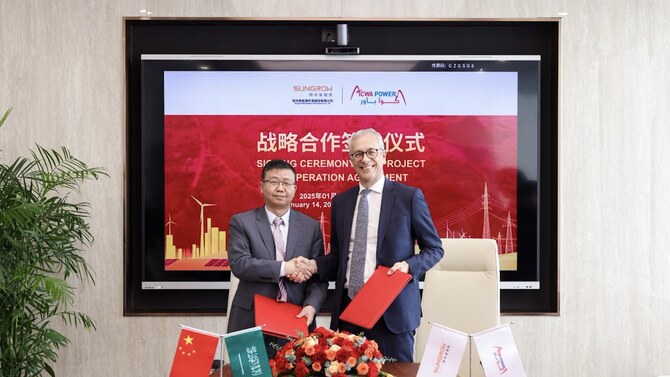
The deals include a 132-megawatt solar photovoltaic portfolio in Guangdong province and a 200-megawatt wind energy project. Supplied
Short Url
Updated 14 January 2025
Follow

ACWA Power expands in China with $312m in renewable energy deals

RIYADH: Saudi Arabia’s ACWA Power has solidified its position in China’s renewable energy sector with two major agreements valued at $312 million.

These agreements mark a significant step in the company’s global expansion strategy and underscore its commitment to driving the country’s clean energy transition.

The deals include a 132-megawatt solar photovoltaic portfolio in Guangdong province and a 200-megawatt wind energy project, according to a company statement. Both projects are central to ACWA Power's broader strategy in China, which was launched in 2023 to support the nation’s renewable energy goals.

Marco Arcelli, CEO of ACWA Power, expressed enthusiasm about the developments: “This is a significant milestone for ACWA Power in China, establishing our operational presence in renewable energy and water desalination. We are committed to working alongside our Chinese partners to contribute to the country's clean energy and water transition.”

Arcelli further emphasized the company’s long-term vision: “We are not only investing in renewable energy projects but also in Chinese expertise and building enduring relationships within the country.”

The solar project, ACWA Power’s first collaboration at the asset level with its long-term supply chain partner Sungrow Renewables, will span three separate sites in Guangdong. Additionally, the wind energy agreement, which was signed with Mingyang Smart Energy Group — a leading wind turbine manufacturer — opens the door for joint investments in China’s rapidly expanding wind sector.

ACWA Power’s formal entry into China’s renewable energy market was announced in December 2024, with the company planning to develop projects exceeding 1 gigawatt across multiple provinces.

Mohammad Abunayyan, founder and chairman of ACWA Power’s board of directors, commented: “Our entry into China’s renewable energy market represents a key milestone in our global strategy for a sustainable future. Our growth is not just about adding megawatts; it’s about forging lasting partnerships that accelerate the energy transition and create a cleaner, more prosperous world for future generations.”

These projects are part of an initial phase that will see ACWA Power expand its portfolio to more than 1 gigawatt of capacity in China. This move aligns with the company’s long-term ambition to triple its assets under management to approximately $250 billion globally by 2030.


New SPARK launch ushers Eastern Province from black gold to EV charging and AI mobility

Updated 10 December 2025
Follow

New SPARK launch ushers Eastern Province from black gold to EV charging and AI mobility

DAMMAM: The lavender carpet was rolled out and the symbolic shovels were placed in decorative sandboxes as Smart Mobility broke ground, bringing Saudi-made EV charging to life at its first manufacturing facility at King Salman Energy Park in Dammam.

As part of the ceremony, Smart Mobility inaugurated SPARK’s first electric vehicle charging station.

The project brought together Foxconn Interconnect Technology, a unit of Taiwan’s Foxconn that makes components used for connectivity, and Saudi’s Saleh Suleiman Alrajhi & Sons. 

It also represented a significant milestone in supporting foreign investment in the Kingdom and a major step toward localizing advanced manufacturing capabilities in order to support the rapidly-growing EV market.

“As we gather today to celebrate a groundbreaking of an important edition in this ecosystem …we’re creating a community— with all that comes with a community,” SPARK President and CEO Mishal Al-Zughaibi said.

He highlighted the park’s proximity to the Kingdom’s core energy infrastructure.

It will be headquartered in the Eastern Province, notably near to where Aramco’s Well No. 7, later named “Prosperity Well,” struck black gold in 1938, six years after the country unified as a Kingdom. That discovery changed the country — and the world. 

In recent years, there has been a tremendous effort to diversify beyond oil and, once again, the Eastern Province is at the forefront, but this time, it is using innovation and AI to catapult the Kingdom into that new realm. 

The location was also ideal, it was noted, on several levels, including how it would allow for ample access to ports, and the planned integration with the future GCC Railway network would additionally create a unified regional manufacturing and export corridor. 

According to Smart Mobility, SPARK facility was created with the aim to produce Saudi-made EV charging solutions, including the Charging Point Management System. Three products are already certified by the Saudi Standards, Metrology and Quality Organization. 

Launching in 2026, the project aims to align with Vision 2030 and to support local content goals, which will be overseen by the Local Content and Government Procurement Authority.

Smart Mobility CEO, Prince Fahad Nawaf Al Saud, who was on hand, said the decision to build at SPARK was strategic.

“SPARK is the Kingdom’s primary hub for energy, logistics and industrial innovation. For EV infrastructure to scale reliably, it must be integrated with the country’s most critical energy assets,” he said.

Prince Fahad also addressed the evolving and morphing nature of the industry, saying: “Mobility is being reshaped by artificial intelligence. Vehicles are becoming intelligent systems that think, react and connect. Level-4 autonomous capability is accelerating globally and these systems depend on electric platforms.”

He added that if the Kingdom aims to lead in AI, automation and smart city technologies, it must develop EV infrastructure as a foundational national pillar.

“EVs are not simply a fuel alternative — they are the operating system of the AI era,” he said.

Prince Fahad stated: “This groundbreaking ceremony is not only a milestone for Smart Mobility, it is a milestone for the Kingdom.”

He added: “Guided by his Royal Highness Crown Prince Mohammed bin Salman, we built this with the support from the Ministry of Energy, Ministry of Industry, and Ministry of Investment and many government entities that continue to empower our national ambitions to localization and advanced manufacturing.” 

Continuing to address the crowd, Prince Fahad said: “Some people in Saudi love petrol cars, fuel is cheap — why would anyone shift it to electric? And they are right (to question that). Traditional vehicles are still deeply loved, but we must also recognize the truth.” 

The truth, to him, is that AI is “no longer science fiction,” it is reality now. “We are entering an age where we must respond quickly to global changes … we have much work ahead to test, to certify, to scale and to deliver on the promise,” he said.

“The world is entering a new chapter defined not by horsepower but by computing powe r— and Saudi Arabia must lead, not follow in this transition,” Prince Fahad added.. 

FIT Chairman and CEO Sidney Lu noted that next year the Chinese calendar will welcome the Year of the Horse, an apt metaphorical transition as it signals powerfully moving forward from old to now.

He was excited to be on the ground on his first visit to the Eastern Province. 

“FIT brings decades of experience in precision manufacturing, high-reliability electronics, and large-scale global production,” Lu said, adding: “Our shared objective is clear: bring world-class technologies into Saudi Arabia, embed them locally and position Saudi-made solutions for future export.”

While Lu headed back to his home in Taiwan following the meeting “to recharge,” he said the joint venture will be showcasing FIT’s global manufacturing expertise with Saudi Arabia’s industrial ambitions — and that gives him much energy. 

 “I love this place. Every time I come over here, I get inspired; inspired by the spirits, by the energy, by the youth. And I really get inspired with how people are willing to move forward,” Lu told Arab News.