‘Survival mode’ for families displaced by Ethiopia quakes

1 / 2
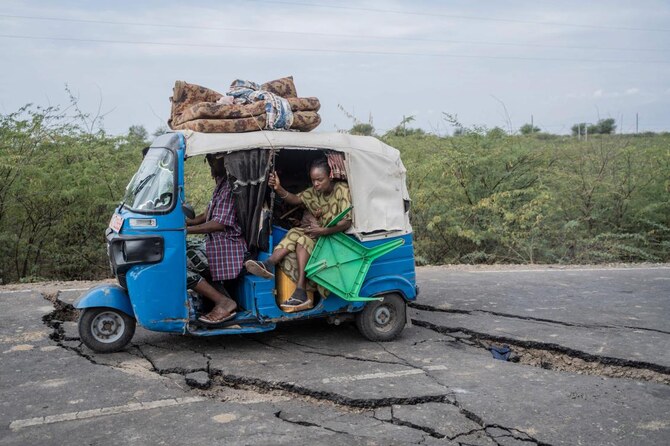
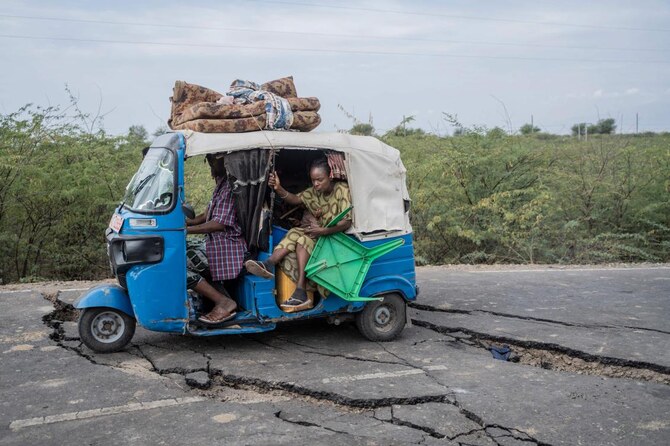
Residents ride a tuk-tuk taxi along a road damaged by multiple earthquakes near the town of Kabanna, on January 12, 2025. (Photo by Amanuel Sileshi / AFP)
2 / 2
Residents displaced by multiple earthquakes gather to fill their water jars at a water tank in a recently established displacement camp in Awash Arba, on January 11, 2025. (AFP)
Short Url
Updated 14 January 2025
Follow

‘Survival mode’ for families displaced by Ethiopia quakes

  • Ethiopia’s Rift Valley is one of the most seismically active regions in the world

AWASH: Under a makeshift shelter, Moussa Akele kills time chewing the stimulant khat, wondering where his family will get its next meal after fleeing a series of earthquakes that have shaken several regions of Ethiopia.
The 40-year-old was at home in Kabanna in the Afar region, about 250 kilometers (155 miles) northeast of the capital Addis Ababa, when an earthquake struck in late December.
“It caused widespread panic and destroyed our houses. People were terrified,” he said.
Ethiopia’s Rift Valley is one of the most seismically active regions in the world.
For several weeks, frequent tremors, including one measuring 5.8 on the Richter scale, have been shaking the rural regions of Afar and Oromia.
There are fears they could cause a major dam to collapse or lead to the eruption of a volcano, Mount Dofan, so the authorities have evacuated tens of thousands of people.
Akele, who worked in a sugar factory, found refuge with his family about 20 km from Kabanna. Like several thousand others, they now live in a tent pitched in the middle of arid vegetation.
“We were evacuated from our good and peaceful life and are now living in survival mode,” he said.
Trucks loaded with water and food arrive regularly, “but there are a lot of people and it’s not enough,” he added.
Most of the displaced are pastoralists, who had to leave their livestock behind.
Under a blazing sun and amid dust clouds caused by the trucks, several dozen women and children queue with jerry cans. Fights occasionally break out in the desperation.

Assea Ali didn’t have time to take anything with her.
“We fled for our lives,” said the 26-year-old mother of two.
“This is the condition we are living in now,” she added, pointing to a small tent and sighing: “I have no hope.”
On a small hill overlooking the camp, a health center has been set up by local authorities.
Several women rush in as soon as it opens, most to weigh their young children.
“Until the government and support agencies like UNICEF or the World Health Organization intervene, we are helping people with the resources we have,” said Abokar Hassan, 24, a health response officer.
He estimates between 200 and 300 people see him each day, mainly to prevent the spread of cholera.
According to the UN Office for Humanitarian Affairs (OCHA), Ethiopian authorities have evacuated more than 60,000 people living in high-risk areas, including some near a dam.
“A comprehensive humanitarian response is under way, but significant gaps remain,” OCHA said in a statement on Saturday.
The region is known to be a “volcanic, tectonic zone,” Cecile Doubre, a seismologist at the Strasbourg School and Observatory of Earth Sciences and a specialist in Afar, told AFP.
“There has been no eruption yet, but there is a spread of magma under the earth’s crust, between zero and 15 km. It is spreading in a large fissure, about 50 km long,” she added. “It’s a major geological event.”
Some sections of the road bear the scars of seismic activity, with the track to Kabanna partially collapsed.
In the city, there is a heavy silence, broken only by the lowing of oxen wandering the deserted streets amid several destroyed houses and businesses.
Despite the situation, Akele remains hopeful.
“The fear and uncertainty we are experiencing now are temporary, and we must not let them make us despair,” he said.


Shooter kills 9 at Canadian school and residence

Updated 11 February 2026
Follow

Shooter kills 9 at Canadian school and residence

  • The shooter was found dead with an apparent self-inflicted gunshot wound
  • A total of 27 people were wounded in the shooting, including two with serious injuries

TORONTO: A shooter killed nine people and wounded dozens more at a secondary school and a residence in a remote part of western Canada on Tuesday, authorities said, in one of the deadliest mass shootings in the country’s history.
The suspect, described by police in an initial emergency alert as a “female in a dress with brown hair,” was found dead with an apparent self-inflicted gunshot wound, officials said.
The attack occurred in Tumbler Ridge, British Columbia, a picturesque mountain valley town in the foothills of the Rockies.
A total of 27 people were wounded in the shooting, including two with serious injuries, the Royal Canadian Mounted Police said in a statement.
Prime Minister Mark Carney said he was “devastated” by the “horrific acts of violence” and announced he was suspending plans to travel to the Munich Security Conference on Wednesday, where he had been set to hold talks with allies on transatlantic defense readiness.
Police said an alert was issued about an active shooter at Tumbler Ridge Secondary School on Tuesday afternoon.
As police searched the school, they found six people shot dead. A seventh person with a gunshot wound died en route to hospital.
Separately, police found two more bodies at a residence in the town.
The residence is “believed to be connected to the incident,” police said.
At the school, “an individual believed to be the shooter was also found deceased with what appears to be a self?inflicted injury,” police said.
Police have not yet released any information about the age of the shooter or the victims.
“We are devastated by the loss of life and the profound impact this tragedy has had on families, students, staff, and our entire town,” the municipality of Tumbler Ridge said in a statement.
Tumbler Ridge student Darian Quist told public broadcaster CBC that he was in his mechanics class when there was an announcement that the school was in lockdown.
He said that initially he “didn’t think anything was going on,” but started receiving “disturbing” photos about the carnage.
“It set in what was happening,” Quist said.
He said he stayed in lockdown for more than two hours until police stormed in, ordering everyone to put their hands up before escorting them out of the school.
Trent Ernst, a local journalist and a former substitute teacher at Tumbler Ridge, expressed shock over the shooting at the school, where one of his children has just graduated.
He noted that school shootings have been a rarity occurring every few years in Canada compared with the United States, where they are far more frequent.
“I used to kind of go: ‘Look at Canada, look at who we are.’ But then that one school shooting every 2.5 years happens in your town and things... just go off the rails,” he told AFP.

‘Heartbreak’ 

While mass shootings are extremely rare in Canada, last April, a vehicle attack that targeted a Filipino cultural festival in Vancouver killed 11 people.
British Columbia Premier David Eby called the latest violence “unimaginable.”
Nina Krieger, British Columbia’s minister of public safety, said it was “one of the worst mass shootings in our province’s and country’s history.”
The Canadian Olympic Committee, whose athletes are competing in the 2026 Winter Games in Italy, said Wednesday it was “heartbroken by the news of the horrific school shooting.”
Ken Floyd, commander of the police’s northern district, said: “This has been an incredibly difficult and emotional day for our community, and we are grateful for the cooperation shown as officers continue their work to advance the investigation.”
Floyd told reporters the shooter was the same suspect police described as “female” in a prior emergency alert to community members, but declined to provide any details on the suspect’s identity.
The police said officers were searching other homes and properties in the community to see if there were additional sites connected to the incident.
Tumbler Ridge, a quiet town with roughly 2,400 residents, is more than 1,100 kilometers (680 miles) north of Vancouver, British Columbia’s largest city.
“There are no words sufficient for the heartbreak our community is experiencing tonight,” the municipality said.