Six EU nations call for temporary Syria sanctions relief

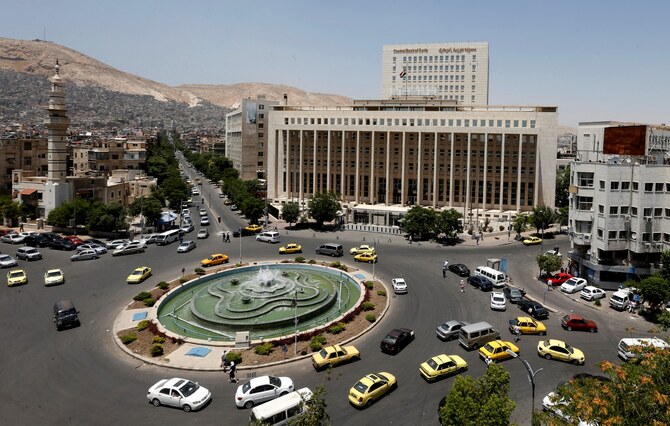
Vehicles drive along the roundabout past the Central bank of Syria in the capital Damascus' Sabaa Bahrat Square on June 17, 2020. (AFP)
Short Url
Updated 13 January 2025
Follow

Six EU nations call for temporary Syria sanctions relief

  • EU foreign ministers are set to discuss relaxing Syria sanctions during a meeting in Brussels on Jan. 27

Six member states of the European Union have called for the bloc to temporarily suspend sanctions on Syria in areas such as transport, energy and banking, according to a paper seen by Reuters.
EU foreign ministers are set to discuss relaxing Syria sanctions during a meeting in Brussels on Jan. 27.
European leaders began reassessing their policy toward Damascus after the ousting of president Bashar Assad by insurgent forces led by the Islamist Hayat Tahrir Al-Sham (HTS), which is designated as a terrorist group by the United States and most other countries, as well as the United Nations.
The document, signed by Germany, France, the Netherlands, Spain, Finland and Denmark, said the EU “should immediately begin adjusting our sanctions regime.”
Nevertheless, the paper also warned that if EU expectations of respect for human rights and minorities are not met, further sanctions may not be lifted and a snapback mechanism could be applied to sanctions already removed.
The US last week issued a sanctions exemption for transactions with governing institutions in Syria for six months in an effort to ease the flow of humanitarian assistance.
The six EU members said the bloc should lift sanctions to facilitate civilian flights, reevaluate sanctions on high-value goods, remove an export ban on oil and gas technology, and reopen financial channels between the EU and Syria.
They also said sanctions against members of the Assad administration and its supporters should remain in place.
Lifting sanctions on HTS would have to be discussed at the United Nations level and coordinated with close partners, the paper said, adding that “it will depend on our joint assessment of the listed entity HTS and its leader (Ahmed) Al-Shara’a and of the evolution on the ground in Syria”.
Kaja Kallas, the bloc’s foreign policy chief, met Syria’s new foreign minister, Asaad Hassan Al-Shibani, on Sunday in Riyadh, where top Middle Eastern and Western diplomats gathered to discuss the situation in the country.
“Now is the time for Syria’s new leadership to deliver on the hope they have created – through a peaceful & inclusive transition that protects all minorities,” she said.
“Next, we will discuss with EU Foreign Ministers how to ease sanctions,” she added.


Syria’s leader set to visit Berlin with deportations in focus

Updated 58 min 15 sec ago
Follow

Syria’s leader set to visit Berlin with deportations in focus

  • Sharaa is scheduled to meet his counterpart Frank-Walter Steinmeier, the German president’s office said

BERLIN: Syrian President Ahmed Al-Sharaa is expected in Berlin on Tuesday for talks, as German officials seek to step up deportations of Syrians, despite unease about continued instability in their homeland.
Sharaa is scheduled to meet his counterpart Frank-Walter Steinmeier, the German president’s office said.
Chancellor Friedrich Merz’s office has yet to announce whether he would also hold talks with Sharaa during the visit.
Since ousting Syria’s longtime leader Bashar Assad in late 2024, Sharaa has made frequent overseas trips as the former Islamist rebel chief undergoes a rapid reinvention.
He has made official visits to the United States and France, and a series of international sanctions on Syria have been lifted.
The focus of next week’s visit for the German government will be on stepping up repatriations of Syrians, a priority for Merz’s conservative-led coalition since Assad was toppled.
Roughly one million Syrians fled to Germany in recent years, many of them arriving in 2015-16 to escape the civil war.
In November Merz, who fears being outflanked by the far-right AfD party on immigration, insisted there was “no longer any reason” for Syrians who fled the war to seek asylum in Germany.
“For those who refuse to return to their country, we can of course expel them,” he said.

- ‘Dramatic situation’ -

In December, Germany carried out its first deportation of a Syrian since the civil war erupted in 2011, flying a man convicted of crimes to Damascus.
But rights groups have criticized such efforts, citing continued instability in Syria and evidence of rights abuses.
Violence between the government and minority groups has repeatedly flared in multi-confessional Syria since Sharaa came to power, including recent clashes between the army and Kurdish forces.
Several NGOs, including those representing the Kurdish and Alawite Syrian communities in Germany, have urged Berlin to axe Sharaa’s planned visit, labelling it “totally unacceptable.”
“The situation in Syria is dramatic. Civilians are being persecuted solely on the basis of their ethnic or religious affiliation,” they said in a joint statement.
“It is incomprehensible to us and legally and morally unacceptable that the German government knowingly intends to receive a person suspected of being responsible for these acts at the chancellery.”
The Kurdish Community of Germany, among the signatories of that statement, also filed a complaint with German prosecutors in November, accusing Sharaa of war crimes, genocide and crimes against humanity.
There have also been voices urging caution within government.
On a trip to Damascus in October, Foreign Minister Johann Wadephul said that the potential for Syrians to return was “very limited” since the war had destroyed much of the country’s infrastructure.
But his comments triggered a backlash from his own conservative Christian Democratic Union party.