

Pakistan religion minister in Saudi Arabia to attend Global Hajj and Umrah Conference

An aerial view shows the Abraj al-Bait also known as the Mecca Royal Hotel Clock Tower Saudi in Arabia's holy city of Makkah on June 17, 2024, during the annual hajj pilgrimage. (AFP/File)
Short Url
Updated 13 January 2025
Follow

Pakistan religion minister in Saudi Arabia to attend Global Hajj and Umrah Conference

  • The fourth edition of the Global Hajj and Umrah Conference and Expo is being held in Jeddah on Jan. 13-16
  • Hussain will deliver a speech at the summit that aims to enhance pilgrim services and promote competitiveness

ISLAMABAD: Pakistan’s Religious Affairs Minister Chaudhry Salik Hussain has arrived in Saudi Arabia on a three-day visit to attend the Global Hajj and Umrah Conference and Expo, and sign the Hajj Agreement 2025, the Pakistani religious affairs ministry said on Sunday.

The fourth edition of the Global Hajj and Umrah Conference and Expo, organized by the Saudi Ministry of Hajj and Umrah, is being held in Jeddah on Jan. 13-16.

Hussain will deliver a speech at the conference, which will have participation of ministers, distinguished personalities, and diplomats from 90 countries.

“The conference aims to enhance services for pilgrims and promote transparency and competitiveness in related industries,” the Pakistani religious affairs ministry said in a statement.

“It will feature 47 panel discussions, 50 workshops, and exhibitions showcasing the latest Hajj technologies and services with 280 displays.”

On Sunday, Hussain also met with Saudi Minister of Hajj and Umra Dr. Tawfiq bin Fawzan Al-Rabi’ah and the two figures reviewed arrangements for Hajj 2025. He praised the efforts of the Saudi leadership in providing excellent facilities to pilgrims.

“There is further potential to strengthen economic and investment cooperation between the two countries,” Hussain was quoted as saying by his ministry.

“This year, measures have been taken to provide better facilities for Pakistani pilgrims compared to previous years, and instructions have been given to the Hajj Affairs Office in Jeddah to ensure the best services for the pilgrims.”
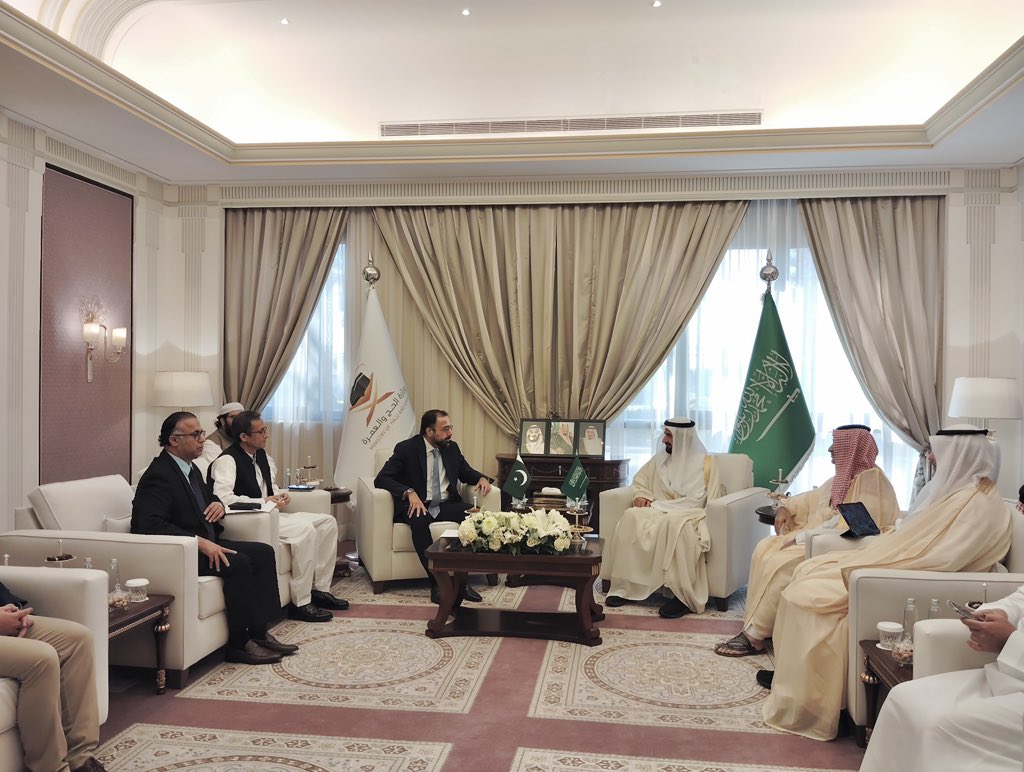


Pakistan’s Religious Affairs Minister Chaudhry Salik Hussain (center left) meets Saudi Minister of Hajj and Umra Dr. Tawfiq bin Fawzan Al-Rabi’ah (center right) in Jeddah on January 11, 2025. (@MORAisbOfficial/X)

The Saudi Hajj and Umrah minister remarked that a large number of pilgrims come from Pakistan each year, and assured that every possible cooperation would be provided to Pakistani pilgrims, according to the Pakistani religious affairs ministry.

Saudi Arabia has allocated a quota of 179,210 Hajj pilgrims for Pakistan in 2025, divided equally between government and private schemes.

For the first time, Pakistan’s Hajj policy allowed pilgrims last year to make payments in installments. Under this scheme, the first installment of Rs 200,000 ($717) had to be submitted with the application, the second installment of Rs 400,000 ($1,435) within 10 days of balloting and the remaining amount by February 10 this year.

The Pakistani religious affairs ministry has also launched the Pak Hajj 2025 mobile application, available for both Android and iPhone users, to guide pilgrims. Additionally, the government announced a reduction in airfare, lowering ticket prices for federal program pilgrims to Rs 220,000, down from last year’s Rs 234,000.

Pakistan International Airlines, Saudi Airlines, and private carriers have agreed to transport pilgrims this year.


Pakistan’s president condemns Kabul blast, accuses Taliban of allowing militant ‘safe havens’

Updated 12 sec ago
Follow

Pakistan’s president condemns Kabul blast, accuses Taliban of allowing militant ‘safe havens’

  • President Zardari links attack on Chinese-run restaurant to Kabul’s failure to meet Doha commitments
  • He highlights the ‘failure’ of Afghanistan’s Taliban to establish a ‘broad-based and inclusive government’

KARACHI: President Asif Ali Zardari on Monday condemned a blast that ripped through a Chinese-run restaurant in Kabul, killing at least seven people, while criticizing Afghanistan’s Taliban administration for allowing “safe havens” to militant groups to export extremist violence in the region.

The explosion struck the restaurant in Kabul’s Shahr-e-Naw commercial district, an area considered one of the safest in the Afghan capital, killing one Chinese national and six Afghans and wounding several others, including a child, according to Afghan authorities.

The Afghan affiliate of Daesh militant group claimed responsibility, saying the attack was carried out by a suicide bomber.

“The Taliban regime in Afghanistan has failed to honor the commitments made under the Doha Peace Agreement, particularly the obligation to prevent the use of Afghan soil for the export of terrorism,” Zardari said in a statement circulated by his office.

“Pakistan has repeatedly stressed that no terrorist groups should be allowed safe havens in Afghanistan and that regional peace and security must be upheld,” he continued, adding that “it is not just Pakistan but other neighbors of Afghanistan, including Tajikistan, [that] have recently been affected by the terrorists operating out of Afghan soil.”

Pakistan has frequently accused Afghanistan of sheltering proscribed armed factions such as the Tehreek-e-Taliban Pakistan and the Balochistan Liberation Army, and of facilitating attacks on Pakistani civilians and security forces, allegations the Taliban deny.

The two countries witnessed major border skirmishes in October last year, followed by talks mediated by Qatar and Türkiye.

Pakistan subsequently closed its border and suspended bilateral and transit trade with Afghanistan, a move that led to a 17% drop in “cross-border attacks,” according to the Center for Research and Security Studies.

Late November also saw a series of deadly incidents along the Tajikistan–Afghanistan border, with militants on the Afghan side firing across the frontier into Tajikistan, killing five Chinese workers employed on Chinese–Tajik mining and construction projects.

In December, Tajik border forces clashed with armed individuals who crossed from Afghanistan, killing several assailants but losing a border guard in the fighting.

Zardari paid tribute to Chinese nationals working in Afghanistan “despite rising insecurity” and expressed solidarity with the victims and their families, while reiterating calls for political reform in Kabul.

“The failure to establish a broad based and inclusive government by the Taliban is contrary to the Doha Agreement,” he said in the statement.