

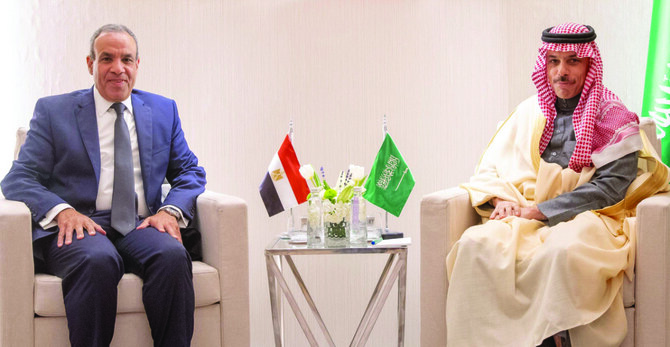
Saudi FM meets Egyptian counterpart in Riyadh

Prince Faisal bin Farhan (R) holds talks with Badr Abdelatty in Riyadh. (Supplied)
Short Url
Updated 12 January 2025
Follow

Saudi FM meets Egyptian counterpart in Riyadh

  • They discussed cooperation and other topics of common interest

RIYADH: Saudi Foreign Minister Prince Faisal bin Farhan met with his Egyptian counterpart Badr Abdelatty at the expanded ministerial meeting on Syria in Riyadh on Sunday.

During the meeting, they discussed cooperation and other topics of common interest, the Foreign Ministry wrote on X.

Meanwhile, Riyadh Gov. Prince Faisal bin Bandar received Mohamed Ramadhan Ruwange, ambassador-designate of Kenya to the Kingdom, in Riyadh on Sunday.


KSrelief implemented 78 projects for disabled people

Updated 5 sec ago
Follow

KSrelief implemented 78 projects for disabled people

  • Providing fair opportunities and supporting their health, education, and social needs while strengthening their participation across different fields of life embodies the values of compassion and solidarity

RIYADH: Since its establishment, the King Salman Humanitarian Aid and Relief Center has carried out 78 projects in several countries, including Yemen, Syria, Sudan, Poland, Senegal, Jordan, Somalia, Tunisia, Lebanon and Turkiye.

Valued at more than $64.39 million, these projects aim to enhance health and rehabilitation services and provide assistive devices for people with disabilities.

Care and empowerment of persons with disabilities forms one of the pillars of humanitarian work, and reflects a society’s awareness and its ability to include every individual.

Providing fair opportunities and supporting their health, education, and social needs while strengthening their participation across different fields of life embodies the values of compassion and solidarity. The more integration programs grow and their abilities develop, the greater the contribution and prosperity of the community.

Disability is not an obstacle to creativity, but an invitation to open paths and create room for distinct talents that deserve support and protection.

Their empowerment is not only a humanitarian duty, but also a civil approach grounded in compassion and solidarity that helps build a more inclusive and just future.