

Four Daesh members, including two leaders, killed in eastern Iraq

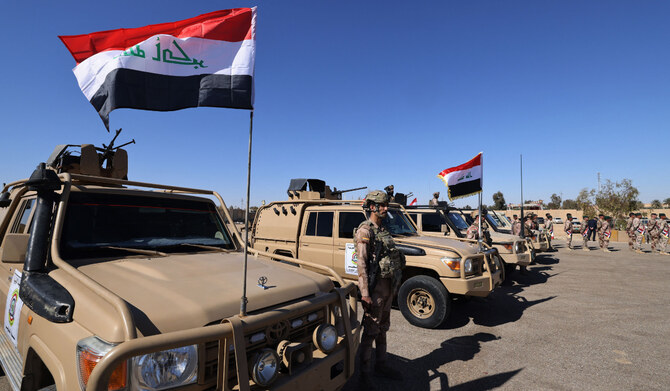
Iraqi soldiers from the new 'desert battalion' special forces stand next to military vehicles as the take part in a graduation ceremony at the Ain al-Asad air base in Anbar west of Baghdad on February 29, 2024. (AFP)
Short Url
Updated 12 January 2025
Follow

Four Daesh members, including two leaders, killed in eastern Iraq

  • The caliphate collapsed in 2017 in Iraq, where it once had a base just a 30-minute drive from Baghdad, and in Syria in 2019, after a sustained military campaign by a US-led coalition

BAGHDAD: Four members of the Daesh, including two senior leaders, were killed in an airstrike carried out by Iraqi aircraft in the Hamrin Mountains in eastern Iraq, security officials said on Saturday.
The Iraqi Security Media Cell, an official body responsible for disseminating security information, said in a statement four bodies of Daesh militants were found in the area where Iraqi F-16 fighter jets carried out the strike on Friday.
Talib Al-Mousawi, an official at Iraq’s Popular Mobilization Forces (PMF) — a grouping of armed factions originally set up to fight Daesh in 2014 that was subsequently recognized as an official security force, told Reuters the dead included two top Daesh leaders in the Diyala province in eastern Iraq.
The identity of another militant will be determined following an examination, the Security Media Cell said.
At the height of its power from 2014-2017, the Daesh “caliphate” imposed death and torture on communities in vast swathes of Iraq and Syria and had influence across the Middle East.
The caliphate collapsed in 2017 in Iraq, where it once had a base just a 30-minute drive from Baghdad, and in Syria in 2019, after a sustained military campaign by a US-led coalition.
Daesh responded by scattering in autonomous cells; its leadership is clandestine and its overall size is hard to quantify. The UN estimates it at 10,000 in its heartlands.


Lebanon foreign minister declines Tehran visit, proposes talks in neutral country

Updated 10 December 2025
Follow

Lebanon foreign minister declines Tehran visit, proposes talks in neutral country

  • Lebanon’s foreign minister Youssef Raji cited ‘current conditions’ for the decision not to go to Iran

Lebanon’s foreign minister Youssef Raji said on Wednesday he had declined an invitation to visit Tehran for now, proposing instead talks with Iran in a mutually agreed neutral third country, Lebanese state news agency NNA reported.

Raji cited “current conditions” for the decision not to go to Iran, without elaborating, and stressed that the move did not mean rejection of dialogue with Iran. He did not immediately respond to a request from Reuters for additional comment.

Iran’s Foreign Minister Abbas Araqchi had extended the invitation last week, seeking talks on bilateral ties.

Raji said Lebanon stood ready to open a new phase of constructive relations with Iran, on the condition that ties be based strictly on mutual respect, full recognition of each country’s independence and sovereignty, and non-interference in internal affairs under any pretext.

In an apparent reference to calls to disarm Hezbollah, the Lebanese armed movement allied for decades to Iran, Raji added that no strong state could be built unless the government held the exclusive right to hold weapons.

Hezbollah, once a dominant political force with wide influence over the Lebanese state, was severely weakened by Israeli strikes last year that ended with a US-brokered ceasefire. It has been under mounting domestic and international pressure to surrender its weapons and place all arms under state control.

In August, Iran’s top security official Ali Larijani visited Beirut, warning Lebanon not to “confuse its enemies with its friends.” In June, Foreign Minister Araqchi said Tehran sought a

“new page” in ties.