OIC’s COMSTECH launches ‘expert service’ to foster tech cooperation among member states

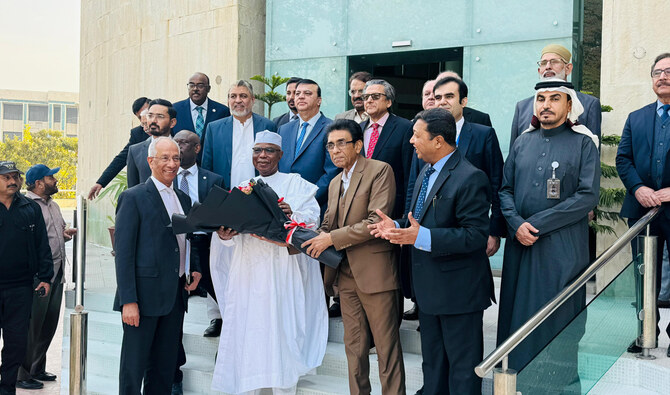
Pakistan’s Education Minister Khalid Maqbool Siddique gives bouquet to the Organization of Islamic Cooperation Secretary-General Hissein Ibrahim Taha during his visit to the COMSTECH Secretariat in Islamabad on January 10, 2025. (Photo courtesy: COMSTECH)
Short Url
Updated 11 January 2025
Follow

OIC’s COMSTECH launches ‘expert service’ to foster tech cooperation among member states

  • COMSTECH, an intergovernmental body, aims to promote science and technology, focusing on sustainable development and poverty reduction
  • The strategic initiative is designed to enhance technological self-reliance, foster development, and mitigate brain drain in OIC member states

ISLAMABAD: The Organization of Islamic Cooperation’s (OIC) Ministerial Standing Committee on Scientific and Technological Cooperation (COMSTECH) has launched an “expert service” to foster technological cooperation among OIC member states, the committee said on Friday.
COMSTECH, an intergovernmental organization established by the OIC in 1981, is headquartered in Islamabad and continues to serve as a cornerstone of the OIC’s mission to promote scientific excellence and technological innovation, focusing on sustainable development, poverty reduction, and improvement in quality of life across member states.
The service was launched during OIC Secretary-General Hissein Ibrahim Taha’s visit to the COMSTECH Secretariat in Islamabad along with Pakistan’s Science and Technology Minister Khalid Maqbool Siddiqui. The high-profile event was attended by ambassadors of OIC member states, diplomats, vice-chancellors, government officials, scientists, and researchers from various OIC countries.
Launching the COMSTECH Expert Service for Technological Cooperation, Secretary-General Taha emphasized the importance of collaboration among OIC member states in the critical fields of science and technology to overcome the key challenges faced by the Muslim world, according to COMSTECH.
“This strategic initiative is designed to enhance technological self-reliance, foster sustainable development, and mitigate brain drain within OIC member states,” the OIC body said in a statement.
“The program aims to mobilize expertise from across the Muslim world to address pressing challenges in health care, agriculture, energy, and education, embodying the spirit of collaboration and mutual progress among OIC countries.”
The OIC chief said the upcoming 16th COMSTECH General Assembly, scheduled to be held in Islamabad later this year, would be a vital platform to discuss the future of science and technology in the OIC region.
“COMSTECH is a beacon of hope, empowering individuals and communities through groundbreaking initiatives,” he said. “I urge all member states to support and actively engage in these programs to collectively create a brighter and more prosperous future for the OIC community.”
On the occasion, Siddiqui reaffirmed the importance of science and technology as fundamental pillars for sustainable development within the OIC.
He termed the launch of the COMSTECH Expert Service a “pivotal step in uniting expertise across the Muslim world to address shared challenges and build resilience.”


Pakistan says 34 militants killed in counterterror operations in Balochistan, KP this week

Updated 5 sec ago
Follow

Pakistan says 34 militants killed in counterterror operations in Balochistan, KP this week

  • Pakistan military says 26 militants killed in separate operations in Khyber Pakhtunkhwa this week
  • Eight other militants were gunned down in southwestern Balochistan’s Zhob district, says military 

ISLAMABAD: Pakistani security forces killed 34 militants this week in the southwestern Balochistan and northwestern Khyber Pakhtunkhwa (KP) provinces bordering Afghanistan, the military’s media wing said on Wednesday amid a surge in militant attacks in the country. 

The Inter-Services Public Relations (ISPR), the military’s media wing, said security forces carried out a series of “high tempo intelligence-driven operations” this week in the two provinces. It said 26 militants belonging to the Pakistani Taliban or the Tehreek-e-Taliban Pakistan (TTP) outfit were killed while eight militants were killed in Balochistan in the operations. 

In the first counterterror operation on Tuesday, Pakistani forces targeted a TTP militant who was trying to enter the country in North Waziristan through the Pakistan-Afghanistan border, the ISPR said. Three TTP militants were killed in a second counterterror operation in Lakki Marwat district, the military added. 

In the third counterterror operation, 10 TTP militants were killed in Bannu district while 12 others were gunned down in North Waziristan in another separate operation, the ISPR said. 

“During the fifth engagement, own troops conducted an intelligence-based operation in the general area of Sambaza, Zhob District,” the military’s media wing said in a statement.

“After an intense fire exchange, eight terrorists belonging to Fitna Al Hindustan were successfully neutralized.”

Pakistan’s military uses the terms “Fitna Al-Khwarij” for the TTP and “Fitna Al Hindustan” for separatist militants in Balochistan. Islamabad alleges these militant groups are supported by India, a charge New Delhi has always denied. 

The ISPR said security forces retrieved weapons and ammunition from the militants in Balochistan’s Zhob district, adding that they were involved in “terrorist activities” in the area.

“The security forces of Pakistan remain resolute and unwavering in their commitment to defend the nation’s frontiers,” the ISPR said. 

The counterterror operations take place amid surging tensions between Pakistan and Afghanistan. Islamabad said it carried out strikes on alleged militant camps in Afghanistan on Saturday night, killing over 100 militants. 

Afghanistan said the attacks violated its territorial sovereignty, accusing Islamabad of killing and wounding dozens of civilians. 

Islamabad alleges militants based in Afghanistan are responsible for surging militant attacks inside Pakistani territory. Afghanistan rejects these allegations and urges Pakistan to focus on its security challenges instead of blaming Kabul.