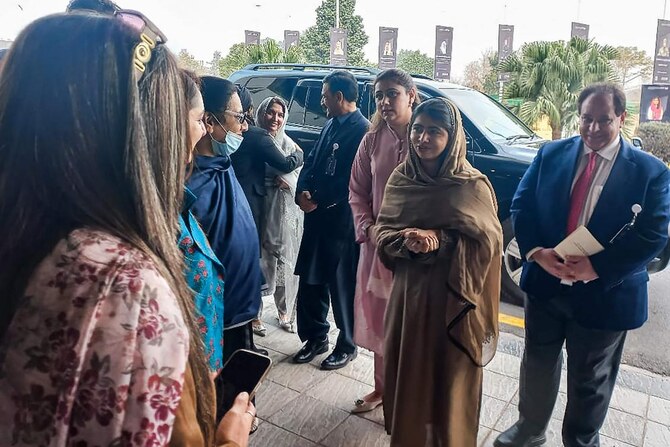
Malala Yousafzai ‘overwhelmed and happy’ to be back in Pakistan

Nobel Peace Prize Laureate Malala Yousafzai, second right, arrives for a global summit on girls’ education in the Islamic world in Islamabad on Jan. 11, 2025. (AFP)
Short Url
Updated 11 January 2025
Follow

Malala Yousafzai ‘overwhelmed and happy’ to be back in Pakistan

  • The education activist was shot by the Pakistani Taliban in 2012 when she was a schoolgirl
  • Pakistan is facing a severe education crisis with more than 26 million children out of school

ISLAMABAD: Nobel Peace Prize laureate Malala Yousafzai said Saturday she was “overwhelmed” to be back in her native Pakistan, as she arrived for a global summit on girls’ education in the Islamic world.
The education activist was shot by the Pakistani Taliban in 2012 when she was a schoolgirl and has returned to the country only a handful of times since.
“I’m truly honored, overwhelmed and happy to be back in Pakistan,” she said as she arrived at the conference in the capital Islamabad.
The two-day summit was set to be opened Saturday morning by Prime Minister Shehbaz Sharif, and brings together representatives from Muslim-majority countries, where tens of millions of girls are out of school.
Yousafzai is due to address the summit on Sunday.
“I will speak about protecting rights for all girls to go to school, and why leaders must hold the Taliban accountable for their crimes against Afghan women & girls,” she posted on social media platform X on Friday.
The country’s education minister Khalid Maqbool Siddiqui said the Taliban government in Afghanistan had been invited to attend, but Islamabad has not received a response.
Afghanistan is the only country in the world where girls and women are banned from going to school and university.
Since returning to power in 2021, the Taliban government there has imposed an austere version of Islamic law that the United Nations has called “gender apartheid.”
Pakistan is facing its own severe education crisis with more than 26 million children out of school, mostly as a result of poverty, according to official government figures — one of the highest figures in the world.
Yousafzai became a household name after she was attacked by Pakistan Taliban militants on a school bus in the remote Swat valley in 2012.
She was evacuated to the United Kingdom and went on to become a global advocate for girls’ education and, at the age of 17, the youngest Nobel Peace Prize winner.


Climate activist group files second lawsuit against Sweden

Updated 5 sec ago
Follow

Climate activist group files second lawsuit against Sweden

  • Sweden’s Supreme Court in February 2025 ruled that the complaint filed against the state was inadmissible
  • “We still have a chance to get out of the planetary crises and build a safe and fair world,” Edling said

STOCKHOLM: A group of climate activists said Friday they were filing another lawsuit against the Swedish state for alleged climate inaction, after the Supreme Court threw out their case last year.
The group behind the lawsuit, Aurora, first tried to sue the Swedish state in late 2022.
Sweden’s Supreme Court in February 2025 ruled that the complaint filed against the state — brought by an individual, with 300 other people joining it as a class action lawsuit — was inadmissible.
The court at the time noted the “very high requirements for individuals to have the right to bring such a claim” against a state.
“We still have a chance to get out of the planetary crises and build a safe and fair world. But this requires that rich countries that emit as much as Sweden stop breaking the law,” Aurora spokesperson Ida Edling said in a statement Friday.
The group, which said the lawsuit had been filed with the Stockholm District Court Friday, said it believes the Swedish state is obligated “to reduce Sweden’s emissions as much and as quickly as necessary in order for the country to be in line with its fair share.”
“This means that emissions from several sectors must reach zero before 2030,” the group said, while noting this was 15 years before Sweden’s currently set targets.
The Swedish Environmental Protection Agency as well as the OECD warned last year that Sweden was at risk of not reaching its own goal of net zero emissions by 2045.
While the first lawsuit was unsuccessful, the group noted that international courts had made several landmark decisions since the first suit was filed, spotlighting two in particular.
In an April 2024 decision, Europe’s top rights court, the European Court of Human Rights, ruled that Switzerland was not doing enough to tackle climate change, the first country ever to be condemned by an international tribunal for not taking sufficient action to curb global warming.
In 2025, the International Court of Justice issued an advisory opinion stating that countries violating their climate obligations were committing an “unlawful” act.