


PARIS: Talks are taking place on whether US and French troops could secure a border zone in northern Syria as part of efforts to defuse conflict between Turkiye and Western-backed Kurdish Syrian forces, a senior Syrian Kurdish official said.
Ankara has warned that it will carry out a cross-border offensive into northeastern Syria against the Kurdish YPG militia if the group does not meet Turkish demands.
Turkiye regards the YPG, which spearheads the US-allied Syrian Democratic Forces (SDF), as a terrorist group linked to Kurdish PKK militants who for 40 years have waged an insurgency against the Turkish state.
The SDF played an important role in defeating Daesh in Syria in 2014-17. The group still guards Daesh fighters in prison camps there, but has been on the back foot since rebels ousted Syrian President Bashar Assad on Dec. 8.
French President Emmanuel Macron said earlier this week that Paris would not abandon the SDF, which was one among a myriad of opposition forces during Syria’s 13-year-long civil war.
“The United States and France could indeed secure the entire border. We are ready for this military coalition to assume this responsibility,” Ilham Ahmed, co-chair of foreign affairs for the Kurdish administration in northern territory outside central Syrian government control, was quoted as saying by TV5 Monde.
“We ask the French to send troops to this border to secure the demilitarised zone, to help us protect the region and establish good relations with Turkiye.”
Neither France nor Turkiye’s foreign ministries immediately responded to requests for comment. The US State Department was not immediately available for comment.
It is unclear how receptive Turkiye would be to such an initiative, given Ankara has worked for years to secure its border against threats coming from Syria, and has vowed to destroy the YPG.
“As soon as France has convinced Turkiye to accept its presence on the border, then we can start the peace process,” Ahmed said. “We hope that everything will be settled in the coming weeks.”
A source familiar with the matter said such talks were going on, but declined to say how advanced or realistic they were.
Washington has been brokering ceasefire efforts between Turkish-backed groups and the SDF after fighting that broke out as rebel groups advanced on Damascus and overthrew Assad.
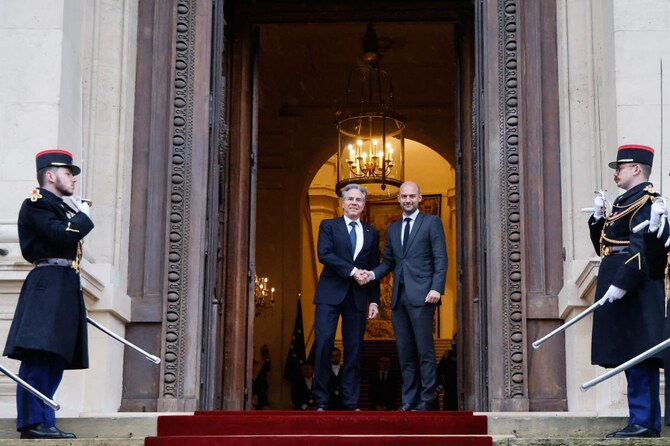
Addressing a news conference in Paris alongside outgoing US Secretary of State Antony Blinken, French Foreign Minister Jean-Noel Barrot hinted that there were talks on the issue.
“The Syrian Kurds must find their place in this political transition. We owe it to them because they were our brothers in arms against Islamic State,” Barrot said.
“We will continue our efforts ... to ensure that Turkiye’s legitimate security concerns can be guaranteed, but also the security interests of (Syria’s) Kurds and their full rights to take part in the construction in the future of their country.”
Blinken said it was vital to ensure that the SDF forces continued the job of guarding more than 10,000 detained Daesh militants as this was a legitimate security interest for both the US and Turkiye.
“We have been working very closely with our ally ... Turkiye to navigate this transition ... It’s a process that will take some time,” Blinken said.
The US has about 2,000 troops in Syria who have been working with the SDF to prevent a resurgence of Daesh.
A French official said France still has dozens of special forces on the ground dating from its earlier support of the SDF, when Paris provided weapons and training.


