Pakistan hopes Afghanistan joins other Islamic countries at girls’ education summit

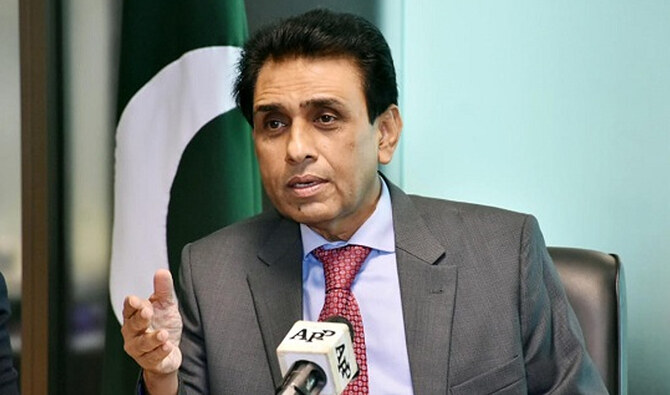
This photo, taken on June 22, 2024, shows Pakistan’s Education Minister Khalid Maqbool Siddiqui during a press conference in Islamabad. (APP/File)
Short Url
Updated 11 January 2025
Follow

Pakistan hopes Afghanistan joins other Islamic countries at girls’ education summit

  • Pakistan to host global conference on girls education in Islamabad from Jan. 11-12 
  • No justification for restricting women’s education in Islam, says education minister

ISLAMABAD: Pakistan’s education minister on Thursday hoped Afghanistan would join representatives from 47 other Islamic countries and attend the upcoming global conference on girls’ education in Muslim countries, scheduled to be held later this week in Islamabad. 
Pakistan’s education ministry will host the global conference titled: “Girls’ Education in Muslim Communities: Challenges and Opportunities” from Jan. 11-12 in Islamabad. Pakistan’s foreign office said on Wednesday that 150 representatives from 47 countries, including education experts, religious scholars, diplomats, and politicians are expected to partake in the summit. 
Since the Afghan Taliban seized Kabul in August 2021, women and girls have been gradually barred from attending secondary school and university, undertaking most forms of paid employment, and attending public spaces such as public parks or gyms by the government there. 
“We have extended an invitation to Afghanistan to participate in this conference and hope that their delegation will attend, as it is a very important neighboring country,” Education Minister Khalid Maqbool Siddiqui told reporters during a media briefing in Islamabad.
Since the Taliban’s return to power in 2021, at least 1.4 million Afghan girls have been denied access to secondary education, according to a report by the United Nations International Children’s Emergency Fund (UNICEF) released in August last year.
The minister said everyone respects tribal customs and cultures, but all such practices must align with Islamic values in Muslim countries, adding that nothing holds precedence over them. 
“In Islam, there is no justification for restricting women’s education,” Siddiqui said. 
He said that while the conference will officially kick off on Saturday, a session of the world’s religious scholars on girls’ education, chaired by the religion minister, will take place on Friday.
Siddiqui said the Muslim World League, the Organization of Islamic Cooperation and key Islamic countries are actively participating in this event.
“Malala Yousafzai, a renowned activist for girls’ education, will also participate in this conference,” he said, adding that experts and representatives from diplomatic missions in Islamabad from non-Muslim countries will also attend the event.
Describing the objective of the conference, he said the primary aim of the conference is to stress the implementation of the Islamic message, which clearly states that both men and women have the right to education.
“By promoting girls’ education, we can build better homes, a better society and a stronger nation,” he said. 
He said education in Pakistan was currently in an emergency state as millions of children were out of school and needed important steps to deal with this situation. 
Siddiqui said that an “Islamabad Declaration” will be announced after the conference on Sunday. 
“This declaration will outline decisive steps to transform the trends of girls’ education in Islamic countries by mobilizing all available resources,” he said. 
Prime Minister Shehbaz Sharif will inaugurate the event and deliver the keynote address at the opening session on Jan. 11. 
Pakistan’s foreign office said Sharif will reaffirm the nation’s commitment to promoting girls’ education and gender equality.


Pakistan Railways targets $3.6 billion revenue amid track expansion, service upgrades

Updated 4 sec ago
Follow

Pakistan Railways targets $3.6 billion revenue amid track expansion, service upgrades

  • Government plans new railway lines and modern trains with security cameras, Wi-Fi and dining cars
  • Revival of a robust railway system is seen as key as Pakistan pushes to become a regional trade hub

ISLAMABAD: Pakistan Railways has set a target of generating Rs 1 trillion ($3.6 billion) in revenue by June as the government expands railway tracks and upgrades passenger services with amenities such as Wi-Fi and modern dining cars, Federal Minister for Railways Hanif Abbasi said on Tuesday.

Pakistan Railways was once the backbone of long-distance travel and freight movement across the country, connecting major cities and ports soon after independence. However, decades of underinvestment, aging infrastructure and competition from road transport led to a steady decline in services and reliability.

As Pakistan seeks to position itself as a regional trade and transit hub, the government has renewed focus on rebuilding a robust rail network for both passengers and cargo.

“Pakistan Railways has set a target of achieving Rs 1 trillion in revenue by June 2026,” Abbasi said, according to an official statement. “Pakistan Railways will be transformed into a modern, safe and profitable organization,” he added.

The minister said work has already begun on digitization, outsourcing, construction of new railway tracks and improvement of passenger facilities.

He said the Asian Development Bank has approved a $2 billion loan for the construction of a 480-kilometer new railway track between Karachi and Rohri, a project expected to cut travel time by at least five hours.

Groundbreaking for the project is planned for July 2026, with completion expected within two and a half to three years.

Under the Reko Diq project, Abbasi said work is underway on a 900-kilometer railway track from Rohri to Nokundi, including construction of 500 kilometers of new track and upgrading of 400 kilometers of existing track.

The 87-kilometer Nokundi–Taftan line has also been included to strengthen rail connectivity with Iran.

The minister said a 54-kilometer People’s Train route is being launched in Balochistan at a cost of Rs 4 billion ($14.4 million), while eight regional routes will be developed in Punjab.

Provinces have also been offered the option to operate branch lines, with Punjab, Sindh and Balochistan allocating funds and consultations underway with Khyber Pakhtunkhwa.

Abbasi said Pakistan is also advancing rail connectivity with Kazakhstan, Uzbekistan and Iran and that the Islamabad–Tehran–Istanbul railway service will be launched after security clearance.

Passenger services are being upgraded alongside infrastructure expansion, he continued.

“Cleanliness and improvement work at Rawalpindi Railway Station has been completed, while three prime trains have already been upgraded, and more trains will be upgraded by June 30,” the minister said. “By December 31, all major trains will be upgraded, featuring security cameras, Wi-Fi, hostesses and modern dining cars.”

He added that Wi-Fi routers have been installed at railway stations, ticket booking has been enabled through the Rabta mobile application and a 1,700-kilometer fiber-optic network is being laid.

Karachi and Lahore railway stations are being upgraded for security, while progress is underway on a Rs 8.9 billion ($32 million) digital systems agreement with the Frontier Works Organization and a $85 million project with DP World at Pipri Yard.

Abbasi said 155 railway stations have been shifted to solar energy and Pakistan Railways recently recorded its highest-ever daily revenue of Rs 300 million ($1.1 million).

The minister also said a new Lahore–Rawalpindi track, backed by provincial funding, will cut travel time between the two cities to about two and a half hours once completed.