Lebanon’s bonds climb as parliament elects first president since 2022

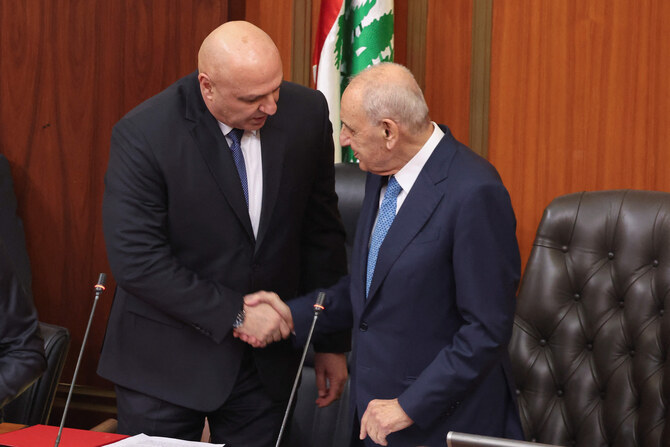
Lebanese Parliament Speaker Nabih Berri shakes hands with Lebanon’s army chief Joseph Aoun after he is elected as the country’s president at the parliament building in Beirut, Lebanon, Jan. 9, 2025. Reuters/Mohamed Azakir
Short Url
Updated 09 January 2025
Follow

Lebanon’s bonds climb as parliament elects first president since 2022

LONDON: Lebanon’s government bonds extended a three-month long rally on Thursday as its parliament voted in a new head of state for the crisis-ravaged country for the first time since 2022.

Lebanese lawmakers elected army chief Joseph Aoun as president. It came after the failure of 12 previous attempts to pick a president and the move boosts hopes that Lebanon might finally be able to start addressing its dire economic woes.

Lebanon’s battered bonds have almost trebled in value since September when the regional conflict with Israel weakened Lebanese armed group Hezbollah, long viewed as an obstacle to overcoming the country’s political paralysis.

Most of Lebanon’s international bonds, which have been in default since 2020, rallied after Aoun’s victory was announced to stand between 0.8 and 0.9 cents higher on the day and at nearly 16 cents on the dollar.

They have also risen almost every day since late December, although they remain some of the lowest priced government bonds in the world, reflecting the scale of Lebanon’s difficulties.

With its economy still reeling from a devastating financial collapse in 2019, Lebanon is in dire need of international support to rebuild from the war, which the World Bank estimates to have cost the country $8.5 billion.


Saudi Arabia opens December ‘Sah’ sukuk sale at 4.68% return 

Updated 10 sec ago
Follow

Saudi Arabia opens December ‘Sah’ sukuk sale at 4.68% return 

RIYADH: Saudi Arabia has opened subscriptions for its December issuance of the government-backed “Sah” savings sukuk, offering investors an annual return of 4.68 percent, slightly lower than the 4.71 percent provided in the previous month. 

In a post on X, the National Debt Management Center announced that the subscription window opened at 10:00 a.m. Saudi time on Dec. 7 and will close at 3:00 p.m. on Dec. 9. 

Part of the 2025 issuance calendar managed by the NDMC, the sukuk reflects the Kingdom’s continued efforts to promote financial inclusion and encourage personal savings. 

Launched under the Financial Sector Development Program — a key component of the Vision 2030 agenda — Sah aims to raise the national savings rate to 10 percent by 2030, up from about 6 percent currently. 

According to NDMC, the minimum subscription amount is SR1,000 ($266.56), while the maximum is capped at SR200,000 per investor. The sukuk carries a one-year maturity and offers fixed returns paid at redemption. 

Subscriptions are available exclusively to Saudi nationals aged 18 and above through approved investment platforms, including SNB Capital, Aljazira Capital, Alinma Investment, SAB Invest and Al-Rajhi Capital. 

Sukuk are Shariah-compliant financial instruments that grant investors partial ownership in an issuer’s underlying assets, serving as a popular alternative to conventional bonds. 

Last month, NDMC announced that it raised SR5.83 billion through its riyal-denominated sukuk program.  

The November issuance was divided into five tranches, with the first one valued at SR700 million, set to mature in 2027.  

The second tranche amounted to SR1.37 billion, maturing in 2029, while the third tranche, worth SR180 million, will expire in 2032.  

The fourth tranche, valued at SR197 million, is due in 2036, while the last tranche, due in 2039, was valued at SR3.38 billion. 

Saudi Arabia’s debt market has seen robust growth in recent years, drawing strong investor interest in fixed-income instruments amid a global environment of rising interest rates. 

In October, Kuwait Financial Center, also known as Markaz, reported that Saudi Arabia dominated the Gulf Cooperation Council’s primary debt market in the third quarter of 2025, raising $20.32 billion through 36 issuances — a 62.7 percent year-on-year increase in value.