BEIRUT: A day before the Lebanese parliament was due to assemble to discuss the election of a president — an office that has remained vacant for more than 26 months — there was a flurry of activity on Wednesday including intensified discussions, communications and declarations.
Reports in the afternoon suggested that Hezbollah’s preferred candidate, Suleiman Frangieh, “may announce his withdrawal from the presidential race,” leaving army chief Gen. Joseph Aoun as the leading contender.
The day was marked by a visit from French envoy Jean-Yves Le Drian, who arrived in Beirut on Tuesday evening and was expected to attend the parliamentary presidential election session on Thursday.
He held meetings with several political and parliamentary figures, during which he reportedly recommended Aoun for “consideration without any preconditions.” This was in relation to the bloc of Hezbollah and Amal Movement MPs who opposed the general’s nomination on the grounds that his election would require a constitutional amendment because he still serves in his capacity as commander of the army.
The head of Hezbollah’s parliamentary bloc, MP Mohammed Raad, was quoted after meeting the French envoy as saying: “Hezbollah will not stand in the way of the Lebanese people’s consensus on the name of a president for the republic.”
Media estimates suggest that Aoun, if he secures the support of Hezbollah and Amal, would win 95 votes in the 128-member parliament. This level of support would mean a constitutional amendment is not needed.
Events leading up to Thursday’s session suggested all parliamentary blocs are committed to attending, which would ensure the quorum required for the election is reached. The presidency has been vacant since former president Michel Aoun’s term ended in October 2022. Previous attempts to appoint a successor failed amid disagreements between political factions about suitable candidates.
Prime Minister Najib Mikati said he was feeling “joy for the first time since the presidential vacancy as, God willing, we will have a new president for the republic tomorrow,” raising hopes that the office might finally be filled.
One political observer said there is now the real possibility that “all members of parliament, regardless of their political affiliations, would choose their candidate within the framework of consensus and understanding during the voting sessions, which will remain open as confirmed by the speaker of parliament, Nabih Berri, until” a decision is reached.
This renewed optimism was in contrast to the prior skepticism about the possibility that parliamentary blocs would be able to successfully convene a session to elect a president, given their previous failures to reach a consensus on a candidate who could secure a majority in the first round of voting.
The electoral session on Thursday will be the 13th of its kind. During the previous one, in June 2024, the candidate favored by Hezbollah and its allies, former minister and Marada Movement leader Suleiman Frangieh, who was close to the Assad regime in Syria, faced the candidate favored by the Free Patriotic Movement and opposition parties, former Minister of Finance Jihad Azour, who is director of the Middle East and Central Asia department at the International Monetary Fund.
During that session, Frangieh received 51 votes in the first round of voting and Azour 59. When the totals were announced, Hezbollah and Amal MPs withdrew from the session, thereby depriving it of the quorum required for a second round of voting, as stipulated by the constitution.
Against this background of long-running political divisions resulting in deadlock within the parliament, and in light of the war between Israel and Hezbollah, the number of presidential candidates has dwindled from 11 to just a few names. Aside from Aoun, Frangieh and Azour, the other candidates whose names continued to circulate to varying degrees on Wednesday included Samir Geagea, the head of the Lebanese Forces party, which heads the parliament’s biggest Christian bloc. However, he is fiercely opposed by Hezbollah.
Less-discussed candidates include the acting chief of Lebanon’s General Security Directorate, Elias Al-Bayssari; MP Ibrahim Kanaan, who resigned from the Free Patriotic Movement to join the Independent Consultative Parliamentary Gathering; and former ambassador Georges Al-Khoury, a retired brigadier general. Al-Khoury has the support of Maronite Patriarchate, Speaker Berri and the Free Patriotic Movement, but the majority of the opposition rejects his candidacy.
MP Neemat Frem, who has presented a political and economic vision for the country, is also a candidate. He is on good terms with the Patriarchate and the opposition. Others include Farid Al-Khazen, who is also on good terms with Berri and close to the Patriarchate, and Ziad Baroud, a human rights activist and former minister of interior who is seen as a consensus candidate.
The parliamentary blocs continued to hold talks on Wednesday afternoon to discuss preferred candidates. Lebanese Forces MP Fadi Karam said: “Starting today, there has been a significant shift toward having Joseph Aoun as a president.”
During a meeting on Wednesday, the Maronite Archbishops Council called for “a national parliamentary awakening that leads tomorrow to the election of a president who brings together the country’s sons and daughters within the framework of national unity, solidarity and reform, allowing Lebanon to regain its leading role in the East.”
The archbishops said: “The opportunity has become appropriate and available for national deliberation on the importance of Lebanon’s progress toward a positive neutrality that saves the country from the damage of conflicts and drives it toward a healthy cycle of one fruitful national life.”

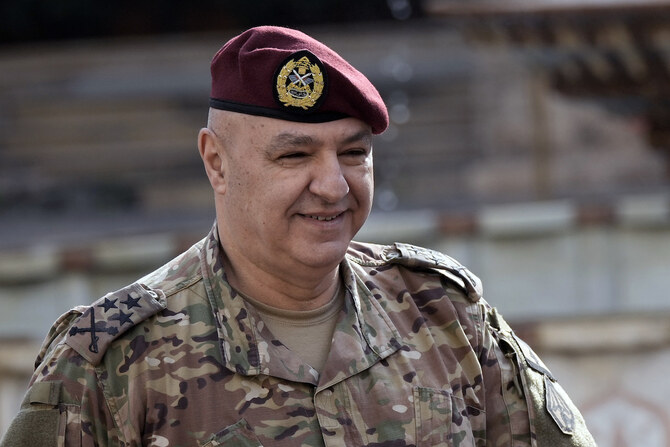
Army chief Gen. Joseph Aoun seems increasingly likely to be Lebanon’s new president
Short Url
https://arab.news/mbdmc
Army chief Gen. Joseph Aoun seems increasingly likely to be Lebanon’s new president
- On eve of latest attempt by MPs to agree on a candidate, reports suggest Hezbollah’s preferred candidate ‘may announce his withdrawal’
- French envoy Jean-Yves Le Drian arrives in Beirut and is expected to attend the parliamentary presidential election session on Thursday
As tensions flare on Israel-Lebanon border, war-torn communities struggle to rebuild
- One year into a shaky ceasefire on this heavily fortified border, Israel’s government says most of those displaced have returned to their homes in the north
- Israel’s government says it has invested hundreds of millions of dollars in border recovery efforts, that it plans to invest more in economic revival
METULA, Israel: Ilan Rosenfeld walks through the burnt-out shell of his former business, stepping over crackling pieces of clay plates that used to line his cafe and past metal scraps of Hezbollah rockets littering the rubble.
It’s all that’s left for him in this small, war-ravaged town — the northernmost in Israel, surrounded on three sides by Lebanon.
“Everything I had, everything I saved, everything I built – it’s all burned,” he said as he scanned the damage of the business he’d run for 40 years in Metula, which has long been at the crosshairs of flare-ups along the volatile border. “Every day I wake up, and all I have left are tears.”
Rosenfeld was among tens of thousands of people forced from their homes when war broke out between Israel and the militant group Hezbollah in October 2023, following Hamas’ attack in southern Israel.
One year into a shaky ceasefire on this heavily fortified border, Israel’s government says most of those displaced have returned to their homes in the north, where they struggle to pick up the pieces of their lives. Others are reluctant to come back, as Israel has stepped up attacks in Lebanon. Communities like Metula that were in the center of the conflict remain little more than ghost towns, most still half empty, with many people skeptical of their government’s promise to keep them safe.
The Israeli strikes into southern Lebanon continue, with several a week. Hezbollah has refused to completely disarm until Israel fully withdraws.
“The security situation is starting to deteriorate again,” Rosenfeld said, looking at the bomb shelters on a list recently distributed by the local government. “And where am I in all this? I can barely survive the day-to-day.”
In some towns on the Israel-Lebanon border, the return has been a trickle
Metula residents were among the 64,000 forced to evacuate and relocate to hotels and temporary homes farther south when Hezbollah began firing rockets over the border into Israel in fall 2023. Months of fighting escalated into a full-fledged war. In September 2024, Israel killed 12 and wounded over 3,000 in a coordinated pager attack and killed Hezbollah’s leader in a strike. A month later, the ceasefire deal was reached.
Today, residents have trickled back to the sprawling apple orchards and mountains as Israel’s government encourages them to go home. Officials say about 55,000 people have returned.
In Metula, just over half of the 1,700 residents are back. Yet the streets remain largely empty.
Many hoped to rebuild their lives, but they returned to find 60 percent of the town’s homes damaged from rocket fire, according to the local government. Others were infested and destroyed by rats. The economy — largely based on tourism and agriculture — has been devastated.
With many people, especially young families, reluctant to return, some business owners have turned to workers from Thailand to fill labor shortages.
“Most of the people who worked with us before the war didn’t come back,” said Jacob Katz, who runs a produce business. “We’ve lost a lot … and we can’t read the future.”
Rosenfeld’s modest cafe and farm were perched on a hill overlooking the border fence. Tourists would come to eat, camp in buses converted to rooms and enjoy the view. But now, the towns on the Lebanese side of the border have been reduced to rubble by Israel’s attacks.
Without a home, Rosenfeld sleeps in a small shelter next to the scraps that remain of his business. He has little more than a tent, a refrigerator and a few chairs. Just a stone’s throw away sit a military watch tower and two armored vehicles.
Israel’s government says it has invested hundreds of millions of dollars in border recovery efforts, that it plans to invest more in economic revival, and that residents can apply for support funds.
But Rosenfeld said that despite his requests for government assistance, he hasn’t received any aid.
He’s among residents and business leaders who say they feel forgotten. Most say they need more resources to rebuild.
“The Israeli government needs to do much more for us,” Metula deputy mayor Avi Nadiv said. “The residents who live on Israel’s northern border, we are Israel’s human shield.”
A spokesman for Zeev Elkin, a Cabinet minister overseeing reconstruction in the north, said the local government has not used funds allocated to reconstruction “due to narrow political and oppositional considerations.”
Hezbollah-Israel tensions are flaring
As Hezbollah refuses to disarm, Israel has accused Lebanon’s government of not doing enough to neutralize the militant group. The Lebanese army says it has boosted its presence over the border area to strengthen the ceasefire.
Israel continues to bombard what it says are Hezbollah sites. Much of southern Lebanon has been left in ruins.
The strikes are among a number of offensives Israel has launched – including those in Gaza, the West Bank and Syria – in what it calls an effort to crack down on militant groups.
The Lebanon strikes have killed at least 127 civilians, including children, since the ceasefire took hold, according to a November UN report. UN special rapporteur Morris Tidball-Binz said the strikes amount to “war crimes.” Israel has maintained that it has the right to continue strikes to protect itself from Hezbollah rearming and accuses the group of using civilians as human shields.
Last week, Israel struck the southern suburbs of the Lebanese capital of Beirut, killing Hezbollah’s top military commander. The group, still weakened by last year’s fighting, has not responded.
‘The army cannot protect me’
In Metula, signs of the tensions are everywhere. The local government’s list of public shelters reads: “Metula is prepared for an emergency.”
Explosions and gunfire periodically echo from military drills while farmer Levav Weinberg plays with his 10-, 8- and 6-year-old children. Weinberg, a military reservist, said his kids are too scared to ride their bikes on the street.
Weinberg, 44, and his family returned in July, skeptical of the government’s promise that everything was returning to normal but eager to keep their business alive.
Metula’s government continues to encourage people to come back, telling residents the region is safe and the economy will bounce back.
“Today we feel the winds of, let’s call it, the winds of war – but it doesn’t deter us,” Nadiv said. “Coming back to Metula – there’s nothing to be afraid of. ... The army is here. The houses are fortified. Metula is prepared for anything.”
Weinberg isn’t so sure. In recent weeks, he and his wife have considered leaving once again.
“The army cannot protect me and my family,” Weinberg said. “You sacrifice your family to live in Metula these days. It’s not a perfect life, it’s not that easy, and at some point your kids pay the price.”
It’s all that’s left for him in this small, war-ravaged town — the northernmost in Israel, surrounded on three sides by Lebanon.
“Everything I had, everything I saved, everything I built – it’s all burned,” he said as he scanned the damage of the business he’d run for 40 years in Metula, which has long been at the crosshairs of flare-ups along the volatile border. “Every day I wake up, and all I have left are tears.”
Rosenfeld was among tens of thousands of people forced from their homes when war broke out between Israel and the militant group Hezbollah in October 2023, following Hamas’ attack in southern Israel.
One year into a shaky ceasefire on this heavily fortified border, Israel’s government says most of those displaced have returned to their homes in the north, where they struggle to pick up the pieces of their lives. Others are reluctant to come back, as Israel has stepped up attacks in Lebanon. Communities like Metula that were in the center of the conflict remain little more than ghost towns, most still half empty, with many people skeptical of their government’s promise to keep them safe.
The Israeli strikes into southern Lebanon continue, with several a week. Hezbollah has refused to completely disarm until Israel fully withdraws.
“The security situation is starting to deteriorate again,” Rosenfeld said, looking at the bomb shelters on a list recently distributed by the local government. “And where am I in all this? I can barely survive the day-to-day.”
In some towns on the Israel-Lebanon border, the return has been a trickle
Metula residents were among the 64,000 forced to evacuate and relocate to hotels and temporary homes farther south when Hezbollah began firing rockets over the border into Israel in fall 2023. Months of fighting escalated into a full-fledged war. In September 2024, Israel killed 12 and wounded over 3,000 in a coordinated pager attack and killed Hezbollah’s leader in a strike. A month later, the ceasefire deal was reached.
Today, residents have trickled back to the sprawling apple orchards and mountains as Israel’s government encourages them to go home. Officials say about 55,000 people have returned.
In Metula, just over half of the 1,700 residents are back. Yet the streets remain largely empty.
Many hoped to rebuild their lives, but they returned to find 60 percent of the town’s homes damaged from rocket fire, according to the local government. Others were infested and destroyed by rats. The economy — largely based on tourism and agriculture — has been devastated.
With many people, especially young families, reluctant to return, some business owners have turned to workers from Thailand to fill labor shortages.
“Most of the people who worked with us before the war didn’t come back,” said Jacob Katz, who runs a produce business. “We’ve lost a lot … and we can’t read the future.”
Rosenfeld’s modest cafe and farm were perched on a hill overlooking the border fence. Tourists would come to eat, camp in buses converted to rooms and enjoy the view. But now, the towns on the Lebanese side of the border have been reduced to rubble by Israel’s attacks.
Without a home, Rosenfeld sleeps in a small shelter next to the scraps that remain of his business. He has little more than a tent, a refrigerator and a few chairs. Just a stone’s throw away sit a military watch tower and two armored vehicles.
Israel’s government says it has invested hundreds of millions of dollars in border recovery efforts, that it plans to invest more in economic revival, and that residents can apply for support funds.
But Rosenfeld said that despite his requests for government assistance, he hasn’t received any aid.
He’s among residents and business leaders who say they feel forgotten. Most say they need more resources to rebuild.
“The Israeli government needs to do much more for us,” Metula deputy mayor Avi Nadiv said. “The residents who live on Israel’s northern border, we are Israel’s human shield.”
A spokesman for Zeev Elkin, a Cabinet minister overseeing reconstruction in the north, said the local government has not used funds allocated to reconstruction “due to narrow political and oppositional considerations.”
Hezbollah-Israel tensions are flaring
As Hezbollah refuses to disarm, Israel has accused Lebanon’s government of not doing enough to neutralize the militant group. The Lebanese army says it has boosted its presence over the border area to strengthen the ceasefire.
Israel continues to bombard what it says are Hezbollah sites. Much of southern Lebanon has been left in ruins.
The strikes are among a number of offensives Israel has launched – including those in Gaza, the West Bank and Syria – in what it calls an effort to crack down on militant groups.
The Lebanon strikes have killed at least 127 civilians, including children, since the ceasefire took hold, according to a November UN report. UN special rapporteur Morris Tidball-Binz said the strikes amount to “war crimes.” Israel has maintained that it has the right to continue strikes to protect itself from Hezbollah rearming and accuses the group of using civilians as human shields.
Last week, Israel struck the southern suburbs of the Lebanese capital of Beirut, killing Hezbollah’s top military commander. The group, still weakened by last year’s fighting, has not responded.
‘The army cannot protect me’
In Metula, signs of the tensions are everywhere. The local government’s list of public shelters reads: “Metula is prepared for an emergency.”
Explosions and gunfire periodically echo from military drills while farmer Levav Weinberg plays with his 10-, 8- and 6-year-old children. Weinberg, a military reservist, said his kids are too scared to ride their bikes on the street.
Weinberg, 44, and his family returned in July, skeptical of the government’s promise that everything was returning to normal but eager to keep their business alive.
Metula’s government continues to encourage people to come back, telling residents the region is safe and the economy will bounce back.
“Today we feel the winds of, let’s call it, the winds of war – but it doesn’t deter us,” Nadiv said. “Coming back to Metula – there’s nothing to be afraid of. ... The army is here. The houses are fortified. Metula is prepared for anything.”
Weinberg isn’t so sure. In recent weeks, he and his wife have considered leaving once again.
“The army cannot protect me and my family,” Weinberg said. “You sacrifice your family to live in Metula these days. It’s not a perfect life, it’s not that easy, and at some point your kids pay the price.”
© 2025 SAUDI RESEARCH & PUBLISHING COMPANY, All Rights Reserved And subject to Terms of Use Agreement.


