



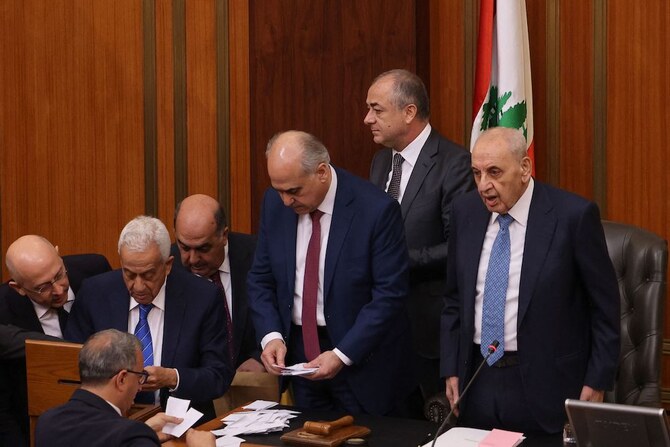

BEIRUT: Lebanese Armed Forces Chief Gen. Joseph Aoun, 61, was elected as the country’s 14th president by parliamentarians on Thursday.
Aoun received 99 votes, handing him the Presidential Palace for the next six years, breaking a 26-month deadlock over the position.
The military chief took the oath of office in front of deputies before delivering his inaugural speech.
People across Lebanon, especially in Aoun’s hometown, Al-Aichieyh in the south, let off fireworks, ululated, slaughtered sheep and performed dabke dances following the election.
Aoun entered Parliament for the first time in a civil suit, marking his transition from military duty, which started in 1983 when he volunteered for the Army as an officer cadet before then enrolling in the Military College.
He took over command of the Armed Forces on March 8, 2018. He now undertakes the civil mission of leading a country stricken by Israeli aggression against Hezbollah and a deepening economic crisis.
Aoun addressed the Lebanese people, saying: “No matter our differences, in times of crisis, we embrace one another. If one of us falls, we all fall.”
He emphasized the need to “change the political performance in Lebanon,” adding: “Let the world know that starting today, a new stage of Lebanon’s history begins, and I will be the the first servant of the country, upholding the national pact and practicing the full powers of the presidency as an impartial mediator between institutions.
“If we want to build a nation, we must all be under the rule of law and the judiciary.”
Aoun stressed that “interference in the judiciary is forbidden,” adding that “there will be no immunity for criminals or corrupt individuals and there will be no place for mafias, drug trafficking, or money laundering in Lebanon.
“My term will focus on cooperation with the new government to pass a law ensuring judicial independence, while also challenging any laws that violate the constitution.
“I will call for parliamentary consultations to swiftly select a prime minister who would be a partner rather than an adversary.”
Aoun announced plans to rotate senior government positions and restructure the public administration.
He also vowed to assert the state’s right to maintain a monopoly on the possession of weapons.
“We will invest in the military to secure Lebanon’s borders, particularly in the south, demarcate the eastern and northern borders, fight terrorism, implement international resolutions and prevent Israeli hostilities against Lebanon,” Aoun said.
“I will work to activate the role of security forces as a fundamental tool for maintaining security and enforcing laws. We will also discuss a comprehensive defense strategy on the diplomatic, economic and military levels to enable the Lebanese state to end the Israeli occupation and deter its aggression,” he added.
Aoun pledged to “rebuild what the Israeli enemy destroyed in the south, Beirut’s southern suburb, the Bekaa and throughout Lebanon. Our martyrs are the spirit of our determination and our detainees are a trust upon our shoulders.”
He said: “It is time for us to invest in Lebanon’s foreign relations, rather than betting on external forces to gain leverage against one another.”
Aoun affirmed his “rejection of the resettlement of Palestinians.”
He stated: “We affirm our determination to take charge of the security of the camps. We will adopt a policy of positive neutrality and will only export the best products and industries to other countries while attracting tourists.”
Aoun also called for “initiating a serious and peer-level dialogue with the Syrian state to discuss all relations and pending files between us, particularly the file of missing persons and displaced Syrians.”
His speech received enthusiastic applause from MPs, except for those from the Free Patriotic Movement, with Hezbollah’s MPs expressing reservations.
The 13th session was held in the morning amid a notable diplomatic presence, led by France’s presidential envoy, Jean-Yves Le Drian, and the ambassadors of the Quintet Committee overseeing the implementation of the ceasefire agreement with Israel.
The first session resulted in Aoun receiving 71 votes out of the 128 MPs who attended the session.
Meanwhile, 37 MPs cast blank votes, 14 voted with the “Sovereignty and Constitution” expression, two voted for the late professor of international law Chibli Mallat and four votes were canceled. The interventions at the beginning of the session were met with violent verbal confrontations between independent MPs and a FPM deputy.
Aoun needed 86 votes to become president. This number served as an alternative to amending the constitution, preventing any challenges in the Constitutional Council, as Aoun remained in his role and had not resigned two years earlier, which is a constitutional requirement for running for president.
Hezbollah, the Amal movement, the FPM, and other independent MPs did not vote for Aoun in the first round.
Parliamentary Speaker Nabih Berri adjourned the session for two hours for further consultations.
Meanwhile, Amal MP Ali Hassan Khalil and Hezbollah MP Mohammed Raad met Aoun to be reassured regarding “the government formation and the Shiite representation within it.”
During the second round, the white smoke rose to announce the selection of the new president.
While the FPM and other independent MPs maintained their position, the Shiite duo voted for Aoun. The vote tally included nine blank ballots, 15 votes for other names or expressions, and five canceled votes.
In 2017, Aoun, as a senior member of the Lebanese Armed Forces, was part of operations that succeeded in confronting hundreds of Syrian militants affiliated with Daesh and Jabhat Al-Nusra in Arsal.
Two years later, in 2019, he helped restore order after thousands of Lebanese protestors took to the streets following the country’s economic collapse.
In 2020, Aoun led the Lebanese military in providing aid to those affected by the Beirut port explosion.
Aoun also helped avert civil war by preventing two potential clashes: the first in Tayyouneh, between Hezbollah and Lebanese Forces supporters over the arrest of employees accused of negligence in the Beirut port explosion; and the second in Kahaleh, when a Hezbollah truck carrying ammunition overturned in a Christian area, leading to a firefight.
Additionally, Aoun has worked to rid the military of corruption and collaborated with Arab and other foreign states to secure aid for Armed Forced members after their monthly salaries dropped to less than $50.


