

Pakistan’s UN envoy condemns Israel’s occupation of Syrian Golan Heights, seeks ‘full withdrawal’

Pakistan’s top diplomat at the United Nations Munir Akram is addressing a session at UN Security Council in New York, US, on January 8, 2025. (@PakistanPR_UN/X)
Short Url
Updated 09 January 2025
Follow

Pakistan’s UN envoy condemns Israel’s occupation of Syrian Golan Heights, seeks ‘full withdrawal’

  • Ambassador Munir Akram calls a peaceful transition to a more inclusive governance structure in Syria
  • He also appeals for international assistance in Syria’s reconstruction, emphasizing United Nations’ role 

ISLAMABAD: Pakistan’s top diplomat at the United Nations on Wednesday condemned Israel’s occupation of the Golan Heights and called for the restoration of Syrian territorial integrity alongside the establishment of an inclusive government structure.
Ambassador Munir Akram delivered his remarks during a Security Council briefing on Syria’s political and humanitarian situation. Pakistan, which began its two-year term as a non-permanent council member this month, has pledged to uphold the UN Charter and promote just resolutions to global conflicts.
The Security Council briefing follows the downfall of the former Syrian President Bashar Assad’s regime after a swift offensive was launched by opposition forces led by the religio-political group Hay’at Tahrir Al-Sham (HTS).
The rebels quickly seized key cities, including Aleppo, Hama, Homs and Damascus, forcing Assad to flee to Russia, where he was granted asylum. While Damascus airport has resumed international flights to facilitate exiles’ return, Syria remains burdened by significant economic, political and security challenges.
“Syria’s sovereignty and territorial integrity must be restored,” the Pakistani diplomat told the council. “Israel’s occupation of the Syrian Golan Heights is illegal and ‘null and void’ as declared by Security Council ... The Council must demand Israel’s full withdrawal.”
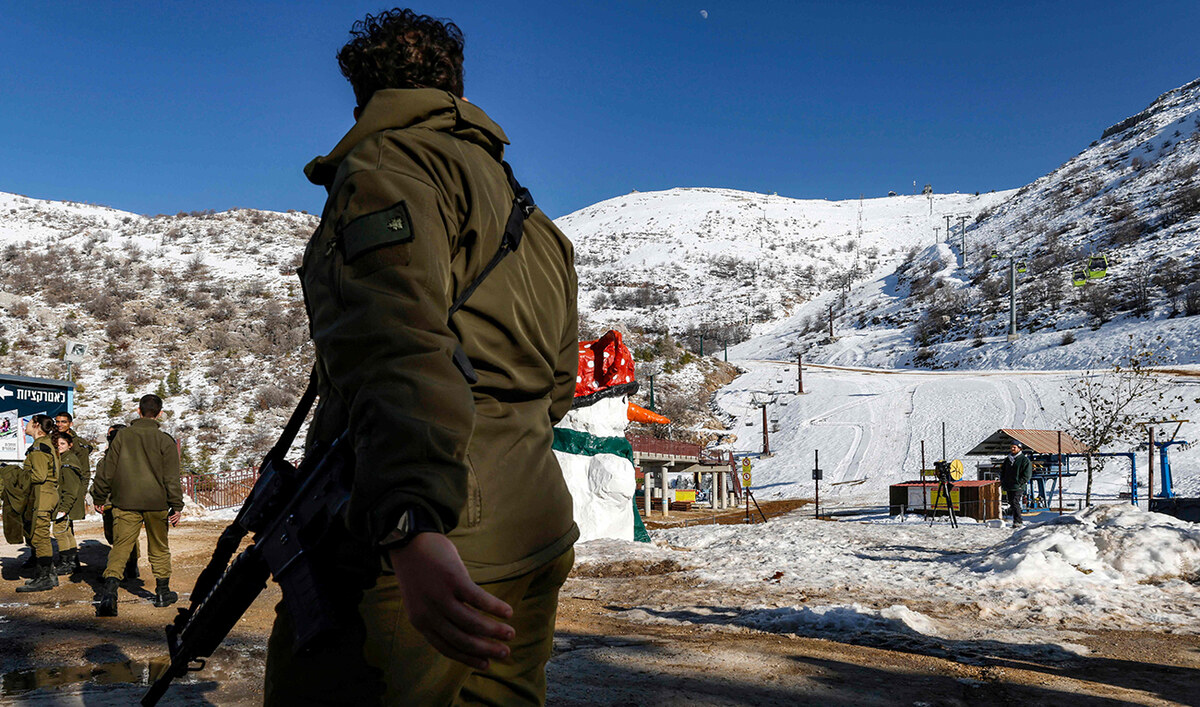


Israeli soldiers gather at the Hermon ski resort, bordering Syria and Lebanon, during a media tour organized by the spokesman of the Israeli army, in the Israeli-annexed Golan Heights on January 8, 2025. (AFP)

Calling Syria a “fraternal country,” Akram welcomed positive statements from the interim administration but stressed the need for their practical implementation.
“Syria is at an important juncture in its history,” he noted. “The recent political developments offer the opportunity to restore normalcy, stability and peace in Syria. Yet this will depend on ensuring a peaceful transition to a new governance structure which is inclusive and stable and ensures Syria’s unity and territorial integrity.”
He also urged vigilance against the “danger of terrorism” emanating from Syria, citing concerns over the presence of foreign fighters and the potential resurgence of Al-Qaeda and Daesh.
“The antecedents of some of the groups, and the reported presence of foreign fighters, dictates caution,” Akram said.
Emphasizing the need to address Syria’s dire humanitarian crisis, thee Pakistani diplomat highlighted that over 70 percent of the population requires aid, with more than one million displaced in recent weeks.
He called for full funding of the UN Humanitarian Response Plan and support for the safe repatriation of Syrian refugees, including those in Turkiye.
He further appealed for international assistance in Syria’s reconstruction, urging collaboration with the new administration to rebuild institutions and stabilize the country.
“The role of the United Nations – especially the Security Council and the Secretary-General – will be indispensable to ensure effective action on all aspects of the challenges confronting Syria,” Akram said.


Pakistan says defense pact with Saudi Arabia elevated brotherly ties to ‘new heights’

Updated 25 February 2026
Follow

Pakistan says defense pact with Saudi Arabia elevated brotherly ties to ‘new heights’

  • Pakistan, Saudi Arabia signed strategic defense pact last year pledging aggression against one will be treated as attack on both
  • Deputy PM Ishaq Dar says enduring bonds with Islamic and Arab nations form vital pillar of Pakistan’s foreign policy 

ISLAMABAD: Deputy Prime Minister Ishaq Dar said on Wednesday that Pakistan’s defense pact with Saudi Arabia elevated its brotherly ties with the Kingdom to “new heights,” stressing that close ties with Arab and Islamic nations form a key pillar of Islamabad’s foreign policy. 

Pakistan and Saudi Arabia signed a Strategic Mutual Defense Agreement on Sept. 17 last year, pledging that aggression against one country would be treated as an attack on both, enhancing joint deterrence and formalizing decades of military and security cooperation.

Both nations agreed in October 2025 to launch an economic cooperation framework to strengthen trade and investment ties. 

“In the Middle East, our landmark Strategic Mutual Defense Agreement with Saudi Arabia has elevated our brotherly ties to new heights,” Dar said while speaking at the Pakistan Governance Forum 2026 event in Islamabad. 

The Pakistani deputy prime minister was speaking on the topic “Navigating International Relations Amidst Changing Geo-Politics.”

Dar noted that Pakistan has reinforced partnerships with other Middle Eastern nations such as the UAE, Qatar, Jordan, Oman, Egypt and Bahrain. He said these partnerships have yielded “concrete agreements” in investment, agriculture, infrastructure, and energy sectors. 

“Our enduring bonds with Islamic and Arab nations form a vital pillar of our foreign policy, and we will continue to expand our partnerships across Asia, Latin America, and Africa,” he said. 

Dar pointed out that the presidents of Kazakhstan, Uzbekistan and Kyrgyzstan have undertaken visits to Pakistan in recent months, reflecting Central Asian nations’ desire to boost cooperation with Islamabad.

On South Asia, the Pakistani deputy PM said Pakistan has successfully transformed its fraternal ties with Bangladesh into “a substantive partnership.”

“Similarly, the trilateral mechanism involving China, Pakistan, and Bangladesh has been launched with a view to expanding and deepening regional cooperation and synergy,” the Pakistani minister said. 

He said Islamabad has strengthened its “all-weather” partnership with China via the second phase of the multi-billion-dollar China-Pakistan Economic Corridor agreement and “unwavering support” from both sides for each other’s core interests. 

Dar said Pakistan had also reinvigorated its partnership with the US, advancing cooperation in trade, technology, investment, and regional stability. 

“This calibrated approach has enhanced our ability to navigate complexity with skill and confidence, ensuring that our national interests are served without compromising our core foreign policy principles,” he said.