RIYADH: The King Faisal Prize 2025 laureates were announced at a ceremony in Riyadh on Wednesday night.
Two King Saud University professors, a Canadian scientist who achieved a breakthrough in cellular therapy and a Japanese scientist doing pioneering work in carbon nanotubes were winners of the most coveted prize in the Arab world.
Announcing the KFP 2025 winners, Dr. Abdulaziz Alsebail, secretary-general of the King Faisal Prize said: “The selection committees of the King Faisal Prize 2025, after meticulous deliberations that were held from Monday to Wednesday, have reached decisions for the prize’s four categories: Islamic studies, Arabic language and literature, medicine, and science. As for the fifth category, the King Faisal Prize for Service to Islam, the announcement will be made at the end of this month.”
The King Faisal Prize for Islamic Studies for 2025 (Topic: Studies of Archaeology in the Arabian Peninsula), was awarded jointly to Professor Saad Abdulaziz Alrashid and Professor Said Faiz Alsaid. Both are Saudi nationals and professors at King Saud University.
Alrashid was awarded the prize for his contribution to the study of Islamic archaeological sites and inscriptions of the Arabian Peninsula, which laid the scientific and methodological groundwork for scholars in this field.
His work has enriched scientific knowledge about Islamic civilization and has become an empirical source for future generations of researchers.
Alsaid was awarded the prize for the originality of his scientific studies, which are based on rich literature and published in several languages. His adaptation of a comparative methodology in studies of inscriptions and ancient writings of the Arabian Peninsula has had a profound impact on understanding the history of the Arabian Peninsula’s civilizations before Islam.
His studies are an important scientific reference for scholars of the history of the Arabian Peninsula and the ancient Near East.
The King Faisal Prize for Arabic Language and Literature (Topic: Studies of Identity in Arabic Literature), was withheld due to the nominated works not reaching the criteria for the prize.
The King Faisal Prize for Medicine (Topic: Cellular Therapy), has been awarded to Michel Sadelain (Canada), Stephen and Barbara Friedman chair and director, Center for Cell Engineering at Memorial Sloan Kettering Cancer Center.
Sadelain has been awarded the prize for his pioneering work in cellular therapy, and in particular for the genetic engineering of immune cells with “chimeric antigen receptors” (CAR-T).
Dr. Sadelain led the team that designed and tested clinically effective and novel CAR-T agents for the treatment of blood cancers.
His group identified CD19 as an effective CAR target and included a CD28 domain in the CAR construct, resulting in strikingly effective clinical responses.
Dr. Sadelain continues to improve CAR-T cell efficacy by devising strategies to overcome treatment resistance. This approach also shows promise in the treatment of autoimmune diseases and solid tumors.
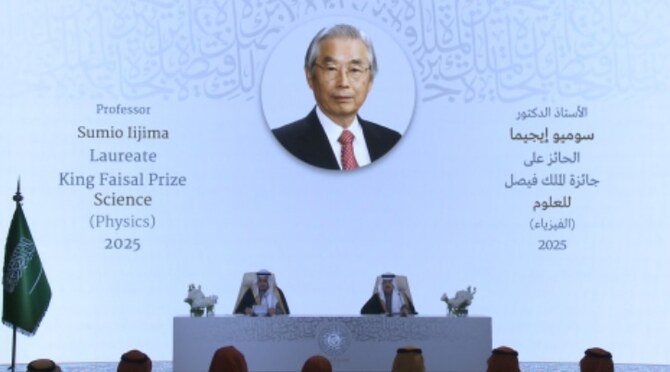
The King Faisal Prize for Science for this year was awarded in physics to Sumio Iijima, a
professor at Meijo University, Japan.
Iijima has been awarded the prize for establishing the field of carbon nanotubes, following his pioneering discovery of carbon nanotubes using electron microscopy. This new class of one-dimensional carbon materials has had a powerful impact on fundamental solid-state physics and material science.
His work has opened new avenues for developing wide-ranging, practical applications in nanotechnology, ranging from electronics to energy storage systems and biomedicine.
The General Secretariat of the King Faisal Prize commended the 2025 laureates and offered thanks to the distinguished members of the selection committees and the experts for their valued contributions.
The selection committees for the prize’s four categories — Islamic studies, Arabic language and literature, medicine, and science — convened at the prize’s headquarters from Monday to Wednesday.
The selection committees included prominent experts, scholars and specialists from 16 countries.
The KFP was established in 1977, and was awarded for the first time in 1979 in three categories — service to Islam, Islamic studies, and Arabic language and literature. Two additional categories were introduced in 1981 — medicine and science. The first medicine prize was awarded in 1982, and in science two years later.
Since 1979, the KFP in its different categories has awarded about 300 laureates to those who have made distinguished contributions to different sciences and causes.
Each prize laureate is endowed with $200,000, a 24-carat gold medal weighing 200 grams, and a certificate inscribed with the laureate’s name and a summary of the work that qualified them for the prize.


![]()
![]()
![]()

King Faisal Prize announces winners for 2025


Short Url
https://arab.news/nnsfx
King Faisal Prize announces winners for 2025
- KSU professors, Canadian and Japanese scientists achieving breakthroughs in cellular therapy and carbon nanotubes win coveted prize
- Selection committees held meetings at King Faisal Prize headquarters to select winners in Islamic studies, Arabic language and literature, medicine, and science


Latest updates


Recommended


© 2026 SAUDI RESEARCH & PUBLISHING COMPANY, All Rights Reserved And subject to Terms of Use Agreement.