Key Pakistan-China highway reopened after six days as protest over power outages ends

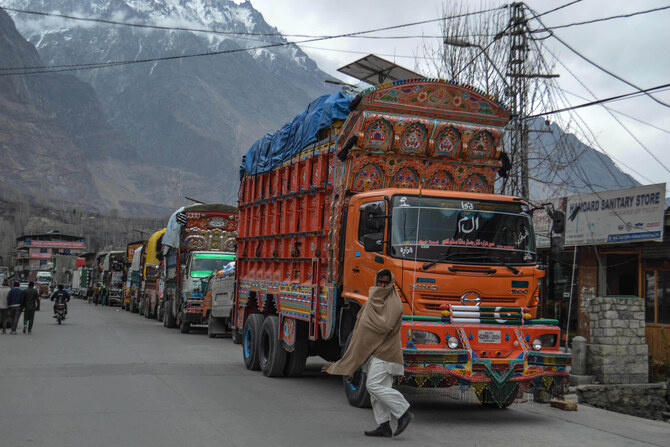
Stranded trucks stand along the Karakoram Highway, blocked by residents during a sit-in protest against power outages in Khaplu city, in Pakistan’s mountainous Gilgit-Baltistan region, on January 7, 2025. Hundreds of people blocked a highway on January 7 in Pakistan’s mountainous northern region in protest against power outages lasting longer than 20 hours, as temperatures plunged to minus 15 degrees Celsius. (AFP)
Short Url
Updated 08 January 2025
Follow

Key Pakistan-China highway reopened after six days as protest over power outages ends

  • Protesters were demanding an end to over 20-hour-long power outages in northern Pakistan
  • Protests ended after center agreed to allocate funds to run thermal generators, says official

KHAPLU, Gilgit-Baltistan: A key highway connecting Pakistan and China via land was reopened for trade and traffic on Wednesday after remaining blocked for six days, as hundreds of protesters agreed to end a sit-in protest against lengthy power outages in the country’s north. 
The protest, which began last week, involved residents, political parties and civil society groups who had blocked the Karakorum Highway (KKH) in Gilgit-Baltistan (GB) region against power outages for over 20 hours. 
The KKH, a vital trade and strategic route linking Pakistan with China, was obstructed at Aliabad, the district headquarters of Hunza. The area plays a critical role in bilateral trade facilitated by the China-Pakistan Economic Corridor (CPEC), which has increased since an agreement to keep the Khunjerab Pass open year-round for economic exchanges.
Protesters had demanded the GB government operate thermal generators to reduce the duration of the power outages during winters. The regional government said it was unable to run thermal generators due to lack of funds. 
Iman Shah, a spokesperson for the GB government, said a high-level meeting in Islamabad was held by the prime minister’s adviser on political affairs, Rana Sanaullah, to discuss the issue. It was decided that the center would allocate funds to run thermal generators in winter while a round of negotiations between protesters and the GB government was held in Hunza, he said. 
“After assuring to fulfil all of their demands, the sit-in has been called off by the protesters,” Shah told Arab News. 
“The thermal generators will be run in all power crisis-hit districts of GB. At least four hours of power will be provided via thermal generators,” Shah added.
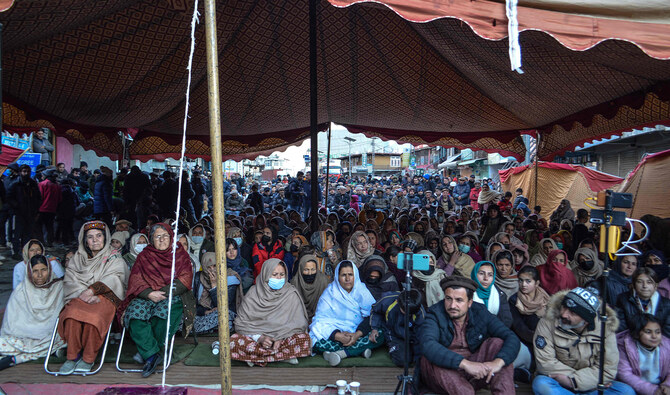


Residents stage a sit-in protest against power outages as they block the Karakoram Highway in Khaplu city, in Pakistan's mountainous Gilgit-Baltistan region, on January 7, 2025. (AFP)

Baba Jan, a member of the committee formed by protesters, confirmed a government delegation, including the GB additional chief secretary, held negotiations with protesters in Hunza on Wednesday. 
“And they announced to meet all of our written demands,” Jan told Arab News. “That’s why we decided to end the protest,” he said. 
“The KKH is opened for all kinds of traffic and protest have peacefully dispersed and returned their homes.”
Power cuts, known locally as load shedding, are a chronic issue in Pakistan, with many areas facing significant disruptions. The harsh winters in GB exacerbate the problem, leaving residents without adequate heating or access to essential services.
Faizullah Faraq, the GB government’s spokesperson, attributed lengthy power outages to the low flow of water during winters.


Pakistan says responding to Afghan ‘offensive operations’ after border fire as tensions escalate

Updated 26 February 2026
Follow

Pakistan says responding to Afghan ‘offensive operations’ after border fire as tensions escalate

  • Afghan Taliban spokesperson says “large-scale offensive operations” launched against Pakistani military bases
  • Pakistan says Afghan forces opened “unprovoked” fire across multiple sectors along shared border

ISLAMABAD: Afghanistan’s Taliban authorities said on Thursday they had launched “large-scale offensive operations” against Pakistani military bases and installations, prompting Pakistan to say its forces were responding to what it described as unprovoked fire along the shared border.

The escalation follows Islamabad’s weekend airstrikes targeting what it said were Tehreek-e-Taliban Pakistan (TTP) and Daesh militant camps inside Afghanistan in response to a wave of recent bombings and attacks in Pakistan. Islamabad said the strikes killed over 100 militants, while Kabul said dozens of civilians were killed and condemned the attacks as a violation of its sovereignty.

In a post on social media platform X, Afghan government spokesperson Zabihullah Mujahid said Afghanistan had launched “large-scale offensive operations” in response to repeated violations by the Pakistani military.


Pakistan’s Ministry of Information said Afghan forces had initiated hostilities along multiple points of the frontier.

“Afghan Taliban regime unprovoked action along the Pakistan–Afghanistan border given an immediate, and effective response,” the ministry said in a statement.

The statement said Pakistani forces were targeting Taliban positions in the Chitral, Khyber, Mohmand, Kurram and Bajaur sectors, claiming heavy Afghan casualties and the destruction of multiple posts and equipment. It added that Pakistan would take all necessary measures to safeguard its territorial integrity and the security of its citizens.


Separately, security officials said Pakistani forces had carried out counterattacks in several border sectors.

“Pakistan’s security forces are giving a befitting reply to the unprovoked Afghan aggression with full force,” a security official said, declining to be named. 

“The Pakistani security forces’ counter-attack destroyed Taliban’s hideouts and the Khawarij fled,” they added, referring to TTP militants. 

The claims from both sides could not be independently verified.

Cross-border violence has intensified in recent weeks, with Pakistan blaming a surge in suicide bombings and militant attacks on militants it says are based in Afghanistan. Kabul denies providing safe havens to anti-Pakistan militant groups.

The clashes mark the third major escalation between the neighbors in less than a year. Similar Pakistani strikes last year triggered weeklong clashes before Qatar, Türkiye and other regional actors mediated a ceasefire in October.

The 2,600-kilometer (1,600-mile) frontier, a key trade and transit corridor linking Pakistan to landlocked Afghanistan and onward to Central Asia, has faced repeated closures amid tensions, disrupting commerce and humanitarian movement. Trade between the two nations has remained closed since October 2025.