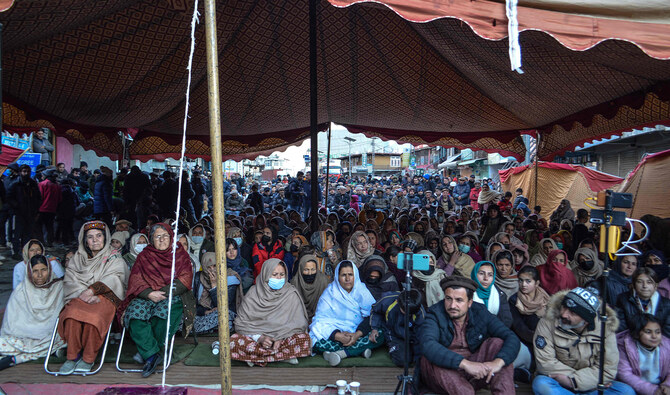
ISLAMABAD: Hundreds of protesters in Pakistan’s northern Hunza Valley blocked the Karakoram Highway (KKH) for the sixth consecutive day on Tuesday, demonstrating against severe power outages during the region’s freezing winter.
The protest, which began on January 1, involves local residents, political parties and civil society groups who vowed to continue their sit-in until their demands for reliable electricity were met.
Demonstrators on Tuesday voiced frustration over the Gilgit-Baltistan government’s failure to ensure even a few hours of power each day, saying over 80,000 people were struggling for basic needs.
The KKH, a vital trade and strategic route linking Pakistan with China, has been obstructed at Aliabad, the district headquarters of Hunza. The area plays a critical role in bilateral trade facilitated by the China-Pakistan Economic Corridor (CPEC), which has increased since an agreement to keep the Khunjerab Pass open year-round for economic exchanges.
“This is a nerve-breaking power outage in Hunza,” said Baba Jan, a protester, speaking at the sit-in. “We are getting power only 30-40 minutes in 24 hours.
“It is very cold here,” he added. “The temperature drops to minus 15 at night. Students don’t have Internet due to the power outage. There are issues in lighting, heating and cooking that people are facing here.”
Rehan Shah, another protester agreed, emphasizing the area’s important defense and strategic location.
“It’s the gate of CPEC and Pakistan-China connectivity,” he noted. “People here are hardly getting power for one hour and twenty minutes during the daytime. They’ve been out protesting on the streets for the last six days.”
Power cuts, known locally as load shedding, are a chronic issue in Pakistan, with many areas facing significant disruptions. The harsh winters in Gilgit-Baltistan exacerbate the problem, leaving residents without adequate heating or access to essential services.
Last week, Hamid Hussain, an engineer at the Gilgit-Baltistan Water and Power Department, acknowledged the issue but attributed it to technical limitations.
“The region heavily relies on hydropower, which often faces disruption in winter due to the freezing of rivers and lakes,” he told Arab News.
“There are 137 power stations in Gilgit-Baltistan,” he added. “The installed capacity of these power stations is 190 megawatts. However, power generation is 140 megawatts during the summer while 76 megawatts during the winter due to the low flow of water.”
Protesters have demanded thermal power generators to supplement energy needs during the winter, but Hussain said they were costly and were hard to implement due to financial constraints.


![]()

Protesters in Pakistan’s north continue blockade of key highway to China over power outages
Short Url
https://arab.news/w6bus
Protesters in Pakistan’s north continue blockade of key highway to China over power outages
- Residents of Gilgit-Baltistan started a sit-in on Jan.1, vowing to protest until they got reliable electricity
- Despite the area’s significance, some residents say they only get electricity for 30 minutes in 24 hours
Latest updates


© 2026 SAUDI RESEARCH & PUBLISHING COMPANY, All Rights Reserved And subject to Terms of Use Agreement.