

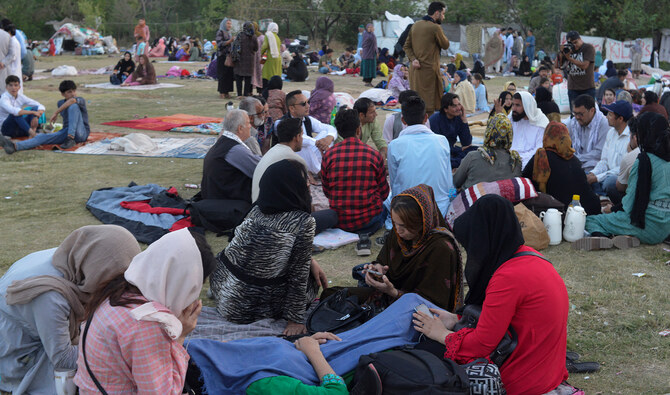

ISLAMABAD: The Islamabad Capital Territory (ICT) administration on Tuesday rejected claims by Afghanistan’s diplomatic mission it had detained approximately 800 Afghan citizens, asserting it was only repatriating illegal foreign nationals in accordance with the law.
Pakistan, which hosted over four million Afghan refugees after the Soviet invasion of Afghanistan in 1979, registered these individuals with the United Nations Refugee Agency (UNHCR). They were issued Proof of Registration (PoR) cards and Afghan Citizen Cards (ACC) to allow legal residence and access to services such as health care and banking.
Another wave of Afghan refugees arrived after the Taliban’s capture of Kabul in 2021 amid the withdrawal of US-led international forces. Confronted with economic challenges and a surge in militant violence perpetrated by groups reportedly operating from Afghan territory, Pakistan initiated a crackdown against “illegal immigrants,” mostly Afghans, citing security concerns.
Pakistani officials said in 2023 that some Afghan nationals had been involved in attacks, including suicide bombings, targeting civilians and security forces, a claimed denied by the administration in Kabul.
The Afghan embassy in Pakistan said on Monday authorities in Pakistan’s federal capital had detained about 800 Afghan nationals, including individuals registered with the UNHCR.
“It is clarified that only the illegal foreign nationals are being repatriated as per law of the land,” the ICT administration said in a statement.
“With regard to Afghan nationals, it is being clarified that those holding valid documentation— such as Proof of Registration (PoR) cards, Afghan Citizen Cards (ACC), visas, or those listed for third-country resettlement— are not being repatriated,” it added. “Islamabad Civil Administration remains committed to safeguarding the rights of all documented individuals.”
The statement further noted that search and combing operations were also conducted in compliance with the law, offering undocumented foreign nationals the chance to validate their status.
It also confirmed that in 2025, Islamabad authorities deported 183 illegal foreign nationals, while two were still in holding areas. Officials stressed that those deported lacked any legal documentation and reiterated that actions are taken strictly against undocumented individuals.
“The civil administration reaffirms its commitment to ensuring fair and humane treatment of all individuals while strictly adhering to legal requirements,” the ICT statement said, urging foreign nationals to carry valid documentation to avoid inconvenience.
Last year in November, Pakistani authorities announced that Afghan nationals would need no-objection certificates (NOCs) to stay in Islamabad. The decision followed the detention of several Afghan nationals who reportedly participated in a political rally by former Prime Minister Imran Khan’s Pakistan Tehreek-e-Insaf (PTI) party, which turned violent, resulting in casualties.
The Afghan embassy expressed concern over alleged “unwarranted arrests, home searches, and extortion targeting Afghan nationals,” highlighting the reported detentions, including 137 who, it said, were temporarily registered with the UNHCR and had applied for visa extensions.


