

Hail’s traditional doors and carvings draw crowds to Handicrafts Festival

1 / 2
The festival takes place at Qishlah Palace in Hail until Jan. 9.(SPA)
2 / 2
The festival takes place at Qishlah Palace in Hail until Jan. 9.(SPA)
Short Url
Updated 07 January 2025
Follow

Hail’s traditional doors and carvings draw crowds to Handicrafts Festival

  • The pavilion also features Islamic plaster engravings inspired by the local environment

RIYADH: Visitors from across the region and beyond are being drawn to the wooden doors and gypsum carvings pavilion at the Handicrafts Festival in Hail, all keen to see the craftsmanship behind the traditional works.

Inspired by Saudi Arabia’s Vision 2030 and the designation of 2025 as the “Year of Handicrafts,” the festival celebrates the rich heritage of such skills and highlights their cultural and economic significance.

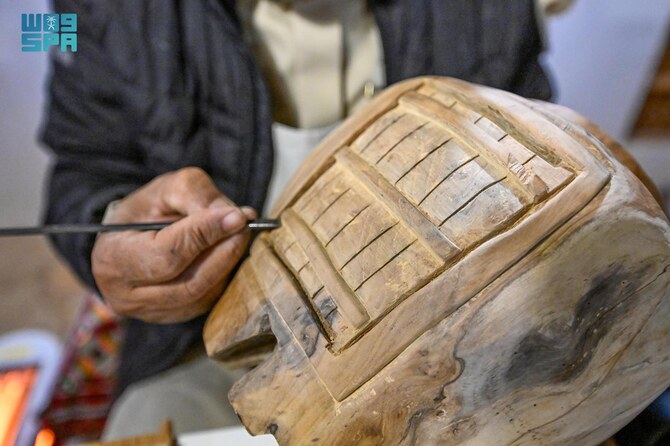
Craftsman Abdullah Al-Khazam explained that creating wooden doors and carvings, including those of old Hail houses made from tamarisk and other woods, demanded exceptional skill and attention to detail.


The difference between Najdi doors made with three beams while Hail doors are crafted with four (SPA)

He highlighted the difference the difference between Najdi doors, made with three beams, and Hail doors, which are crafted with four, reported the Saudi Press Agency.

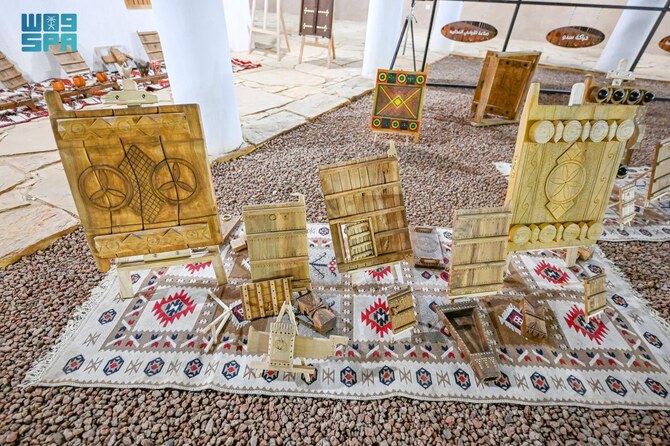
The pavilion also features Islamic plaster engravings inspired by the local environment, a hallmark of Najdi architecture used to adorn buildings, entrances, and majlis, or council rooms.

Replicas of traditional engravings from historical Hail majlis are on display, with many visitors expressing an interest in acquiring the pieces to decorate their own homes.

Also on display are drawings and engravings from ancient clay houses, including Qur’anic verses, sayings, decorative patterns, and depictions of trees and plants.

The festival takes place at Qishlah Palace in Hail until Jan. 9.


Masam project revives hope for displaced families in Hajjah, Yemen

Updated 7 sec ago
Follow

Masam project revives hope for displaced families in Hajjah, Yemen

JEDDAH: The humanitarian demining project Masam has helped to revive hopes among displaced Yemenis to return to their homes after large-scale mine clearance operations in Hajjah governorate, officials said on Saturday.

Ousama Al-Gosaibi, head of Saudi Arabia’s Project Masam for Landmine Clearance in Yemen, received Hajjah Governor Maj. Gen. Abdulkarim Al-Sunaini at the project’s headquarters in the Midi district.

During the visit, officials were briefed on the progress and mechanisms of survey and demining operations in the area.

Al-Sunaini expressed appreciation to Saudi Arabia’s leadership for supporting the Masam humanitarian initiative, saying the project had helped save millions of Yemenis and strengthened security and stability in several Yemeni governorates.

He praised Masam’s humanitarian role and its continued efforts to save lives and restore normalcy in liberated districts.

He added that the project’s response had renewed hope among residents seeking to return to homes and farms they were forced to abandon due to landmines and improvised explosive devices planted by the Houthi militia, which triggered a humanitarian crisis.

Al-Gosaibi, meanwhile, welcomed the visit by local authorities and reaffirmed Masam’s commitment to its humanitarian mission.

He said the project would continue working to clear Yemeni territory of landmines to protect civilians, save lives and create a safe environment that allows affected communities to resume normal daily activities without fear.